
Introduction : L'importance des tests de contaminants dans le sirop de riz
Le sirop de riz est largement utilisé dans la fabrication alimentaire en raison de son goût neutre, de ses propriétés fonctionnelles et de sa polyvalence dans des applications telles que les boissons, les produits de boulangerie, la confiserie et les aliments nutritionnels. Cependant, en tant qu'ingrédient dérivé du riz, sa sécurité dépend fortement d'un contrôle qualité strict tout au long de l'approvisionnement et de la production.
Les tests de contaminants dans le sirop de riz jouent un rôle essentiel dans l'identification des risques potentiels tels que l'arsenic inorganique, les métaux lourds, les résidus de pesticides et les mycotoxines. Pour les fabricants de produits alimentaires et les acheteurs mondiaux, des tests fiables garantissent la conformité réglementaire, la sécurité des consommateurs et la protection à long terme de la marque.
Chez Wuhu Deli Foods, le contrôle des contaminants est intégré à chaque étape de la production, de la sélection du riz brut à la vérification du produit fini, aidant ainsi les clients à recevoir des solutions de sirop de riz cohérentes et sûres.
L'arsenic : le principal objectif des tests de contaminants dans le sirop de riz
Pourquoi le riz présente-t-il un risque plus élevé d'arsenic ?
Le riz absorbe naturellement l'arsenic du sol et de l'eau plus facilement que de nombreuses autres céréales. Ceci est principalement dû au fait que le riz est couramment cultivé dans des conditions inondées, où les environnements de sol anaérobie augmentent la disponibilité des composés de l'arsenic.
Les principales formes d'arsenic comprennent :
- Arsenic inorganique (iAs) : As(III) et As(V), considérés comme la principale préoccupation toxicologique
- Arsenic organique : DMA et MMA, généralement considérés comme moins nocifs
L'arsenic inorganique étant une préoccupation majeure pour la santé, les programmes modernes de sécurité alimentaire se concentrent sur une mesure précise grâce à des méthodes analytiques avancées.
Comment le traitement du sirop de riz réduit-il les niveaux d'arsenic ?
Pendant la fabrication du sirop de riz, plusieurs étapes de traitement aident à réduire les niveaux de contaminants :
✅ La préparation de la pâte réduit la concentration par dilution contrôlée
✅ La filtration élimine les contaminants liés aux particules
✅ Les systèmes d'échange d'ions capturent les composés d'arsenic dissous
✅ Le traitement au charbon actif assure une purification supplémentaire
Bien que le traitement puisse réduire considérablement les niveaux d'arsenic, les tests sur le produit fini restent essentiels car la sécurité doit être vérifiée après la fabrication.
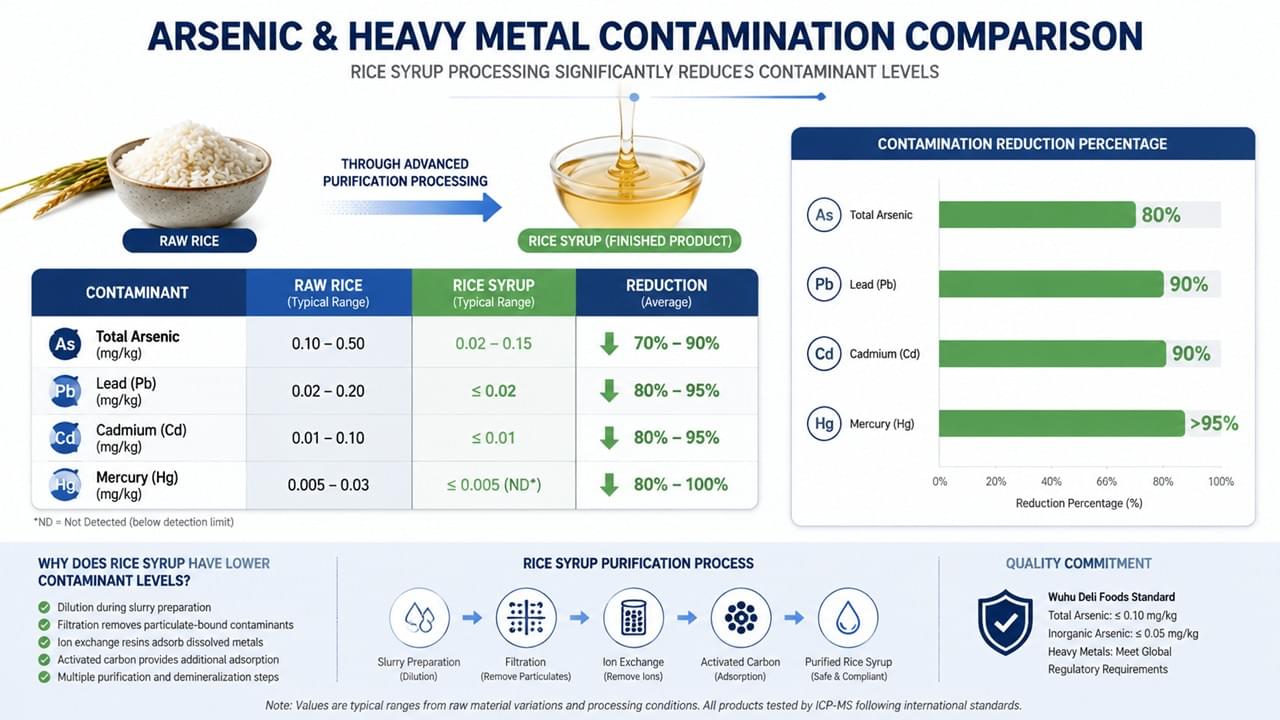
Analyse avancée par ICP-MS du sirop de riz pour une détection précise
Pourquoi l'ICP-MS est-il important pour les tests de contaminants dans le sirop de riz ?
Les fabricants de produits alimentaires modernes s'appuient sur l'analyse par ICP-MS du sirop de riz car elle offre une haute sensibilité et une détection précise des oligo-éléments.
Les tests ICP-MS offrent :
- Des limites de détection aussi basses que 0,001 mg/kg
- Une haute précision et répétabilité
- Une mesure fiable de l'arsenic, du plomb, du cadmium, du mercure et d'autres métaux
Pour les applications de qualité supérieure et pour nourrissons, l'analyse de la spéciation de l'arsenic par HPLC-ICP-MS est particulièrement importante car elle sépare les formes d'arsenic inorganique et organique.
Cette approche de test avancée soutient la conformité aux attentes internationales en matière de sécurité alimentaire, y compris les directives d'organisations telles que l' Organisation des Nations Unies pour l'alimentation et l'agriculture (FAO) et les normes alimentaires mondiales développées par Codex Alimentarius.
Tests de métaux lourds dans le sirop de riz : contaminants clés à surveiller
Paramètres essentiels des tests de métaux lourds dans le sirop de riz
Un complet un programme de tests de métaux lourds dans le sirop de riz devrait inclure plusieurs éléments plutôt que de se concentrer uniquement sur l'arsenic.
Les éléments de test importants comprennent :
| Contaminant | Sources principales | Cible de contrôle |
|---|---|---|
| Plomb (Pb) | Sol, équipement, eau | Strictement contrôlé |
| Cadmium (Cd) | Engrais, pollution industrielle | Surveillance régulière |
| Mercure (Hg) | Contamination environnementale | Contrôle au niveau des traces |
| Chrome (Cr) | Environnement de transformation | Évaluation des risques |
| Nickel (Ni) | Contact avec l'équipement | Dépistage de routine |
Chez Wuhu Deli Foods, la surveillance des métaux lourds est effectuée conformément aux exigences du produit et aux attentes des marchés d'exportation.
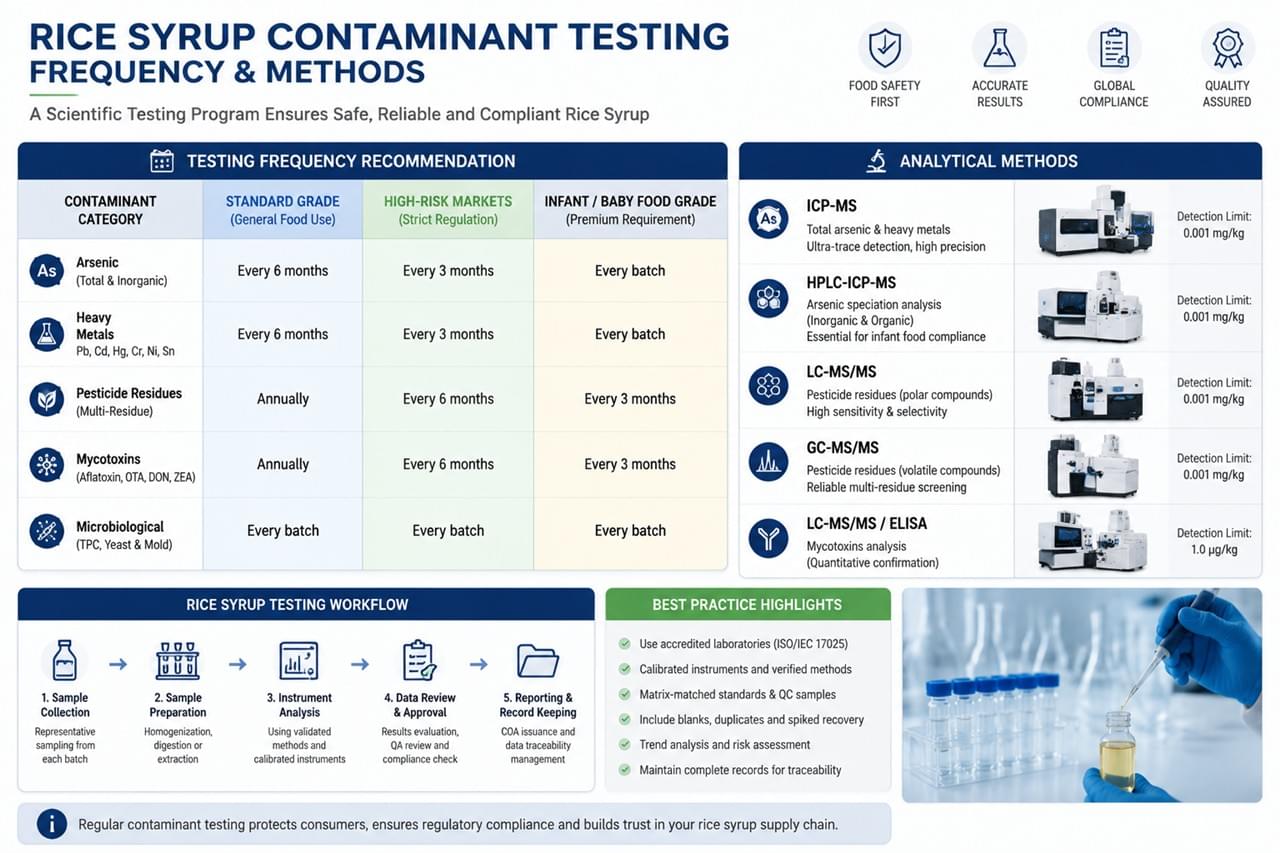
Fréquence de test recommandée :
- Produits standard : Tests de vérification réguliers
- Marchés à haut risque : Surveillance des lots plus fréquente
- Produits de qualité infantile : Tests lot par lot
Exigences de contrôle des résidus de pesticides dans le sirop de riz
Gestion des résidus de pesticides issus de la riziculture
La culture du riz peut impliquer différents produits chimiques agricoles, et certains résidus peuvent subsister si les matières premières ne sont pas correctement contrôlées.
Les catégories de pesticides prioritaires comprennent :
🌱 Organophosphorés
🌱 Pyréthrinoïdes
🌱 Fongicides
🌱 Herbicides
Un programme professionnel de test de résidus de pesticides dans le sirop de riz évalue le sirop fini plutôt que de tester uniquement le riz brut.
Ceci est important car la transformation peut modifier la concentration des résidus, ce qui signifie qu'une vérification du produit final est nécessaire pour la conformité à l'exportation.
Technologie de test multi-résidus
L'analyse moderne des pesticides utilise couramment :
- LC-MS/MS : Convient aux pesticides polaires et sensibles à la chaleur
- GC-MS/MS : Efficace pour les composés pesticides volatils et non polaires
Pour les marchés internationaux, en particulier l'Europe et le Japon, le dépistage multi-résidus offre une assurance qualité plus solide.
Tests de mycotoxines pour une gestion complète de la sécurité alimentaire
Bien que le riz présente généralement un risque de mycotoxines plus faible par rapport à certaines céréales, les fabricants responsables surveillent toujours la contamination potentielle.
Les principales mycotoxines comprennent :
- Aflatoxines (B1, B2, G1, G2)
- Ochratoxine A (OTA)
- Toxines de Fusarium telles que DON et ZEA
Les méthodes de test comprennent :
- Analyse LC-MS/MS
- Méthodes de dépistage ELISA
La combinaison des tests de mycotoxines avec la surveillance des contaminants crée un système de protection de la sécurité alimentaire plus complet.
Gestion intégrée des risques liés aux contaminants chez Wuhu Deli Foods
Un contrôle efficace des contaminants nécessite plus que des tests en laboratoire. Il commence par la gestion des fournisseurs et se poursuit tout au long de la production.
Contrôle des matières premières
Wuhu Deli Foods se concentre sur :
✅ Sélection de fournisseurs de riz fiables
✅ Examen de la documentation de conformité agricole
✅ Tests des matières premières entrantes
✅ Surveillance des risques de contamination régionaux
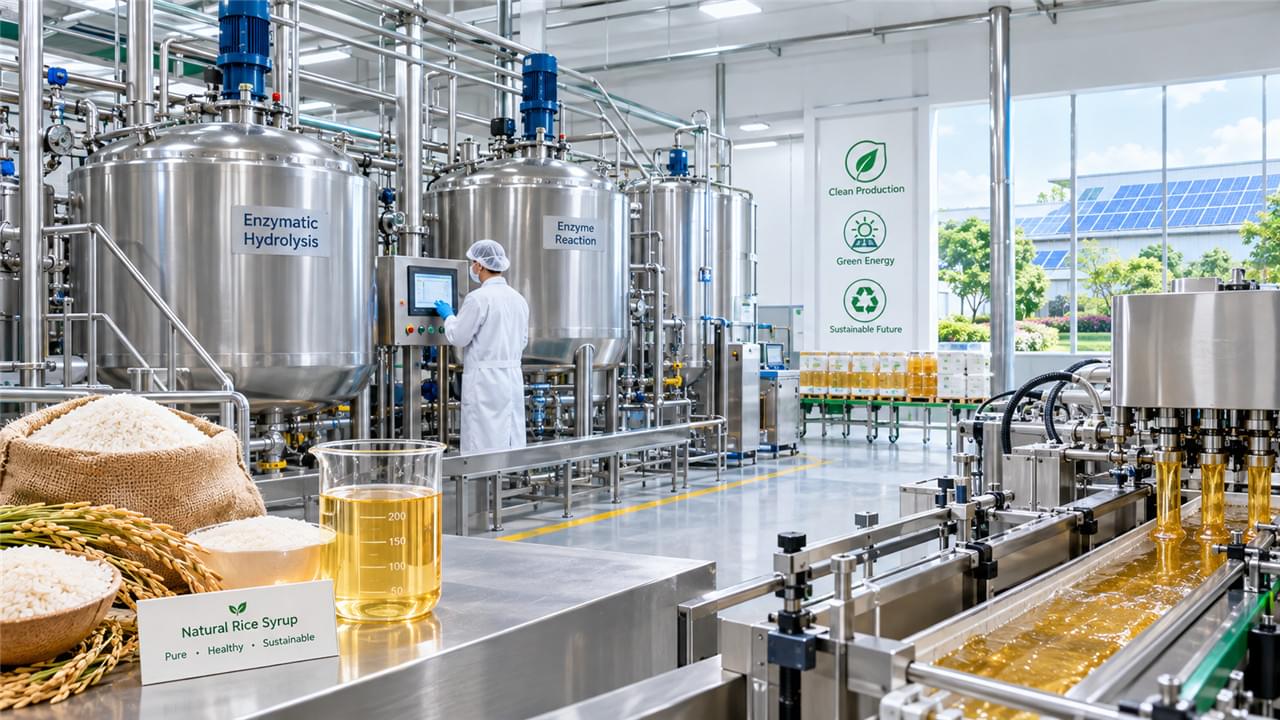
Contrôle du processus de fabrication
Pendant la production, la gestion de la qualité comprend :
- Optimisation des processus de purification
- Validation de l'efficacité de la filtration
- Surveillance des performances du traitement
- Maintien de la traçabilité de la production
Vérification du produit fini
Chaque lot est évalué conformément aux exigences du client et aux réglementations du marché.
La surveillance typique comprend :
| Élément de test | Grade standard | Grade d'exigence supérieure |
|---|---|---|
| Arsenic total | Tests réguliers | Chaque lot |
| Arsenic inorganique | Tests réguliers | Chaque lot |
| Métaux lourds | Tests programmés | Surveillance fréquente |
| Pesticides | Dépistage annuel | Fréquence accrue |
| Mycotoxines | Dépistage annuel | Fréquence accrue |
Choisir un fournisseur fiable de sirop de riz
Pour les fabricants de produits alimentaires, le choix d'un fournisseur ne concerne pas seulement le prix. Les systèmes de qualité, la capacité de test et la transparence de la documentation sont tout aussi importants.
Un fournisseur fiable de sirop de riz doit fournir :
✅ Rapports complets de tests de contaminants
✅ Approvisionnement traçable des matières premières
✅ Certifications internationales de sécurité alimentaire
✅ Normes de production cohérentes
Wuhu Deli Foods combine une technologie de test avancée avec une gestion de la qualité stricte pour soutenir les clients du monde entier avec des ingrédients de sirop de riz sûrs et fiables.
Conclusion : la sécurité commence par des tests complets
Les tests de contaminants dans le sirop de riz est une partie fondamentale de la production moderne d'ingrédients alimentaires. De l'arsenic inorganique et des métaux lourds aux résidus de pesticides et aux mycotoxines, chaque risque potentiel nécessite une surveillance professionnelle et une vérification scientifique.
Grâce à des méthodes de laboratoire avancées, à des contrôles stricts des fournisseurs et à une gestion continue de la qualité, Wuhu Deli Foods aide les clients mondiaux à s'approvisionner en toute confiance en sirop de riz de haute qualité pour les applications alimentaires et de boissons.
📩 Contact Épicerie fine Wuhu pour les documents de test de contaminants, les rapports de qualité et les solutions personnalisées de sirop de riz.


 English
 Deutsch
 Español
 العربية
 Français
 Русский
 Bahasa Indonesia
 한국어
한국어 日本語
日本語 Polski
 Português
 Bahasa Melayu