
Why Rice Syrup Quality Assurance Deserves a Closer Look
Walk into any food plant and you’ll hear the phrase “quality assurance” thrown around. But what does it actually mean when you’re buying rice syrup by the ton? For Wuhu Deli Foods, rice syrup quality assurance isn’t a department tucked in a corner — it’s a company-wide mindset wired into every stage of production, from the moment rice arrives at the gate to the day a container leaves our docks.
This article gives you the inside look: how our rice syrup quality assurance system is structured, what it tests for, how it reacts when something goes off-spec, and how it keeps improving to stay ahead of customer and regulatory expectations.
🏭 Quality Management System Architecture
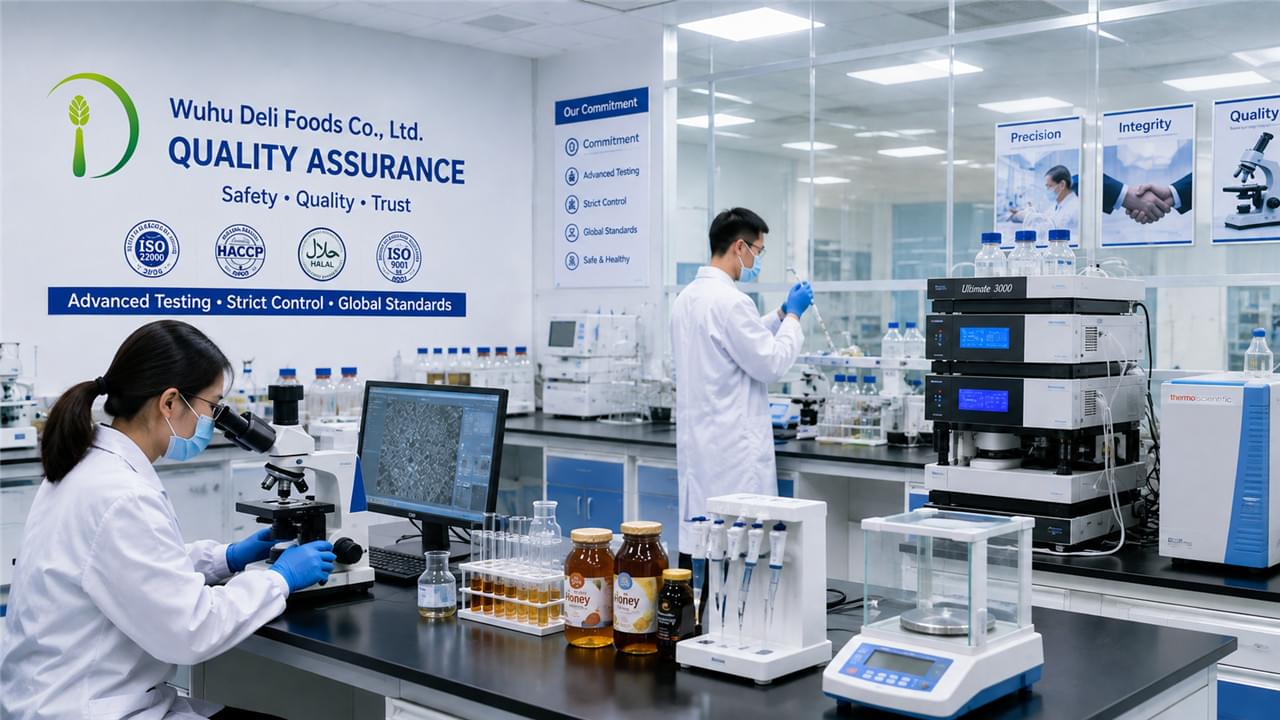
Rice Syrup Quality Assurance Architecture: ISO 22000 & HACCP
Our quality system rests on two interlocking foundations: ISO 22000:2018 and a HACCP plan.
ISO 22000:2018:
- Sets the management framework: policy, planning, operation, evaluation, improvement
- Defines food safety management system (FSMS) requirements
- Requires a documented HACCP plan as a core component
HACCP Plan:
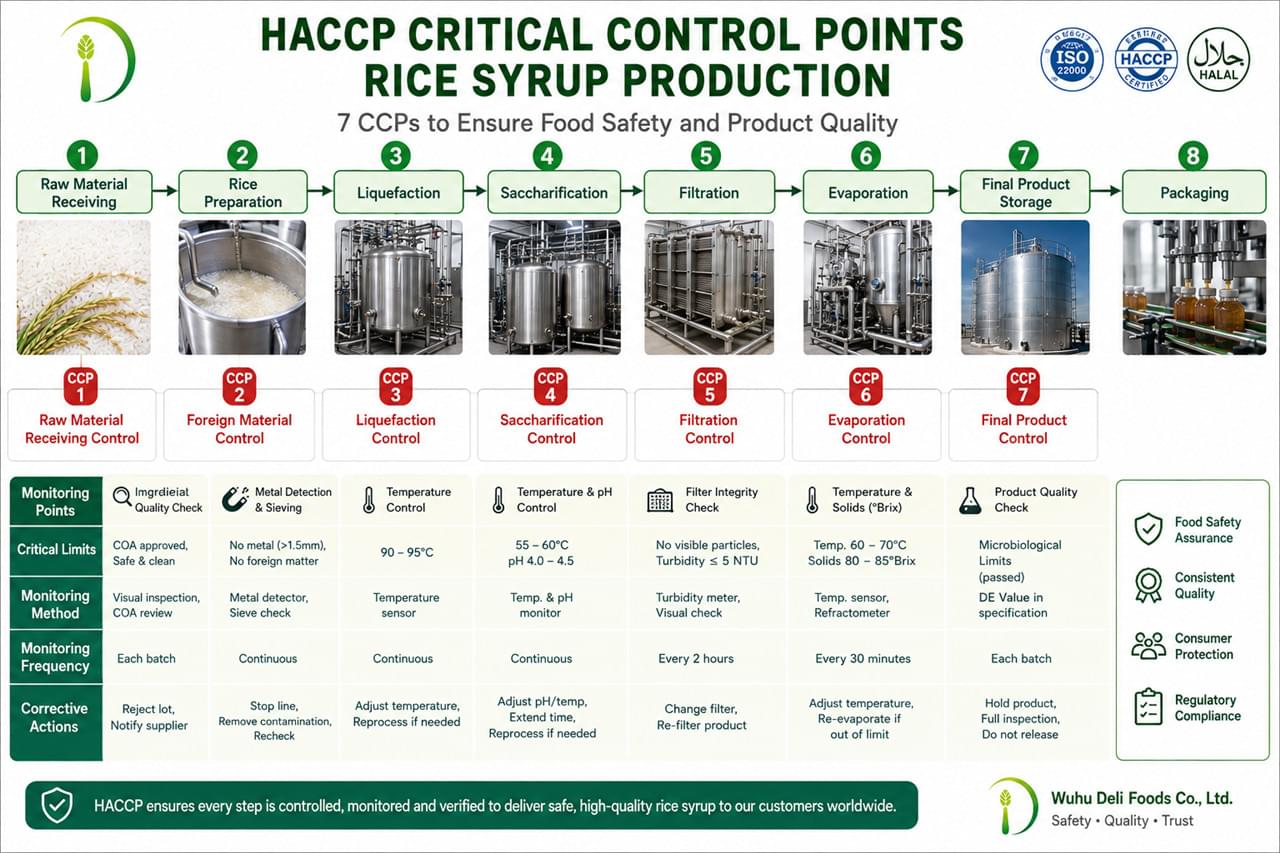
- Identifies 7 Critical Control Points (CCPs) in rice syrup production
- Defines critical limits, monitoring procedures, and corrective actions for each CCP
- Reviewed annually and after any significant process change
Integration with daily business:
- Quality objectives feed into annual business planning
- Management review meetings held quarterly
- Internal audits: minimum twice per year
- Third-party certification: annual surveillance plus 3-year recertification
Organizational Structure
Quality work is split into four focused teams:
- Quality Control (QC): testing, inspection, release decisions
- Quality Assurance (QA): system management, procedures, audits
- Regulatory Affairs: compliance, documentation, customer support
- R&D Quality: new product qualification, application testing
🌾 Raw Material Quality Control
Rice Syrup Quality Assurance Starts with Raw Materials
You can’t make premium syrup from mediocre rice. Every incoming lot goes through the same gauntlet:
Incoming Rice Testing:
| Parameter | Method | Frequency | Specification |
|---|---|---|---|
| Moisture | NIR / oven | Per batch | 10–14% |
| Starch content | Glucoamylase assay | Per batch | ≥75% |
| Protein | Kjeldahl | Per batch | ≤8% |
| Pesticide residues | LC-MS/MS | Monthly | Per market MRL |
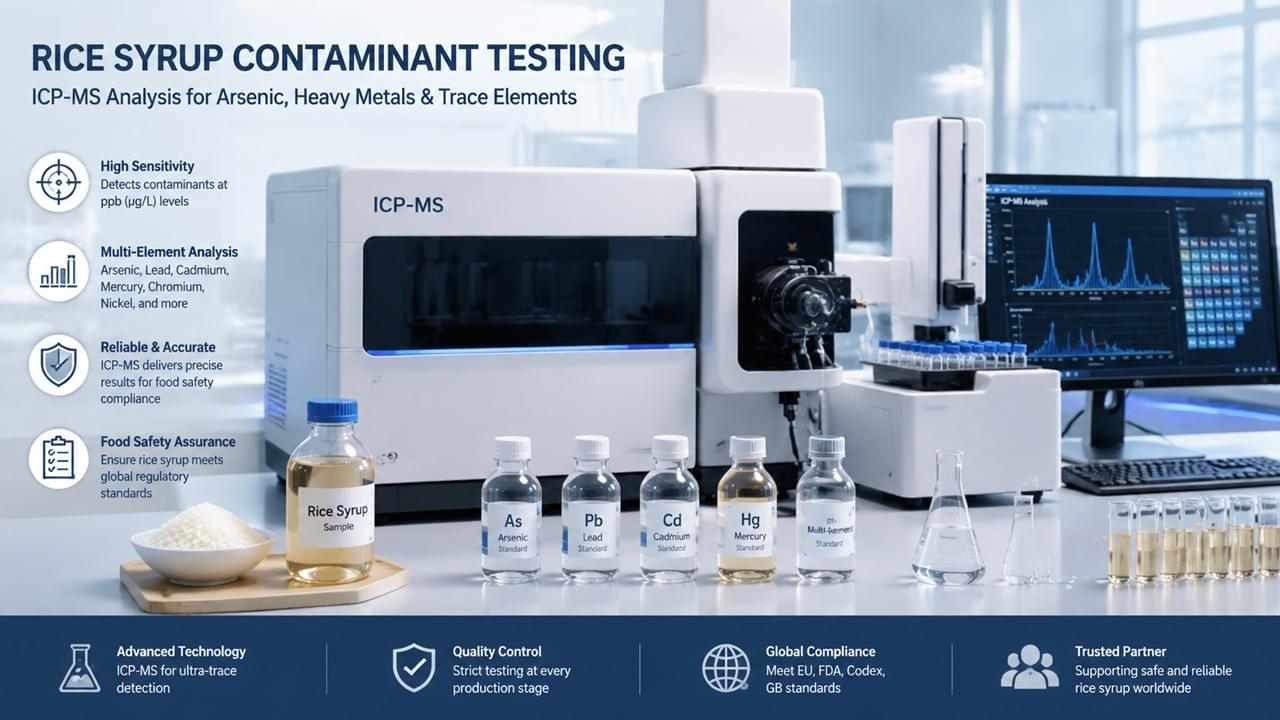
| Heavy metals | ICP-MS | Quarterly | ≤regulatory limits |
| Mycotoxins | ELISA | Monthly | ≤regulatory limits |
| Microbiological | ISO methods | Per batch | TPC <10,000 CFU/g |
Supplier management:
- Approved Supplier List (ASL) reviewed annually
- New supplier qualification: documentation review + initial audit + trial batch testing
- Quarterly supplier scorecards based on quality, delivery, and documentation
- High-risk suppliers get biannual on-site audits
Enzyme Quality Control
Enzymes are the workhorses of syrup production — their quality directly shapes DE value and batch-to-batch consistency:
Enzyme acceptance criteria:
- Activity verified by in-house colorimetric assay
- Certificate of Analysis reviewed per lot
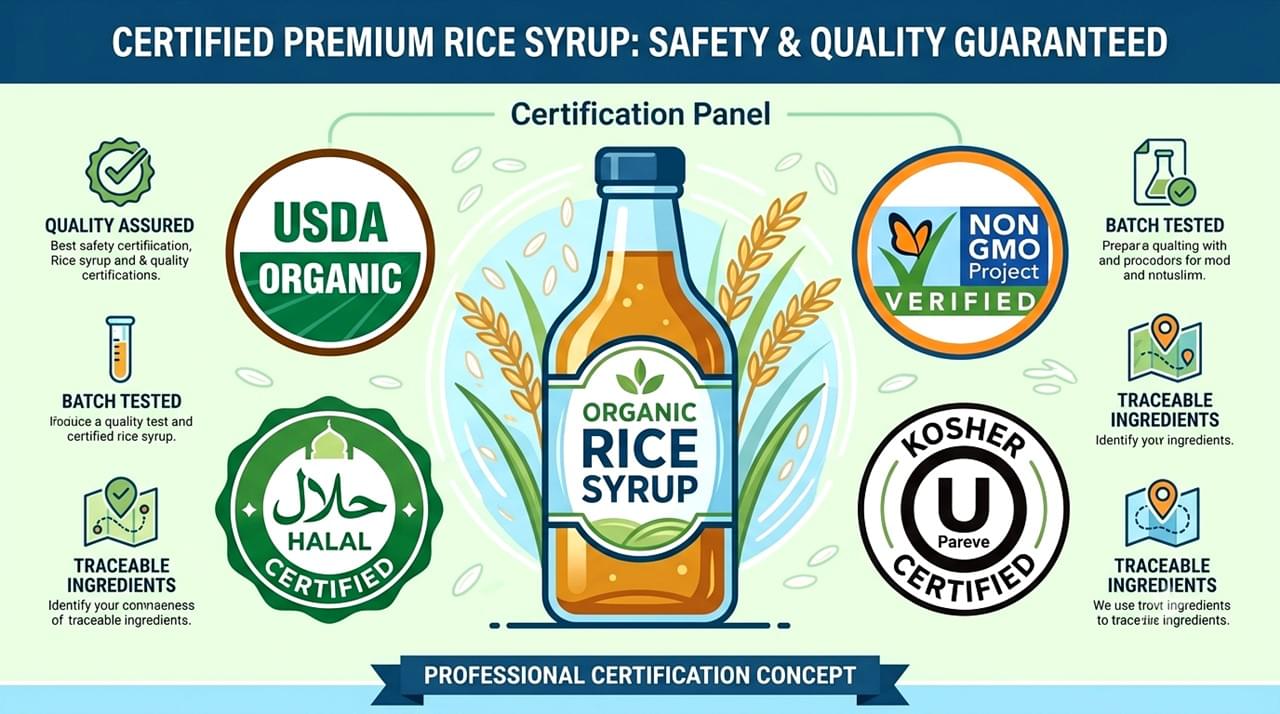
- Halal/Kosher/Organic certificates maintained and verified
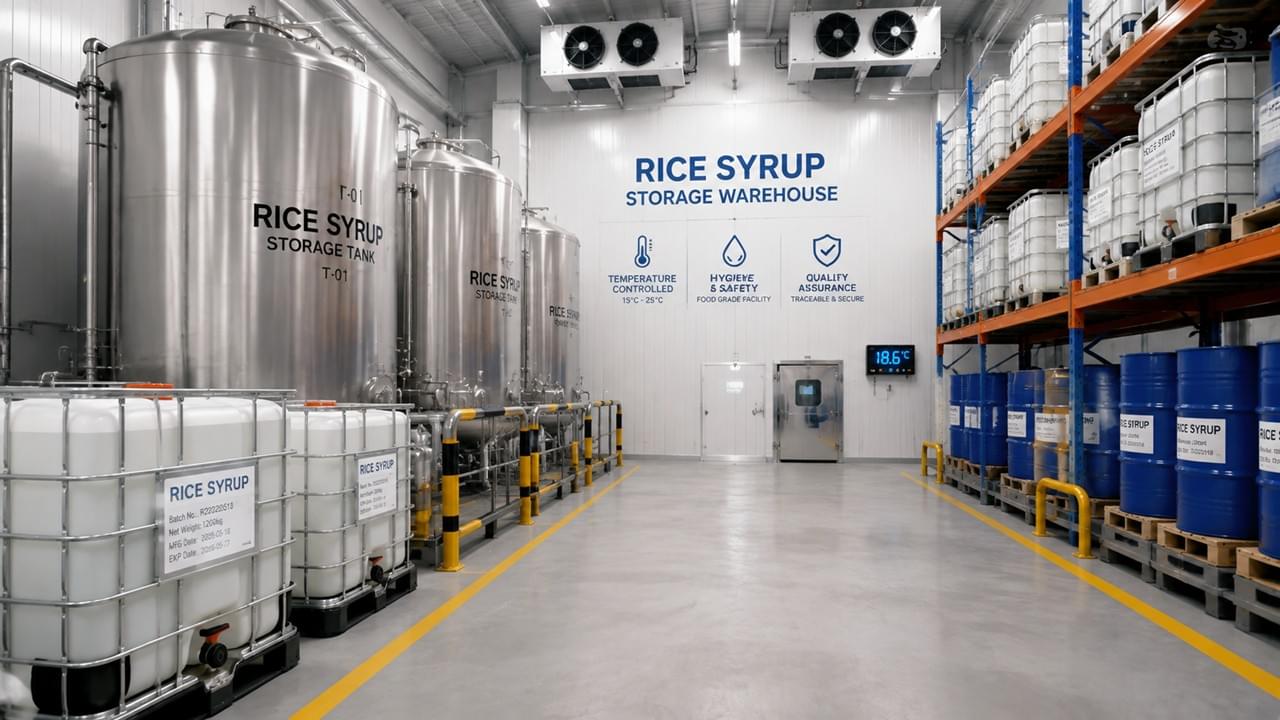
- Cold chain storage monitored for liquid enzymes
🌡️ In-Process Quality Control
In-Process Rice Syrup Quality Assurance: 7 CCPs in Action
In-process rice syrup quality control runs on a tight, documented cadence. The HACCP rice syrup production plan — built on the FDA’s HACCP framework — pins quality to seven control points, each with a hard limit:
| CCP | Control Measure | Critical Limit | Monitoring |
|---|---|---|---|
| CCP1: Starch gelatinization | Temperature | 95°C ±2°C for ≥30 min | Continuous data logger |
| CCP2: Liquefaction pH | pH adjustment | pH 5.8–6.2 | Every 30 minutes |
| CCP3: Saccharification temp | Temperature | 60°C ±2°C | Continuous |
| CCP4: Enzyme inactivation | Temperature | 85°C ±2°C for ≥15 min | Continuous |
| CCP5: Ion exchange | Ash content | ≤0.2% | Every batch |
| CCP6: Evaporation temp | Temperature | ≤70°C | Continuous |
| CCP7: Final filtration | Filter integrity | 0.22 μm integrity test | Per filter change |
How often we test in-process:
- Hourly: reaction vessel temperatures, pH at each step, Brix of concentrate
- Per batch: DE value after saccharification, color post-ion exchange, turbidity post-filtration, ash content
Process capability: SPC charts run on all critical parameters, with a Cpk target of ≥1.33 for DE value, color, and solids content. Out-of-control alarms trigger an immediate CCP review — no exceptions.
🧪 Final Product Release Testing
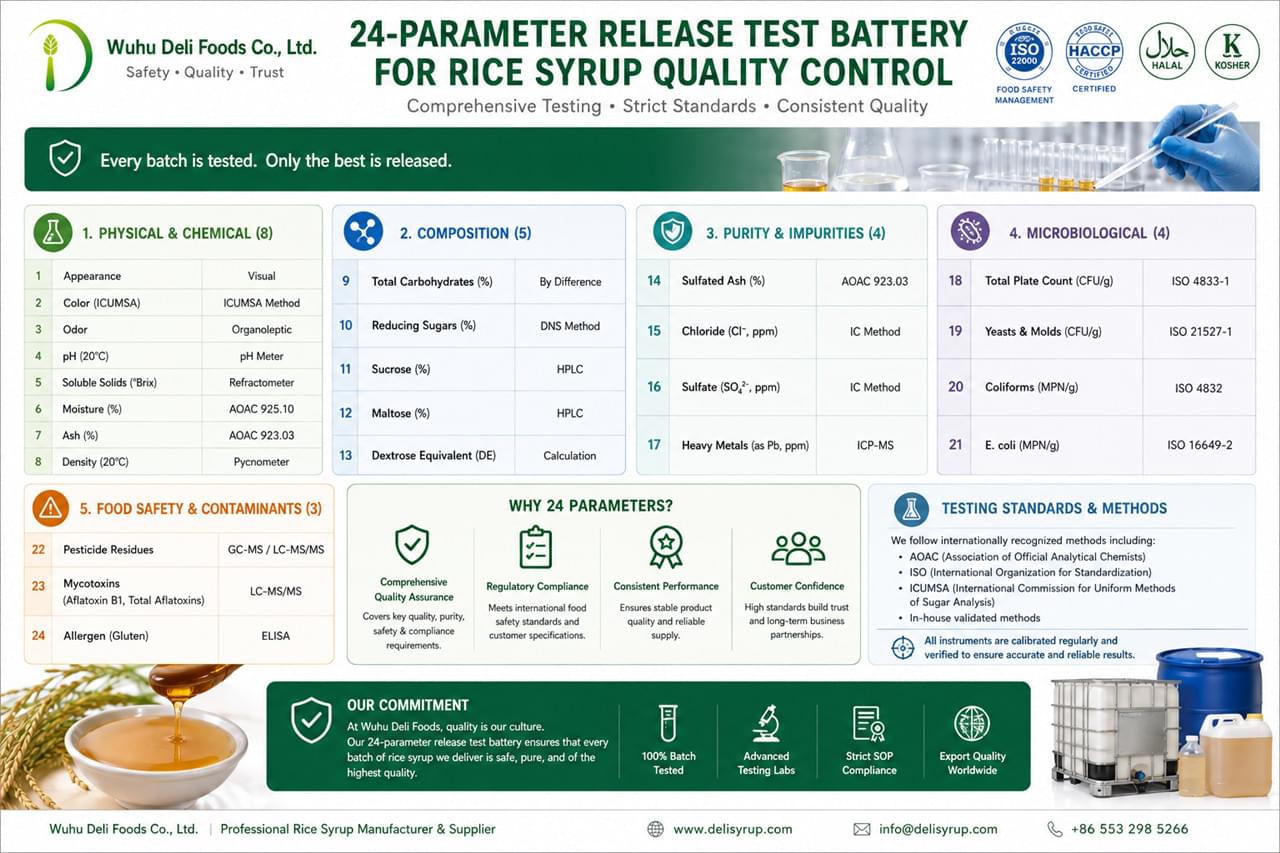
The 24-Parameter Rice Syrup Quality Assurance Release Test
The release battery is the most visible checkpoint in the whole program. No batch ships without clearing all 24 parameters:
Physical/Chemical (12): DE value, solids content (Brix), pH, color (ICUMSA), viscosity, transparency, ash content, protein content, SO₂, heavy metals (As, Pb, Cd), moisture
Microbiological (6): total plate count, yeast and mold, coliforms, E. coli, Salmonella (25g), Listeria (25g)
Sensory (3): appearance, odor (trained panel), taste (trained panel)
Functional (3): sugar profile (HPLC), fermentability test (bread-grade), clarity at 10% dilution
Release decision:
- All 24 within spec: released for delivery
- Any parameter out of spec: quarantined; root cause analysis; disposition decision
- Critical food safety failures (pathogens): automatic rejection with investigation
🛠️ Nonconformance and Corrective Action
Rice Syrup Quality Assurance When Things Go Wrong: CAPA in Practice
A rice syrup quality assurance system shows its true colors when something fails. Every deviation is logged through a documented NCR (Nonconformance Report) system:
NCR categories:
- Critical (Level 1): food safety risk; immediate quarantine; mandatory customer notification
- Major (Level 2): specification breach; quarantine; root cause analysis within 48 hours
- Minor (Level 3): process deviation; investigation; corrective action within 7 days
The CAPA loop:
- Containment — stop the problem from spreading
- Root cause analysis — 5-Why or fishbone diagram
- Corrective action — fix the root cause
- Preventive action — stop it recurring
- Verification — confirm the fix actually worked
- Documentation — full record in the CAPA system
Customer Complaint Management
When a customer flags an issue, the clock starts:
- Acknowledge within 24 hours
- Preliminary investigation report within 72 hours
- Full corrective action report within 14 business days
- Complaint rate target: <0.05% of delivered batches
📈 Continuous Improvement Program
Annual Quality Objectives
Every year, the Quality team commits to measurable goals tied to business strategy. For 2026, that means:
- Cut batch-to-batch DE variation from ±2.0 to ±1.5 on premium grades
- First-pass release rate ≥99.5% across all lines
- Reduce complaint rate from 0.08% to ≤0.05%
- Digital COA with QR code verification live by Q3 2026
Benchmarking and Industry Engagement
We stay plugged into the industry: FSSC 22000 user group participation, IFT and food safety conferences, regulatory alert subscriptions (EU, FDA, CFSA), and annual benchmarking against peer manufacturers.
📦 Customer-Facing Quality Programs
Rice Syrup Quality Assurance for Buyers: Qualification & Traceability
For buyers, the proof is in the paperwork. We make supplier qualification straightforward:
Supplier Qualification Support:
- Supplier Qualification Package (SQP): 35+ documents covering certificates, quality manual summary, site overview, and test data
- Audit support: remote and on-site audit facilitation; third-party results available
- Questionnaire responses: SSAFE/SEDEX-style food safety questionnaires answered within 5 business days
Traceability System:
- Every drop traced forward and backward within 4 hours
- Raw material lot → production batch → finished product → shipment → customer
- Digital traceability integrated with ERP
- Annual mock recall exercise (target: ≤4 hours to full identification)
✅ Conclusion
In food manufacturing quality control, the difference between a commodity and a trusted ingredient is a system you can verify. Rice syrup quality assurance at Wuhu Deli Foods is exactly that — a complete system, not a checkbox. From CCP-controlled process steps to the 24-parameter release battery and rapid corrective action, the goal is simple: give customers the confidence to treat us as a strategic partner, not just a vendor.
Key Quality Assurance Highlights:
- ISO 22000 and HACCP certification with annual third-party surveillance
- 24-parameter batch release testing on every production lot
- 7 Critical Control Points monitored with automated data logging
- Full traceability within 4 hours; annual mock recall exercise
- Complaint rate target <0.05% with structured CAPA response
Contact Wuhu Deli Foods Quality Team for our Supplier Qualification Package.
 English
 Deutsch
 Español
 العربية
 Français
 Русский
 Bahasa Indonesia
 한국어
한국어 日本語
日本語 Polski
 Português
 Bahasa Melayu