
Why Rice Syrup Storage Matters
Ask any production manager who has lost a batch of syrup and they’ll tell you the same thing: rice syrup storage is where quality is won or lost. Unlike dry powders that sit happily on a pallet for months, liquid rice syrup demands specific temperature, packaging, and handling protocols. Slip up, and you’re looking at darkening color, off-flavors, and in the worst case, a spoiled tank.
This guide covers the fundamentals for food manufacturers, warehouse managers, and procurement teams: what makes rice syrup stable, the right rice syrup storage conditions for every container type, realistic shelf life expectations, and the routines that keep quality consistent across the supply chain.
🌡️ Rice Syrup Stability: The Science of Staying Fresh
Good rice syrup storage begins with understanding what makes the product stable in the first place.
Water Activity and Microbiological Safety
Rice syrup keeps itself safe through sheer concentration. With soluble solids typically between 75–85%, the syrup creates an environment so low in water activity that most spoilage organisms simply can’t survive:
- Standard rice syrup (80°Brix): aw ≈ 0.82–0.85
- Concentrated grade (85°Brix): aw ≈ 0.78–0.82
At these levels, most spoilage bacteria can’t grow — they need aw above 0.90. Osmophilic yeasts are the one exception to watch; they can multiply once aw climbs past 0.80, which makes them the biggest microbial risk for syrups. Mold growth stays suppressed, and properly manufactured syrup needs no preservatives at all.
The critical insight: dilution is the enemy. Water getting into the tank — whether from condensate or process water — raises water activity and invites trouble. Strict hygiene protocols prevent this.
Chemical Stability
Syrup can also degrade chemically, even when microbes never get a foothold. Four pathways matter most:
| Degradation Type | Trigger | Effect | Prevention |
|---|---|---|---|
| Maillard browning | Heat + amino acids | Color darkening | Store at ≤25°C |
| Oxidation | Oxygen exposure | Flavor deterioration | Sealed containers, N₂ blanketing |
| Acid hydrolysis | Low pH + heat | DE value increase | Maintain pH 4.0–5.5; avoid heat |
| Fermentation | Osmophilic yeast | CO₂ generation, off-flavors | Hygiene, temperature control |
🌡️ Recommended Storage Conditions
The Right Rice Syrup Storage Temperature Range
The sweet spot: 15–25°C (59–77°F). Stay inside it and you balance viscosity against microbial stability.
- Below 15°C: Viscosity climbs sharply, making syrup hard to pump; very low temperatures can trigger slow crystallization
- 15–25°C: Optimal balance — fluid enough to handle, stable enough to store
- Above 30°C: Color development accelerates; condensation risk rises alongside microbial activity
- Above 40°C: Rapid color deterioration — unacceptable for premium grades
Seasonal management matters too. In summer, insulate tanks from direct sunlight and consider active cooling when ambient temperatures pass 30°C. In winter, use heat tracing or insulation to prevent viscosity from spiking — and never let syrup freeze. Getting rice syrup temperature storage right means holding that 15–25°C window through every season.
Rice Syrup Storage Containers: From Tanks to Pails
Each container size has its own rice syrup storage rules, and following them is half the battle:
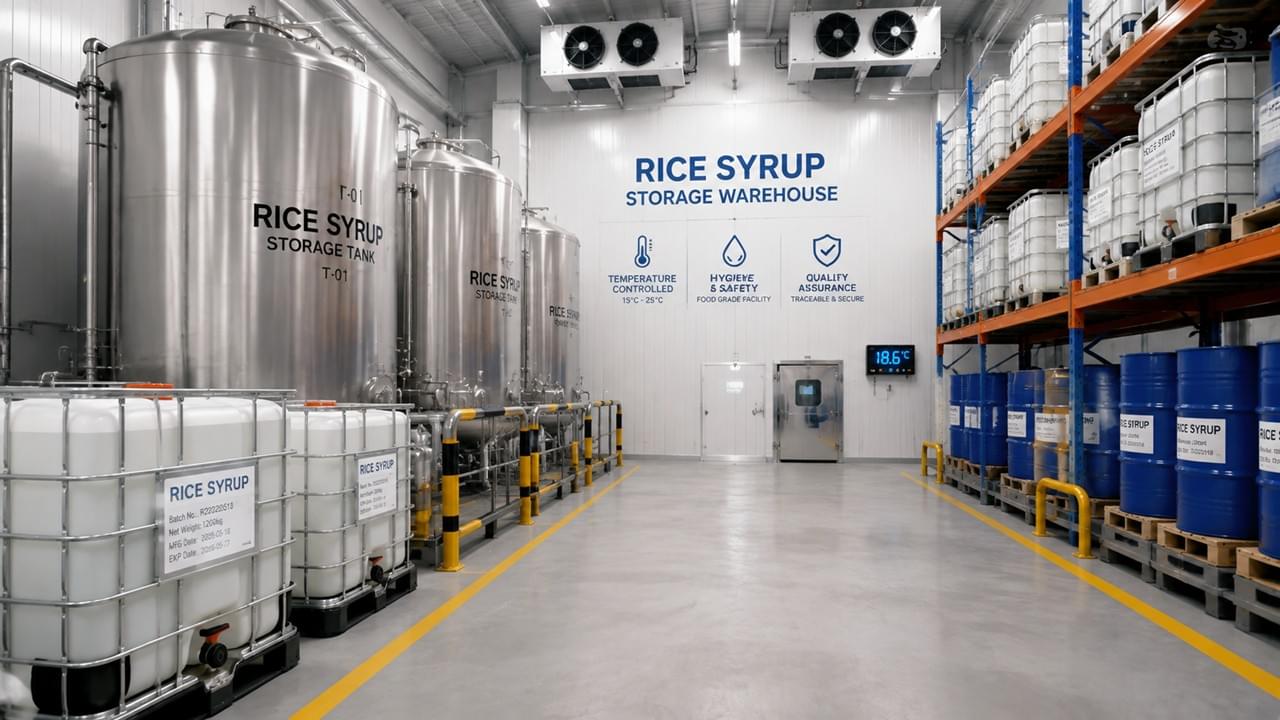
Bulk Storage (>1,000 kg):
- Stainless steel tanks are the gold standard — easy to clean, corrosion-resistant, no migration risk
- Insulated jacketed tanks deliver year-round temperature control
- Clean before every refill with hot water plus food-grade sanitizer
- Nitrogen blanketing keeps oxygen and condensation out
IBC Containers (1,000 L):
- Use food-grade polyethylene liners
- Keep sealed when idle
- Store away from direct sunlight and heat sources
- Inspect for leaks and label integrity on receipt
Drums (200–280 kg):
- Food-grade HDPE or stainless steel-lined drums
- Store upright; stack no more than three high
- Label each drum with batch number, production date, and best-before date
Small Packs (5–25 kg pails):
- Airtight food-grade polyethylene pails
- Refrigerate after opening if not used within two weeks
- Inspect seals on receipt
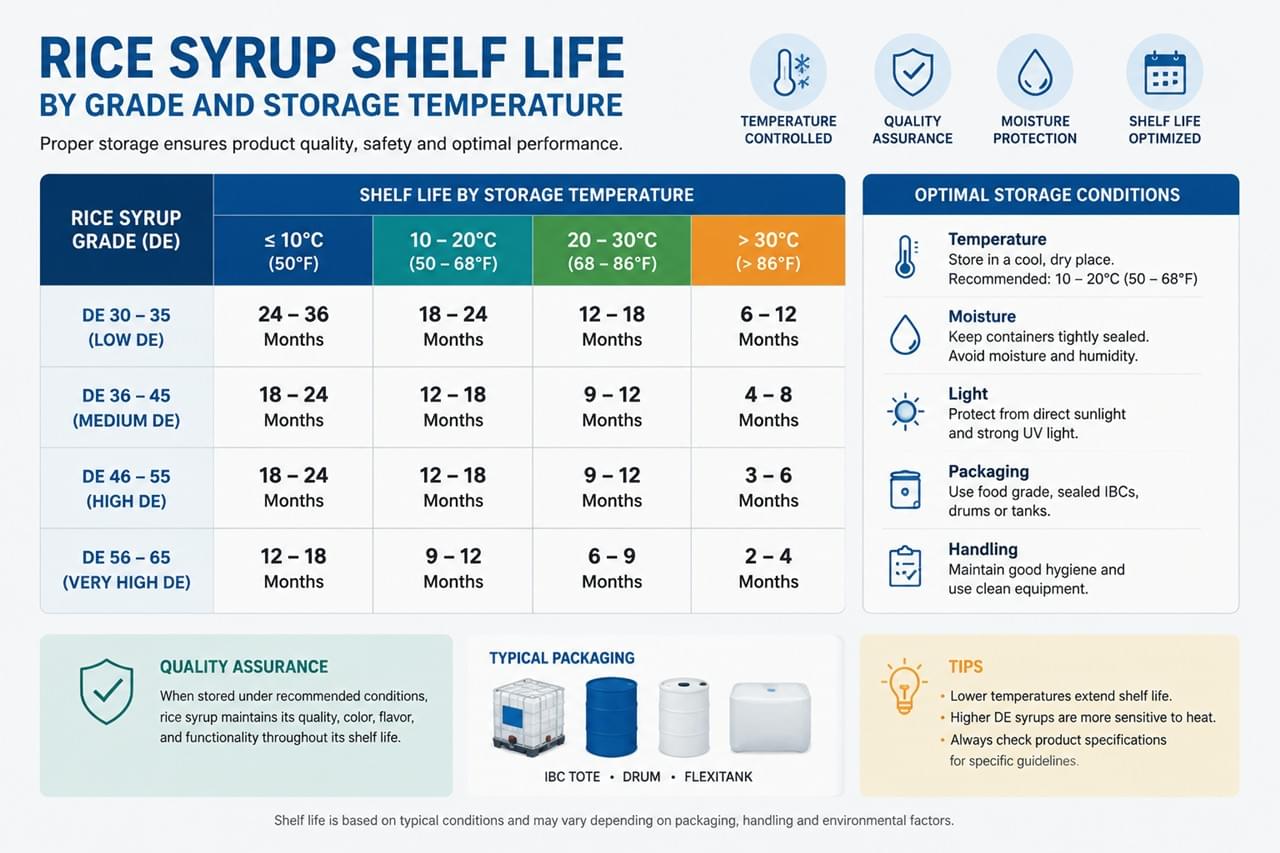
📦 Shelf Life Guidelines
Rice Syrup Storage and Shelf Life by Grade
Here’s what you can realistically expect from properly stored, unopened product:
| Product Grade | Storage Condition | Recommended Shelf Life |
|---|---|---|
| Standard clarified rice syrup | 15–25°C, sealed | 24 months |
| Premium clarified rice syrup | 15–25°C, sealed | 24 months |
| Organic clarified rice syrup | 15–25°C, sealed | 18–24 months |
| High-DE rice syrup (DE 60+) | 15–25°C, sealed | 18 months |
| Low-DE rice syrup (DE 30–38) | 15–25°C, sealed | 24 months |
Once opened or transferred, plan to use the syrup within 4–8 weeks.
Factors That Accelerate Quality Loss
Even with the right shelf life on paper, a few habits can quietly steal it:
- Temperature excursions — every 10°C increase roughly doubles the rate of browning reactions
- Water ingress — dilution raises aw and opens the door to microbes
- Oxygen exposure — drives oxidative flavor deterioration
- Light exposure — UV speeds up discoloration
- Improper cleaning — residual contamination from a previous product
🔄 Handling and Transfer Best Practices
Pumping and Transfer: Viscosity Is the Enemy
Rice syrup handling best practices start with understanding viscosity. It swings dramatically with temperature:
- DE 42 at 15°C: ~8,000–12,000 cP — needs a high-torque pump
- DE 42 at 25°C: ~3,000–5,000 cP — standard positive displacement pump works
- DE 42 at 40°C: ~800–1,200 cP — even a centrifugal pump can handle it
Pump recommendations: positive displacement pumps (gear, lobe, or peristaltic) suit standard storage temperatures; all food-contact surfaces should be 316L stainless steel or food-grade elastomers. Avoid centrifugal pumps below 25°C.
Pre-transfer warming: if syrup has been stored cold, warm it to 30–40°C before transfer to cut viscosity and improve flow. Hot water jacketed lines or in-line heat exchangers do the job.
Sampling and Testing Protocols
On arrival:
- Verify the COA matches delivery documentation
- Check container integrity — no leaks, intact seals
- Take a representative sample for physical inspection (color, odor, clarity)
- Retain a reference sample for six months
Ongoing checks:
- Weekly: visual inspection of stored tanks (color, clarity)
- Monthly: Brix measurement, pH check, microbiological swabs of tank surfaces
- On transfer: confirm DE value if a batch has been stored more than three months
Cross-Contamination Prevention
In multi-ingredient facilities, the rules are non-negotiable:
- Dedicate rice syrup pipework, or fully clean and sanitize between products
- Label all tanks, hoses, and connections clearly
- Never introduce water directly into storage tanks
- Document every cleaning activity in logbooks — FDA Food Code standards are a useful benchmark for facility hygiene
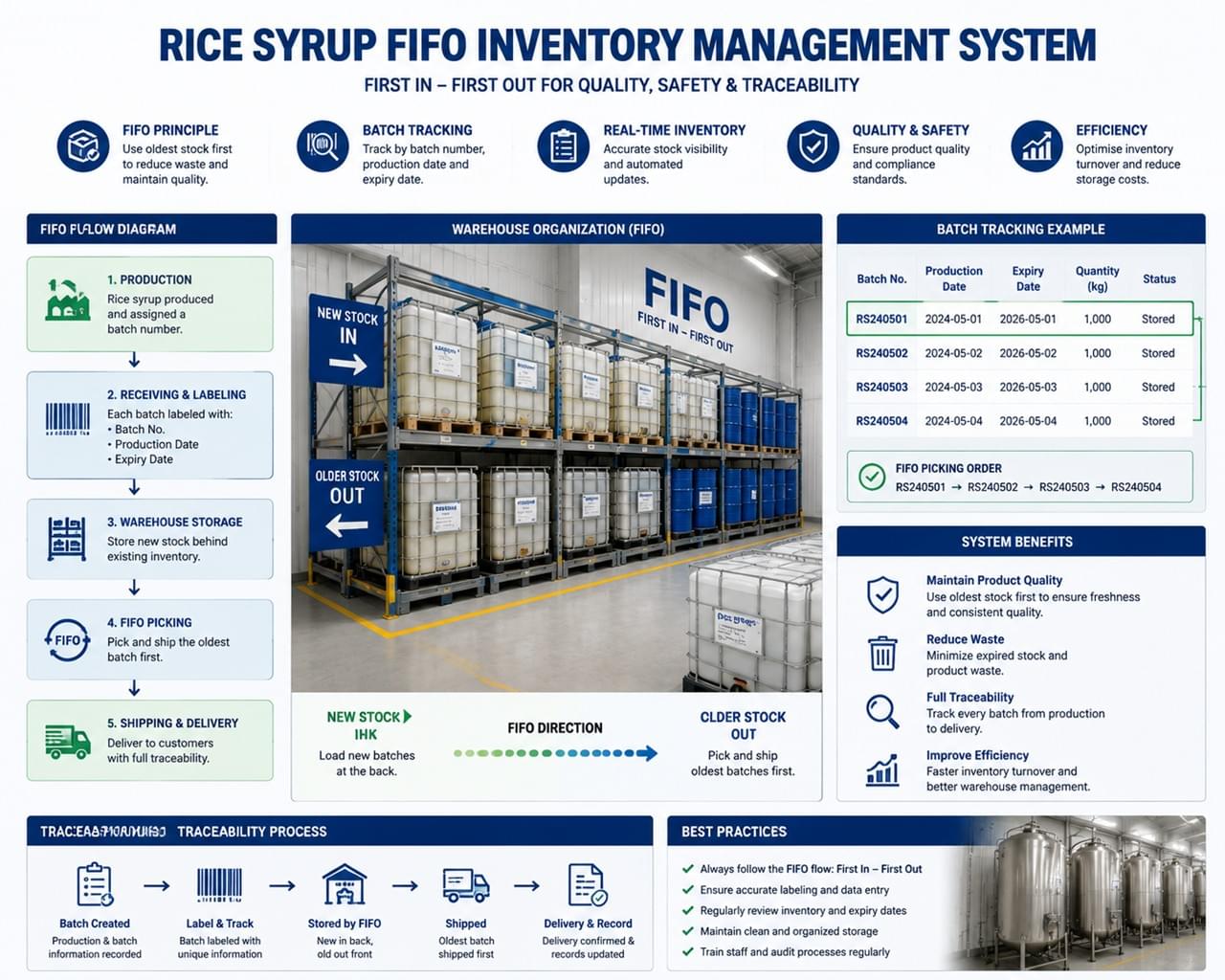
🔄 FIFO Inventory Management
Rice Syrup Storage with FIFO: Rotate It or Lose It
First-In, First-Out — FIFO inventory management — is the single most effective habit in a rice syrup warehouse. It sounds simple, but it takes discipline:
- Receive: record batch number, production date, and best-before date
- Store: position new deliveries behind existing stock
- Dispense: always draw from the oldest batch first
- Track: use ERP or warehouse management software to flag aging inventory
Alert triggers to build into your system:
- Stock reaching 75% of shelf life: initiate usage or transfer
- Stock reaching 90% of shelf life: test for quality compliance and escalate to QC
- Any visual anomaly (color change, cloudiness, CO₂ evolution): quarantine and test immediately
🧪 Quality Retest and Acceptance Criteria
If syrup has lingered near the end of its shelf life or survived a temperature excursion, don’t guess — retest. Here’s the checklist:
- DE value: within specification ± tolerance
- Color (ICUMSA): must not exceed 150% of original specification
- Microbiology: TPC <100 CFU/g; no yeast/mold growth above specification
- pH: within 4.0–5.5
- Sensory: no fermentation odors or unusual off-notes
✅ Conclusion
Done right, rice syrup storage protects your investment and keeps application performance consistent batch after batch. Temperature control, sealed packaging, FIFO inventory management, and routine quality monitoring work together as one system — skip one piece and the rest starts to leak value.
Key Takeaways:
- Store at 15–25°C in sealed, opaque containers to maximize shelf life
- Water ingress is the primary microbiological risk — keep hygiene strict
- Warm syrup before transfer to manage viscosity in cold environments
- Implement FIFO inventory management with documented traceability
- Retest any inventory approaching shelf life limits before use
For storage and handling technical questions, contact Wuhu Deli Foods technical support.

 English
 Deutsch
 Español
 العربية
 Français
 Русский
 Bahasa Indonesia
 한국어
한국어 日本語
日本語 Polski
 Português
 Bahasa Melayu