
Anwendungen von Reissirup in Süßwaren Reissirup gewinnt in der modernen Süßwarenproduktion zunehmend an Bedeutung, da Marken nach Süßungsmitteln mit natürlichen Inhaltsstoffen, besserer Texturkontrolle und stabileren Rezepturen suchen. Von weichen Fruchtgummis bis hin zu glänzenden Bonbons bietet Reissirup sowohl technische Vorteile als auch eine hohe Verbraucherfreundlichkeit.
Die Süßwarenhersteller von heute stehen unter zunehmendem Druck, Textur, Haltbarkeit, Süße und Transparenz der Inhaltsstoffe in Einklang zu bringen. Reissirup hilft, diese Herausforderungen zu meistern und gleichzeitig eine Premium-Produktpositionierung auf wettbewerbsintensiven globalen Märkten zu unterstützen.
Egal ob Sie Gummibärchen, Müsliriegel, Karamellprodukte oder gekochte Bonbons herstellen, das Verständnis des richtigen DE-Wertes und der richtigen Rezepturstrategie kann die Produktqualität und die Verarbeitungseffizienz erheblich verbessern.
🍭 Warum Reissirup in Süßwaren so gut funktioniert
Süßwaren erfordern eine präzise Kontrolle von Kristallisation, Viskosität, Feuchtigkeitswanderung und Textur. Reissirup eignet sich aufgrund seines ausgewogenen Kohlenhydratprofils und seiner milden Süße hervorragend.
Im Vergleich zu herkömmlichen Süßungsmitteln bietet Reissirup mehrere Vorteile:
- ✅ Bessere Kristallisationskontrolle
- ✅ Glatte und stabile Textur
- ✅ Milder Geschmack, der natürliche Geschmacksprofile unterstützt
- ✅ Verbraucherwahrnehmung von Clean-Label-Produkten
- ✅ Fruktosefreie Positionierung
- ✅ Bio-kompatible Optionen
Hersteller schätzen zudem seine Flexibilität in verschiedenen Produktkategorien. Ein einziger Inhaltsstoff kann mit nur geringfügigen Rezepturanpassungen für Gummibärchen, Bonbons, Riegel, Überzüge und Karamellsysteme verwendet werden.
Einen umfassenderen Überblick über industrielle Süßstofflösungen können Leser auch Folgendes erkunden: Wuhu Deli Foods Reissiruplösungen.
🍬 Anwendungen von Reissirup in der Süßwarenherstellung, insbesondere in Hartkaramellen
Eine der etabliertesten Anwendungen von Reissirup in Süßwaren ist die Herstellung von Hartbonbons. In dieser Kategorie dient Reissirup hauptsächlich als Kristallisationsinhibitor.
Ohne geeignete Zusatzstoffe neigt Saccharose während der Lagerung zur Rekristallisation, was zu einer körnigen Textur und einem trüben Aussehen führt. Reissirup trägt dazu bei, eine glatte und transparente Struktur zu erhalten und das Mundgefühl zu verbessern.
🔹 Wichtigste funktionale Vorteile
- Verhindert unerwünschte Saccharosekristallisation
- Verbessert die Klarheit und den Glanz von Süßigkeiten.
- Verleiht Fülle, ohne dabei zu süß zu sein.
- Passt gut zu natürlichen Farbstoffen und Fruchtaromen.
- Reduziert die Aggressivität der Formulierung im Vergleich zu einigen Glukosesirupen.
🔹 Empfohlene Rezeptur für Hartbonbons
| Bestandteil | Empfohlener Bereich |
| Saccharose | 55–65% |
| Reissirup (DE 42–50) | 20–35% |
| Wasser | 15–20% |
🔹 Verarbeitungstipps
Für eine effektive Kristallisation von Hartbonbons mit Reissirup Kontrolle:
- Die Gartemperaturen sollten zwischen 148 und 154 °C liegen.
- Verwenden Sie nach Möglichkeit Vakuumgaren.
- Um die Klebrigkeit zu verringern, sollte man zu viel DE-Sirup vermeiden.
- Für eine gute Haltbarkeit sollte nach dem Kochen ein niedriger Feuchtigkeitsgehalt angestrebt werden.
Auch die Verwendung von Sirupen mit niedrigem Farbanteil hilft den Herstellern, klare Premium-Bonbons mit minimaler Bräunung herzustellen.
Für Hersteller, die sich mit natürlichen Süßwarentrends auseinandersetzen, Nationaler Süßwarenverband bietet nützliche Markteinblicke und regulatorische Aktualisierungen.
🧸 Anwendungen von Reissirup in der Süßwarenherstellung (Gummibärchen)
Gummibärchen erfordern ein sensibles Gleichgewicht zwischen Elastizität, Kaubarkeit, Süße und Feuchtigkeitsregulierung. Hier liegt der Schlüssel. Anwendungen von Reissirup in Süßwaren werden besonders wertvoll.
Reissirup mit niedrigem DE-Wert sorgt für einen dichten und befriedigenden Kaukomfort und verhindert gleichzeitig übermäßiges Klebrigkeit bei Lagerung und Verpackung.
🔹 Warum Gummibärchen von Reissirup profitieren
- Verbessert die Kaustruktur
- Verringert das Ausbluten von Feuchtigkeit
- Unterstützt Clean-Label-Positionierung
- Verbessert die Füllstabilität
- Reguliert die Süßeintensität
🔹 Empfohlene Rezeptur für Reissirup-Gummibärchen
| Bestandteil | Empfohlener Bereich |
| Zucker-/Glukosemischung | 40–50% |
| Reissirup (DE 30–40) | 20–35% |
| Gelatine oder Pektin | 5–8% |
Das Recht Reissirup-Gummibärchen-Formulierung Es hängt stark von der gewünschten Konsistenz ab. Ein höherer Sirupanteil führt im Allgemeinen zu weicheren und elastischeren Gummibärchen.
🔹 Tipps zur Texturoptimierung
- Höherer DE-Wert = weicherer Biss
- Niedrigere DE-Werte = festerer Biss
- Säuren sorgfältig ausbalancieren, um die Gelstärke zu erhalten
- Durch Kontrolle der Wasseraktivität wird die Haltbarkeit verlängert
Marken, die vegane Gummibärchen entwickeln, können auch Reissirup mit Pektinsystemen kombinieren, um eine verbesserte Konsistenz der Textur zu erzielen.
Für weitere Unterstützung bei der Formulierung können Hersteller auf die folgende Quelle verweisen: Institut für Lebensmitteltechnologen für Ressourcen zur Inhaltsstoffforschung.
🥣 Verwendung von Reissirup in Süßwaren wie Müsliriegeln und Energieriegeln
Unter allen Anwendungen von Reissirup in Süßwaren, Müsliriegel zählen weiterhin zu den am schnellsten wachsenden Segmenten. Reissirup dient dabei sowohl als Süßungsmittel als auch als hochwirksames Bindemittel.
Durch seine moderate Süße bleiben Getreide, Nüsse, Früchte und Proteine geschmacklich im Vordergrund.
🔹 Funktionale Vorteile von Bars
- Ausgezeichnete Bindungsstärke
- Verringert die Trennung der Inhaltsstoffe
- Kontrolliert die Feuchtigkeitswanderung
- Unterstützt eine weichere Biss-Textur
- Kompatibel mit organischen Rezepturen
🔹 Empfohlene Rezeptur
| Bestandteil | Empfohlener Bereich |
| Getreide/Hafer | 40–60% |
| Reissirup (DE 38–46) | 20–40% |
| Honig oder Zucker | 5–15% |
🔹 Verarbeitungsempfehlungen
- Den Sirup vor dem Mischen auf 80–90 °C erhitzen.
- Gleichmäßige Beschichtungsverteilung sicherstellen
- Halten Sie den aw-Wert zwischen 0,55 und 0,65.
- Die Riegel langsam abkühlen lassen, damit sie nicht reißen.
Hersteller von funktionellen Snackriegeln kombinieren häufig Reissirup mit Proteinen, Samen und Trockenfrüchten, um die Texturfestigkeit zu verbessern.
Weitere verwandte Anwendungen für Bäckereien finden Sie unter Reissirup in Bäckerei- und Konditoreianwendungen.
🍮 Anwendungen von Reissirup in Süßwaren wie Karamell und Toffee
Karamellsysteme erfordern eine sorgfältige Steuerung von Bräunung, Körnung und Mundgefühl. Anwendungen von Reissirup in Süßwaren Wir helfen Herstellern, eine gleichmäßige Textur zu erhalten und gleichzeitig die Verarbeitungskontrolle zu verbessern.
Reissirup sorgt für eine cremige Konsistenz und ein stabileres Kochverhalten im Vergleich zu einigen herkömmlichen Glukosesystemen.
🔹 Wesentliche Vorteile von Karamellsystemen
- Verhindert die Zuckerkristallisation
- Kontrolliert die Maillard-Braunfärbung
- Verbessert die Textur, die im Mund zergeht.
- Unterstützt Milch- und pflanzenbasierte Systeme
- Verbessert die Glätte des Endprodukts
🔹 Empfohlene Karamellrezeptur
| Bestandteil | Empfohlener Bereich |
| Saccharose | 30–40% |
| Reissirup (DE 42–48) | 25–40% |
| Milch- oder Pflanzencreme | 20–30% |
| Fett | 5–10% |
🔹 Reissirup-Karamell DE Wertauswahl
Die richtige Wahl treffen DE-Wert von Reissirup-Karamell ist von entscheidender Bedeutung:
- DE 42–48 sorgt für eine ausgewogene Viskosität
- Niedrigere DE-Werte verbessern den Körper
- Ein höherer DE-Wert erhöht die Süße und Weichheit.
- Farbarmer Sirup verbessert die Konsistenz des Erscheinungsbildes.
Hersteller, die Premium-Karamellprodukte anstreben, wählen oft Sirupe niedriger ICUMSA-Klassen, um ein helleres und reineres optisches Erscheinungsbild zu erzielen.
🌱 Vorteile von Reissirup mit Clean-Label-Etiketten
Die Nachfrage der Verbraucher nach erkennbaren Zutaten prägt weiterhin die Strategien zur Herstellung von Süßwaren.
Reissirup entspricht den modernen Erwartungen an Clean-Label-Produkte auf natürliche Weise, da er einfach so angeboten werden kann:
- “Reissirup”
- “Brauner Reissirup”
Diese Transparenz verschafft Marken einen deutlichen Marketingvorteil gegenüber der ungewohnten Terminologie für Süßstoffe.
🔹 Zusätzliche etikettenfreundliche Vorteile
- Fruktosefreie Positionierung
- Nicht-Allergen-Profil
- Bio-kompatible Optionen
- Milder, neutraler Geschmack
- Verbraucherfreundliche Inhaltsstofferkennung
Viele Premium-Snack- und Süßwarenmarken verwenden heute Reissirup, um natürliche, biologische und gesundheitsorientierte Produktlinien zu unterstützen.
Für Leitlinien zur Transparenz von Inhaltsstoffen können Hersteller folgende Hinweise verwenden: FDA-Ressourcen zur Lebensmittelkennzeichnung.
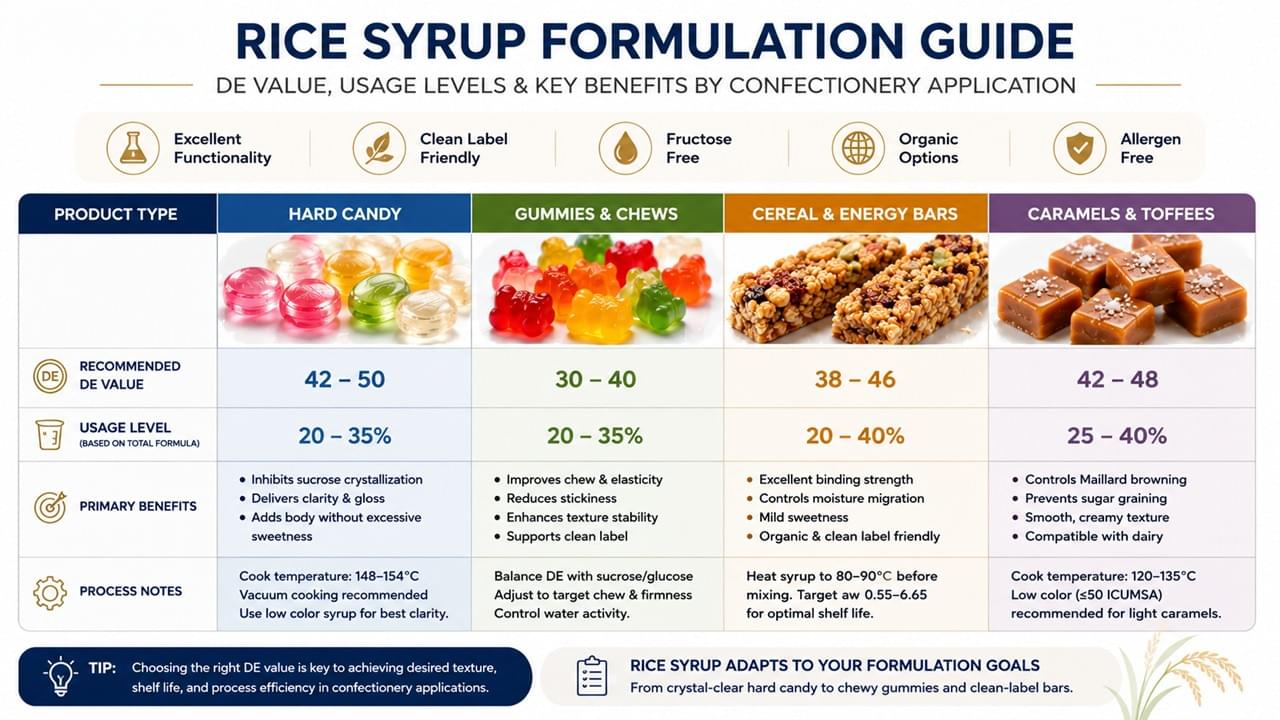
📊 Kurzanleitung für die Anwendung von Reissirup in Süßwaren
| Produkttyp | Empfohlene DE | Nutzungsniveau | Hauptfunktion |
| Hartkaramellen | 42–50 | 20–35% | Kristallsteuerung |
| Gummibärchen | 30–40 | 20–35% | Texturstabilität |
| Müsliriegel | 38–46 | 20–40% | Inhaltsstoffbindung |
| Karamellen | 42–48 | 25–40% | Textur und Bräunung |
| Beschichtungen | 45–55 | 10–25% | Glanz und Haftung |
🚀 Schlussgedanken
Da Süßwarenhersteller weiterhin auf sauberere Etiketten und verbesserte Textursysteme setzen, Anwendungen von Reissirup in Süßwaren werden in der globalen Süßwarenproduktion zunehmend wertvoller.
Von Fruchtgummis und Müsliriegeln bis hin zu Karamell und Bonbons bietet Reissirup zuverlässige Funktionalität und erfüllt gleichzeitig die Erwartungen moderner Verbraucher. Durch die Wahl des richtigen DE-Bereichs und der optimalen Rezeptur können Hersteller die Haltbarkeit, die Konsistenz und die Produktionseffizienz gleichzeitig verbessern.
Für maßgeschneiderte Siruplösungen und technische Unterstützung können sich Hersteller direkt an uns wenden. Die Süßwarenspezialisten von Wuhu Deli Foods.
Eine vollständige Übersicht der Anwendungen finden Sie in unserer Säule 2: Leitfaden für die Anwendung von Reissirup. Für Bäckereianwendungen siehe Reissirup in Bäckerei und Konditorei.


 English
 Deutsch
 Español
 العربية
 Français
 Русский
 Bahasa Indonesia
 한국어
한국어 日本語
日本語 Polski
 Português
 Bahasa Melayu