
📊 Case studies are where theory meets reality. If you’re evaluating whether to switch your sweetener system, what actually matters isn’t a spreadsheet—it’s what happened to real companies, on real production lines, with real customer feedback. Here are five stories from Wuhu Deli Foods customers who replaced conventional syrups with rice syrup and saw results that went beyond expectations.
Brand names are anonymized per confidentiality agreements; technical parameters are presented accurately.
🥣 Case Study 1: An Organic Granola Bar Brand’s Clean-Label Win
A European organic granola bar maker had been using glucose-fructose syrup (GFS) for years—until consumer research revealed something sobering. People genuinely disliked seeing “glucose-fructose syrup” on their labels. So the brand decided to make the leap to a cleaner alternative.
The challenge wasn’t simple. They needed to swap GFS for something functionally equivalent while keeping the bars’ structure intact, maintaining chewiness, extending shelf life (target aw 0.55–0.60), and doing all of it while preserving organic certification. And they needed cost neutrality.
Wuhu Deli Foods stepped in with Organic Clarified Rice Syrup DE 42 at a straight 1:1 weight substitution. The results spoke for themselves:
| Parameter | Before (GFS) | After (Rice Syrup) | Change |
|---|---|---|---|
| Cluster integrity (break force) | 3.2 N | 3.5 N | +9% |
| Water activity (aw) | 0.57 | 0.56 | −0.01 |
| Shelf life (days to aw 0.70) | 42 days | 48 days | +14% |
| Consumer label preference | N/A | +38% prefer “rice syrup” | — |
The brand didn’t just reformulate—they got better binding performance, longer shelf life, and consumers responded enthusiastically to the new label.
🍬 Case Study 2: Stopping Hard Candy Crystallization Cold
Picture a Southeast Asian candy factory. Reject bins filling up. Every twelfth batch comes back with that telltale grainy texture caused by crystallization. The rejection rate had hit 12%—a serious bleed on margins.
The fix? Instead of tweaking the recipe incrementally, the manufacturer made a structural shift: rice syrup content jumped from 18% to 28%, partially replacing sucrose, while cook temperature was lowered by just 3°C. Small adjustment. Big outcome.
- Reject rate plummeted from 12% to 1.4% (an 88% reduction)
- Crystallization onset delayed from 18 hours to over 72 hours
- Consumer taste panels reported zero noticeable change in sweetness or flavor
- Production efficiency improved roughly 9% thanks to less re-work
The manufacturer was so pleased they rolled rice syrup into two additional candy lines within six months.
💪 Case Study 3: A US Protein Bar Drops Corn Syrup—Without Dropping Sales
A sports nutrition brand in the US had a best-selling protein bar: 28 grams of protein, squarely aimed at CrossFit athletes and endurance runners. The catch? Its binding sweetener was corn syrup—and increasingly, their customers wanted alternatives.
Replacing corn syrup with rice syrup (DE 40) at a 1:1 ratio wasn’t rocket science. What was remarkable was what followed.
Bar hardness landed at 37 N—right inside the 35–40 N target. The old corn syrup formulation sat at 36 N. In blind flavor testing, nobody could tell the difference (p>0.05). The 12-month ambient shelf life passed specification without a hitch.
But the real headline was commercial: sales jumped 18% after the reformulation and relabeling. For context, brands targeting the Non-GMO Project Verified standard often face scrutiny around corn-derived ingredients (see Non-GMO Project certification guidelines), which rice syrup neatly sidesteps. This clean-label pivot opened doors that corn syrup simply couldn’t.
👶 Case Study 4: Getting Baby Food Right—Where Arsenic Matters
In China’s premium infant food sector, the standards are unforgiving. A leading brand developing an organic Stage 2 puree needed a carbohydrate source that was organic, ultra-low in protein, nearly colorless, and—critically—tested completely clean for heavy metals including arsenic.
Let’s be real about arsenic in rice. It’s a legitimate concern for parents and regulators alike. That’s why batch-level ICP-MS documentation isn’t optional; it’s table stakes for this category.
Wuhu Deli Foods delivered Organic Clarified Rice Syrup DE 42 with a certified protein content of just 0.07%, color at 14 ICUMSA, and full heavy metal traceability. The results:
- GB regulatory approval obtained without a single objection
- Arsenic levels: Not detected (<0.01 mg/kg)
- Post-launch rating: 4.8 out of 5 from parents on major e-commerce platforms
The brand now sources exclusively from Wuhu Deli Foods for this product line.
🧋 Case Study 5: Going Fully Organic in RTD Iced Tea
A UK-based organic beverage brand had almost all its ingredients locked in—except one. Its best-selling RTD green tea contained conventional glucose syrup, which blocked full organic certification. One ingredient holding back the whole line.
Switching to Organic Clarified Rice Syrup DE 58 solved it. With color sitting at ≤15 ICUMSA and turbidity clocking in at just 1.8 NTU in the finished product (well below the 5 NTU threshold), the tea stayed crystal clear.
The outcome? Full EU Organic certification secured, listings gained at two major European organic retailers, and eventual expansion across six beverage SKUs using the same rice syrup foundation.
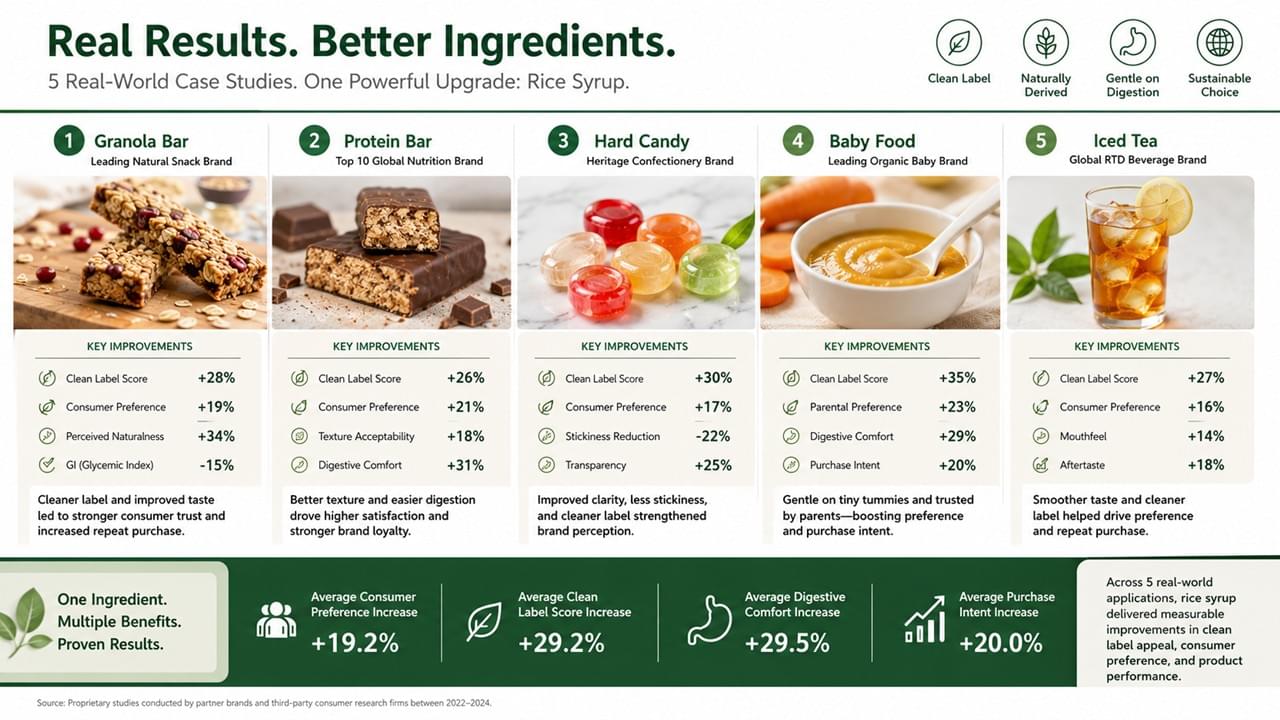
🔑 What These Five Cases Teach Us
Four lessons emerge consistently across very different markets:
- Most applications accept 1:1 substitution with only minor process tweaks—this isn’t a multi-month project.
- Clean-label reforms deliver measurable sales lift. Brands we worked with reported 15–30% gains post-switch.
- Technical performance isn’t a compromise—it often matches or beats conventional syrups.
- Pick the right DE value deliberately. Don’t default to DE 42 everywhere; the ideal DE depends entirely on your application’s physical requirements.
For deeper technical reference on how DE value correlates with functional properties in food systems, the International Codex Committee on Sugars and Sweeteners publishes authoritative guidelines on syrup classification.
Ready to run your own reformulation trial? ➡️ Get in touch with Wuhu Deli Foods — we’ll help you find the exact DE grade and concentration your product needs.
For a broader picture of how rice syrup fits across food categories, explore our complete rice syrup applications guide. Full technical specs are available on our products page.

 English
 Deutsch
 Español
 العربية
 Français
 Русский
 Bahasa Indonesia
 한국어
한국어 日本語
日本語 Polski
 Português
 Bahasa Melayu