
As international food supply chains continue to expand, International Quality Standards for Rice Syrup have become a key benchmark for manufacturers, distributors, and procurement teams. Whether you’re purchasing rice syrup for confectionery, beverages, dairy, or bakery applications, understanding globally recognized quality systems helps reduce sourcing risks, ensure regulatory compliance, and maintain consistent product performance.
🌍 International standards developed by organizations such as the Codex Alimentarius Commission, ISO, and the Global Food Safety Initiative (GFSI) provide a common language for food safety and quality management. Buyers who understand these frameworks are better equipped to evaluate suppliers, compare certifications, and make informed purchasing decisions.
In this guide, we’ll explain the most widely recognized standards governing rice syrup production, what they mean for international buyers, and how they support safer, more reliable global sourcing.
🌍 Understanding International Quality Standards for Rice Syrup
International food standards are designed to harmonize safety requirements across different countries while promoting fair trade and protecting consumers. For rice syrup manufacturers, compliance with these standards demonstrates that production follows recognized food safety practices rather than relying solely on local regulations.
A qualified supplier should not only produce consistent-quality syrup but also operate under independently audited management systems. This gives buyers greater confidence in product safety, traceability, and long-term supply reliability.
Today, most multinational food manufacturers evaluate suppliers based on internationally accepted certifications rather than regional standards alone, making compliance a significant competitive advantage.
📖 International Quality Standards for Rice Syrup Under Codex Alimentarius
The Codex Alimentarius Commission (CAC), jointly established by the Food and Agriculture Organization (FAO) and the World Health Organization (WHO), develops internationally recognized food standards that serve as the foundation for many national regulations and international trade agreements.
You can learn more about Codex on the official website:
https://www.fao.org/fao-who-codexalimentarius/
Codex Stan 212-1999 — Standard for Sugars
For starch-derived sweeteners such as rice syrup, Codex Stan 212-1999 provides fundamental quality requirements that support consistency across international markets.
📌 Typical quality parameters include:
- Dry matter content of 70% or higher
- Sulfur dioxide (SO₂) limited to 20 mg/kg or less(premium rice syrup is typically sulfur-free)
- Defined color classifications for different syrup grades
- Proper product labeling, including the declared DE (Dextrose Equivalent) range
These standardized requirements help simplify product evaluation while reducing misunderstandings between buyers and suppliers in cross-border transactions.
Why Codex Matters for International Buyers
Codex standards are widely referenced by WTO member countries and frequently incorporated into local food legislation. As a result, sourcing rice syrup that aligns with Codex recommendations provides a stronger foundation for exporting products into multiple international markets.
Rather than replacing local regulations, Codex creates a globally accepted baseline that supports smoother international trade and greater regulatory consistency.
🛡️ International Quality Standards for Rice Syrup Through HACCP Principles
Food safety cannot rely solely on finished-product testing. Instead, modern quality management emphasizes preventive controls throughout the manufacturing process.
Codex’s CAC/RCP 1-1969 General Principles of Food Hygiene incorporates the globally recognized HACCP methodology, which focuses on identifying and controlling potential hazards before they become food safety risks.
For rice syrup manufacturers, HACCP typically includes:
✅ Raw material inspection
✅ Process temperature monitoring
✅ Equipment sanitation
✅ Cross-contamination prevention
✅ Finished product verification
Because HACCP principles form the basis of nearly every modern food safety certification, buyers often view effective HACCP implementation as a minimum expectation when qualifying international suppliers.
🏭 International Quality Standards for Rice Syrup with ISO 22000:2018
Among all food safety management systems, ISO 22000:2018 remains one of the most widely recognized certifications for food ingredient manufacturers.
The official ISO overview is available here:
https://www.iso.org/iso-22000-food-safety-management.html
Unlike product-specific regulations, ISO 22000 evaluates how an organization systematically manages food safety throughout its operations.
Its framework integrates three essential components:
- 🔍 HACCP-based hazard analysis
- ⚙️ Prerequisite Programs (PRPs) for operational hygiene
- 📊 Continuous management system improvement
Together, these elements create a comprehensive food safety management system that extends from supplier qualification through production, storage, and customer communication.
Benefits of ISO 22000 Certification
For procurement teams, ISO 22000 certification provides more than a certificate—it offers independent evidence that a manufacturer follows internationally recognized food safety practices.
Key advantages include:
- Reduced supplier assessment risk
- Consistent food safety management across production
- Better traceability throughout the supply chain
- Stronger confidence in regulatory compliance
- Increased acceptance by international food manufacturers
Many multinational food companies include ISO 22000 as a basic qualification requirement during supplier approval because it demonstrates a structured and continuously monitored management system.
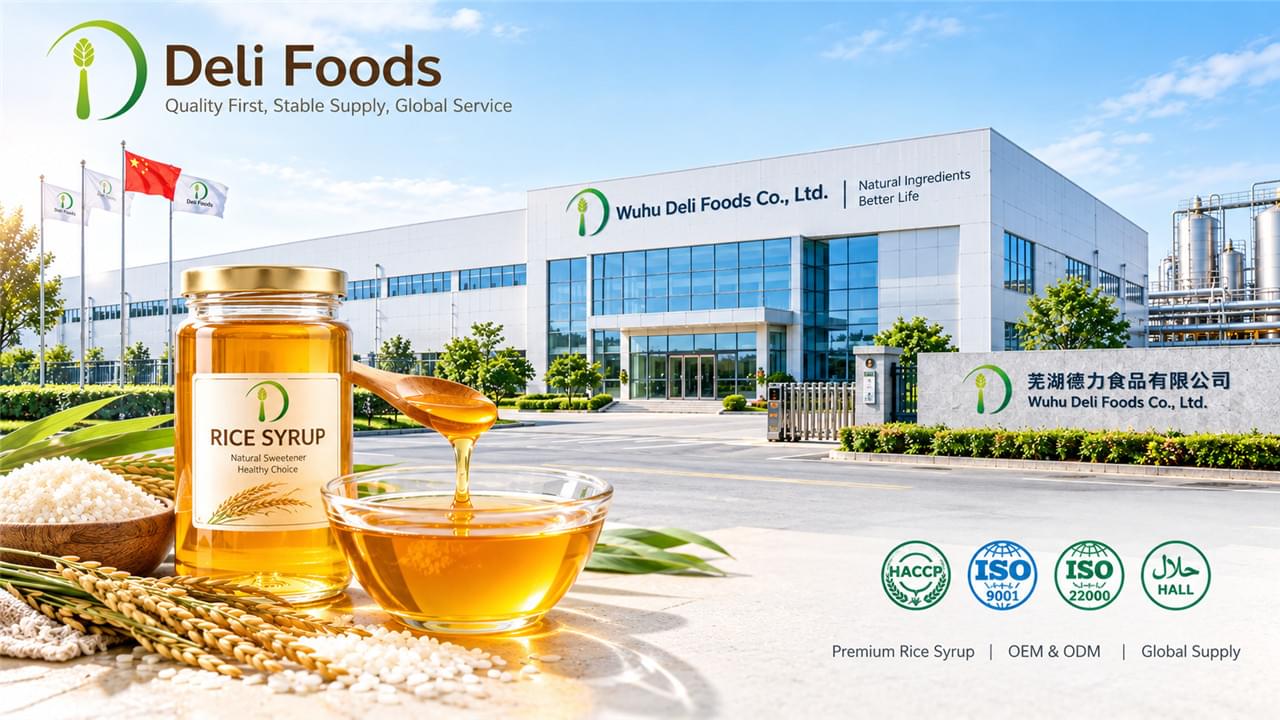
Companies such as Wuhu Deli Foods operate under ISO 22000-certified food safety systems and undergo regular third-party surveillance audits to ensure continued compliance with international requirements.
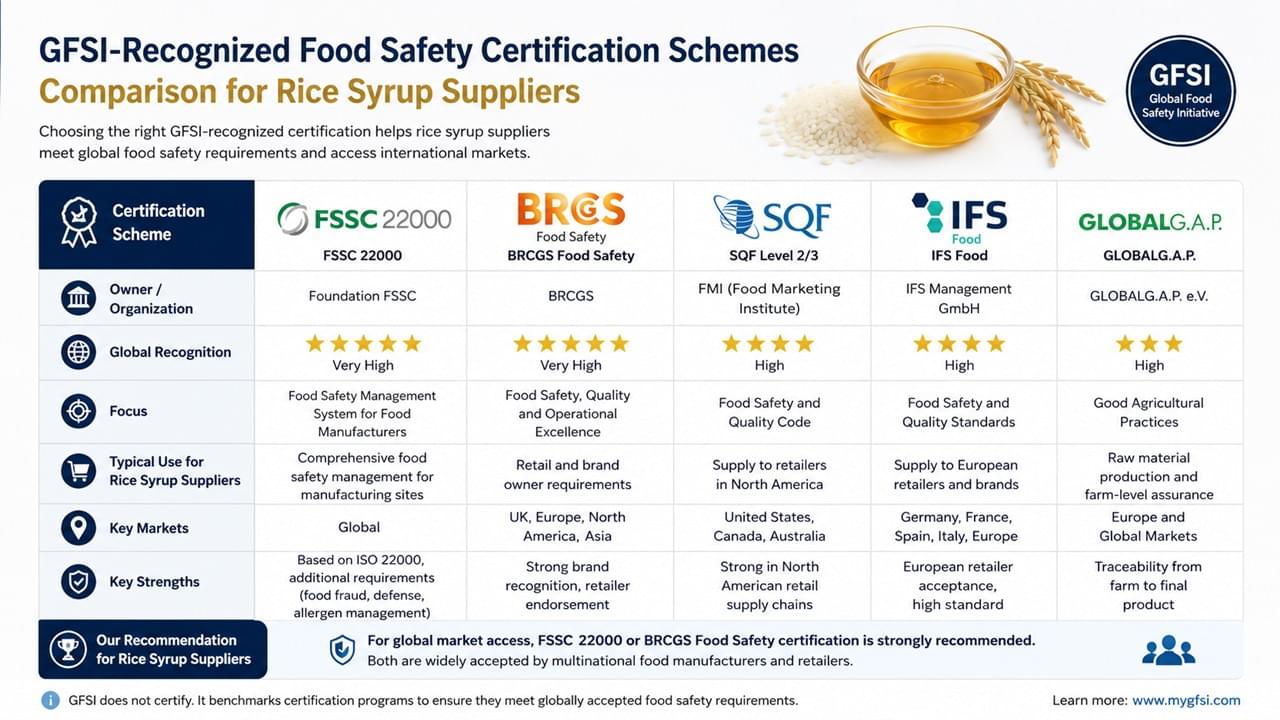
🌟 FSSC 22000: The Premium International Quality Standards for Rice Syrup
For suppliers aiming to serve multinational food brands, FSSC 22000 is widely regarded as one of the highest levels of food safety certification. Built upon ISO 22000, it introduces additional requirements that strengthen risk management throughout the production process.
FSSC 22000 is recognized by the Global Food Safety Initiative (GFSI), making it a preferred certification for many leading food manufacturers around the world.
Unlike ISO 22000 alone, FSSC 22000 places greater emphasis on operational controls, food fraud prevention, food defense, and continuous improvement—areas that have become increasingly important in today’s global food supply chain.
📌 What Makes FSSC 22000 Different?
FSSC 22000 combines several internationally recognized requirements into one comprehensive certification system, including:
- ✅ ISO 22000 Food Safety Management System
- ✅ ISO/TS 22002-1 Prerequisite Programs for Food Manufacturing
- ✅ Additional requirements covering:
- Food fraud prevention
- Food defense
- Allergen management
- Product traceability
- Quality culture and continuous improvement
These additional controls provide buyers with greater assurance that a supplier can consistently meet international expectations while proactively managing emerging food safety risks.
For many global procurement teams, FSSC 22000 demonstrates a supplier’s commitment to operating beyond minimum regulatory requirements.
🌍 International Quality Standards for Rice Syrup and GFSI-Recognized Certifications
The Global Food Safety Initiative (GFSI) does not issue certifications directly. Instead, it benchmarks and recognizes food safety certification programs that meet globally accepted requirements.
More information is available from the official GFSI website:
For buyers sourcing rice syrup internationally, choosing a supplier certified under a GFSI-recognized scheme helps simplify supplier approval while reducing audit complexity across multiple markets.
📊 Comparison of Major GFSI-Recognized Certification Schemes
| Certification | Organization | Global Recognition | Typical Markets |
| FSSC 22000 | Foundation FSSC | ⭐⭐⭐⭐⭐ | Global |
| BRCGS Food Safety | BRCGS | ⭐⭐⭐⭐⭐ | UK, Europe, North America |
| SQF Level 2 & 3 | FMI | ⭐⭐⭐⭐ | United States, Australia |
| IFS Food | IFS Management GmbH | ⭐⭐⭐⭐ | Germany, France, Spain |
| GLOBALG.A.P. | GLOBALG.A.P. | ⭐⭐⭐ | Agricultural Supply Chains |
Among these options, FSSC 22000 and BRCGS Food Safety are generally the most widely accepted certifications for manufacturers supplying multinational food companies. Their broad international recognition can streamline supplier qualification and reduce duplicate customer audits.
🔬 International Quality Standards for Rice Syrup Quality Parameters
International certifications establish management systems, but buyers also need measurable product specifications. A well-defined quality specification ensures every shipment consistently meets application requirements.
🧪 Physical Characteristics
Physical testing confirms that rice syrup maintains the appearance and functional properties required for food manufacturing.
Typical parameters include:
- ✔️ Clear to light amber appearance
- ✔️ Free from visible foreign matter
- ✔️ Solids content typically between 75–85° Brix
- ✔️ Consistent viscosity suitable for the intended application
Stable physical properties help manufacturers achieve reliable processing performance in products such as beverages, confectionery, bakery fillings, and dairy formulations.
⚗️ Chemical Specifications
Chemical analysis verifies that rice syrup performs consistently across different production batches.
Common specifications include:
- ✔️ DE (Dextrose Equivalent) tailored to customer requirements, typically 30–65
- ✔️ pH generally ranging from 0 to 5.5
- ✔️ Color measured using the ICUMSAmethod
- ✔️ Sulfur dioxide typically Not Detected (ND)in modern premium production
For many food manufacturers, maintaining consistent DE values is particularly important because it directly influences sweetness, viscosity, crystallization behavior, and processing characteristics.
🦠 Microbiological Requirements
Microbiological testing confirms that rice syrup is produced under hygienic conditions and is suitable for food manufacturing.
Typical acceptance criteria include:
- ✔️ Total Plate Count below 100 CFU/g
- ✔️ Yeast and Mold below 10 CFU/g
- ✔️ Coliforms below 3 MPN/g
- ✔️ Pathogens such as Salmonellaand Listeria absent in 25 g samples
Routine laboratory testing, combined with preventive process controls, helps ensure product safety while minimizing the risk of contamination throughout production and distribution.
📝 Best Practices for Writing Rice Syrup Purchase Specifications
A detailed purchasing specification helps both buyers and suppliers establish clear quality expectations before production begins.
To improve consistency and reduce potential disputes, consider including the following information in every procurement document:
📌 Reference the applicable international standard
For example, specify compliance with Codex Stan 212-1999 or another recognized standard relevant to starch-derived syrups.
📌 Define the required DE range
Rather than requesting only “rice syrup,” include a precise specification such as DE 42 ±2 to ensure consistent functional performance.
📌 Specify color requirements
Include acceptable ICUMSA values or another recognized testing method appropriate for your application.
📌 State microbiological acceptance criteria
Clearly define microbial limits based on your target market or internal quality requirements.
📌 Request GFSI-recognized certification
Supplier certification provides independent verification that food safety management systems are effectively implemented and maintained.
📌 Require a Certificate of Analysis (COA)
A batch-specific COA allows buyers to verify critical quality parameters before goods are accepted or incorporated into production.
Well-defined specifications reduce misunderstandings, improve communication, and support long-term supplier relationships.
✅ Conclusion
As global food manufacturing continues to evolve, International Quality Standards for Rice Syrup have become essential for ensuring product consistency, food safety, and regulatory compliance across international markets.
Frameworks such as Codex Alimentarius, ISO 22000, and GFSI-recognized certification schemes provide a reliable foundation for evaluating suppliers and reducing procurement risk. By selecting manufacturers that operate under internationally recognized management systems and provide comprehensive product specifications, buyers can improve supply chain transparency while maintaining consistent product quality.
Whether you are sourcing rice syrup for beverages, bakery products, confectionery, dairy applications, or nutritional products, choosing a certified supplier is an investment in long-term quality, safety, and business reliability.
To learn more about our certifications, quality management system, and customized rice syrup solutions, please visit https://www.delisyrup.com/contact/ or contact our technical team for additional product specifications and documentation.

 English
 Deutsch
 Español
 العربية
 Français
 Русский
 Bahasa Indonesia
 한국어
한국어 日本語
日本語 Polski
 Português
 Bahasa Melayu