
Seiring industri pangan global terus berkembang, Standar Kualitas Sirup Beras telah menjadi faktor penting bagi produsen, distributor, dan pembeli internasional. Baik Anda mencari sirup beras untuk minuman, kembang gula, nutrisi bayi, atau makanan olahan, memenuhi persyaratan peraturan tidak lagi opsional—ini penting untuk akses pasar, kepercayaan konsumen, dan kesuksesan bisnis jangka panjang.
🌍 Setiap pasar tujuan menerapkan kerangka hukumnya sendiri untuk keamanan pangan, pelabelan, batas kontaminan, dan praktik produksi. Pada saat yang sama, sertifikasi yang diakui secara internasional memberikan jaminan tambahan bahwa pemasok mempertahankan manajemen mutu dan kontrol manufaktur yang konsisten.
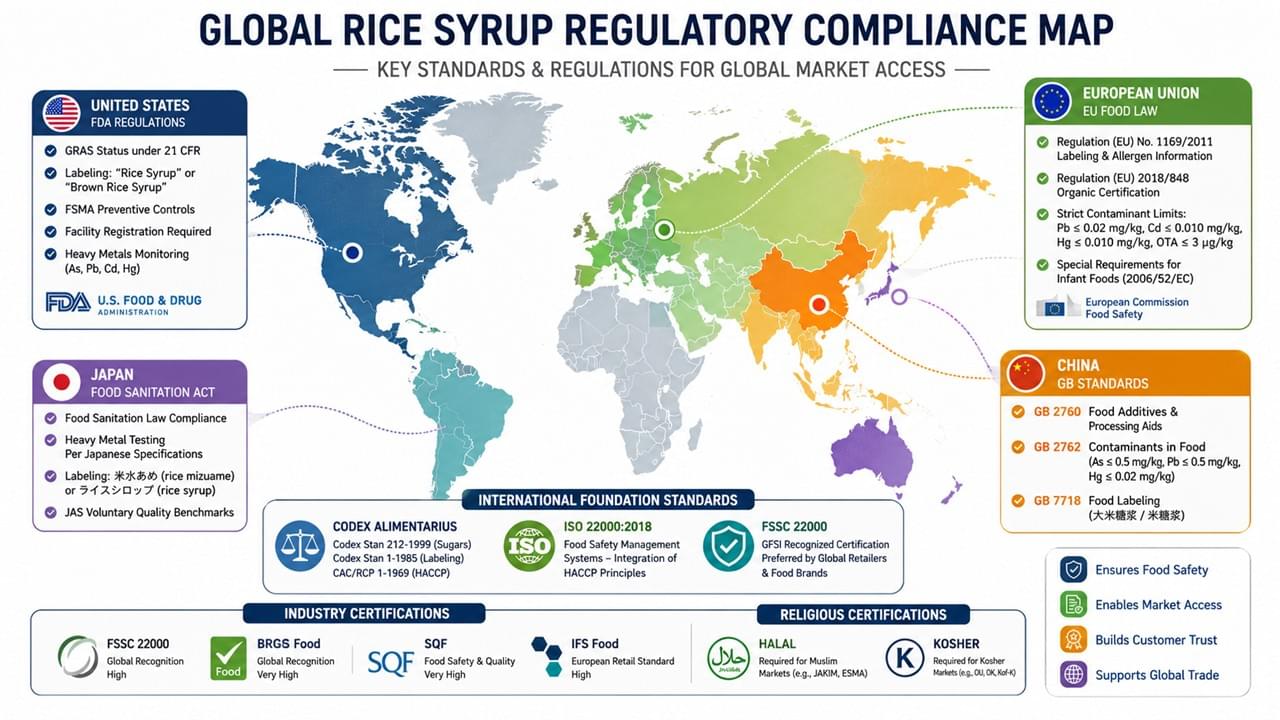
Panduan ini menjelaskan standar kualitas utama yang mengatur sirup beras di seluruh dunia, termasuk peraturan di Amerika Serikat, Uni Eropa, Tiongkok, dan Jepang. Anda juga akan mempelajari sertifikasi apa yang umum diminta oleh pembeli, dokumentasi yang diperlukan untuk perdagangan internasional, dan rekomendasi praktis untuk mengevaluasi pemasok dengan percaya diri.
🌍 Memahami Kerangka Kerja Global untuk Standar Kualitas Sirup Beras
Meskipun peraturan pangan berbeda dari satu negara ke negara lain, sebagian besar otoritas memiliki tujuan yang sama: melindungi konsumen dengan memastikan bahan pangan aman, diberi label secara akurat, dan diproduksi secara konsisten.
Bagi pemasok sirup beras, kepatuhan biasanya melampaui satu peraturan. Perusahaan harus menunjukkan kesesuaian dengan berbagai lapisan persyaratan, termasuk:
- ✅ Prinsip keamanan pangan internasional
- ✅ Hukum pangan nasional
- ✅ Sertifikasi manufaktur
- ✅ Standar pengujian produk
- ✅ Spesifikasi kualitas khusus pelanggan
Memahami bagaimana kerangka kerja ini bekerja sama membantu bisnis mengurangi risiko peraturan sambil meningkatkan keandalan rantai pasokan.
🌎 Codex Alimentarius: Tolok Ukur Internasional
Salah satu referensi yang paling dikenal luas untuk keamanan pangan global adalah Kodeks Alimentarius, yang didirikan bersama oleh Organisasi Pangan dan Pertanian (FAO) dan Organisasi Kesehatan Dunia (WHO). Standar Codex tidak mengikat secara hukum, tetapi sangat memengaruhi peraturan pangan dan kebijakan perdagangan internasional di seluruh dunia.
Bagi produsen sirup beras, beberapa dokumen Codex memberikan panduan berharga.
✅ Standar Codex yang Relevan dengan Sirup Beras
- Codex STAN 212-1999 — Covers glucose syrups and starch-derived sweeteners.
- Codex STAN 1-1985 — Defines general labeling requirements for pre-packaged foods.
- CAC/RCP 1-1969 — Establishes internationally accepted Good Hygiene Practices and HACCP principles.
Many national authorities use these documents as references when developing their own food regulations, making Codex compliance an important consideration for exporters.
💡 You can explore the complete Codex database here:
https://www.fao.org/fao-who-codexalimentarius/
🏭 Sistem Manajemen Keamanan Pangan ISO
While government regulations define legal requirements, certification standards help manufacturers demonstrate that those requirements are consistently implemented.
Among the most recognized systems is ISO 22000:2018, which integrates food safety management with Hazard Analysis and Critical Control Points (HACCP). Rather than focusing only on product testing, ISO 22000 emphasizes preventive risk management throughout production.
Key benefits include:
- ✔ Better traceability throughout manufacturing
- ✔ Improved risk assessment procedures
- ✔ Stronger supplier management
- ✔ Continuous quality improvement
- ✔ Greater confidence for international customers
For buyers evaluating multiple suppliers, ISO certification often serves as an important indicator of operational maturity and quality consistency.
🏆 Mengapa FSSC 22000 Penting
Many multinational food companies require suppliers to hold FSSC 22000 certification because it expands upon ISO 22000 with additional food safety controls recognized by the Global Food Safety Initiative (GFSI).
Compared with standard management certification, FSSC 22000 offers greater assurance that production facilities maintain internationally accepted food safety practices.
Manfaatnya meliputi:
- 🌍 Recognition across major international markets
- 🏭 Strong acceptance among global food brands
- 📋 Enhanced risk management systems
- 🔍 Independent third-party audits
- 🤝 Increased confidence during supplier qualification
For businesses exporting rice syrup to multiple countries, FSSC 22000 can significantly simplify customer approval processes.
🇺🇸 Standar Kualitas Sirup Beras di Amerika Serikat
The United States remains one of the world’s largest food ingredient markets, with regulatory oversight provided primarily by the U.S. Food and Drug Administration (FDA).
Companies exporting rice syrup to the U.S. should understand not only ingredient safety requirements but also facility registration, preventive controls, and labeling obligations.
✅ Status GRAS dan Keamanan Pangan
Rice syrup produced through enzymatic hydrolysis of rice starch is generally considered Generally Recognized As Safe (GRAS) when manufactured using accepted food processing methods.
However, GRAS status does not eliminate regulatory responsibilities. Manufacturers are still expected to implement preventive food safety systems under the Food Safety Modernization Act (FSMA) and maintain comprehensive production records.
Facilities exporting food ingredients to the United States must also register with the FDA before shipping products.
More information is available from the official FDA website:
https://www.fda.gov/
🏷️ Persyaratan Pelabelan FDA
Proper labeling is essential for regulatory compliance and smooth customs clearance.
Under FDA labeling rules, rice syrup should:
- ✅ Be declared using its common or usual name, such as “Rice Syrup” or “Brown Rice Syrup.”
- ✅ Appear in ingredient lists according to weight.
- ✅ Meet applicable nutrition labeling requirements.
- ✅ Support any organic claims with valid USDA Organic certification.
Accurate labeling not only fulfills legal obligations but also helps buyers verify product authenticity and maintain transparent supply chains.
⚠️ Pemantauan Logam Berat
Because rice naturally absorbs minerals from soil and water, international buyers increasingly pay attention to heavy metal testing.
Responsible manufacturers routinely monitor:
- Arsenik
- Memimpin
- Kadmium
- Air raksa
Advanced analytical methods such as ICP-MS (Inductively Coupled Plasma Mass Spectrometry) provide highly accurate detection of trace contaminants, allowing manufacturers to verify compliance with destination-market limits before shipment.
For products intended for infant nutrition or other sensitive applications, testing frequencies are often higher, with many buyers requesting batch-specific analytical reports instead of annual summaries.
🇪🇺 Standar Kualitas Sirup Beras di Uni Eropa
The European Union maintains one of the world’s most comprehensive food safety systems. Businesses exporting rice syrup to EU member states must comply with regulations covering ingredient safety, contaminant limits, traceability, labeling, and production practices.
Unlike some markets that focus primarily on finished-product testing, the EU emphasizes preventive food safety management throughout the entire supply chain. As a result, manufacturers should be prepared to provide detailed technical documentation alongside laboratory reports.
🏷️ Persyaratan Pelabelan UE
Clear and accurate labeling is essential for entering the European market.
Depending on the product formulation, rice syrup may be declared as:
- ✅ Rice Syrup
- ✅ Glucose Syrup (from Rice)
When the syrup is produced exclusively from rice, it is generally not considered one of the allergens listed under EU Regulation (EU) No. 1169/2011, making it suitable for many allergen-conscious formulations. However, manufacturers should always verify labeling requirements based on the final product and destination country.
For organic products, suppliers must also comply with Regulation (EU) 2018/848, which governs organic production and certification across the European Union.
⚠️ Batas Kontaminan dan Keamanan Produk
European authorities apply strict limits to contaminants commonly monitored in cereal-derived ingredients.
Typical quality control programs include testing for:
- Memimpin
- Kadmium
- Air raksa
- Arsenik
- Mycotoxins such as Ochratoxin A
Manufacturers supplying infant foods or products intended for vulnerable consumer groups are usually expected to meet even tighter purity requirements and maintain enhanced production controls.
Regular third-party laboratory testing helps demonstrate compliance while strengthening buyer confidence during supplier qualification.
🇨🇳 Standar GB Tiongkok untuk Sirup Beras
China’s national food safety system is built around the GB (Guobiao) standards, which establish mandatory requirements for food production, processing, labeling, and contaminant control.
For rice syrup manufacturers operating in or exporting from China, compliance with the applicable GB standards is a fundamental requirement for legal production and international trade.
📋 Standar GB Utama
Several national standards are particularly relevant to rice syrup production.
✅ GB 2760 — Aditif Pangan dan Bahan Pembantu Pengolahan
This standard specifies which processing aids may be used during manufacturing, including food-grade enzymes, activated carbon, and ion exchange resins.
Using approved processing materials helps ensure both product safety and regulatory compliance.
✅ GB 2762 — Batas Kontaminan
GB 2762 establishes maximum allowable levels for contaminants such as:
- Heavy metals
- Arsenik
- Memimpin
- Air raksa
- Kadmium
Routine monitoring ensures products remain within legal limits before entering domestic or export markets.
✅ GB 7718 — Pelabelan Pangan
Rice syrup sold in China must follow Chinese labeling requirements, including standardized product names, ingredient declarations, production information, and other mandatory labeling elements.
Accurate labeling not only supports compliance but also improves product traceability throughout the supply chain.
🇯🇵 Persyaratan Sanitasi Pangan Jepang
Japan is recognized for maintaining exceptionally high food safety expectations. Importers often conduct detailed supplier evaluations before approving new ingredients.
For rice syrup, manufacturers should pay close attention to:
- ✅ Heavy metal testing
- ✅ Food hygiene controls
- ✅ Product traceability
- ✅ Proper Japanese labeling
- ✅ Consistent quality documentation
Although the Japanese Agricultural Standards (JAS) certification is voluntary for many products, obtaining recognized certifications can strengthen market competitiveness and demonstrate a commitment to quality.
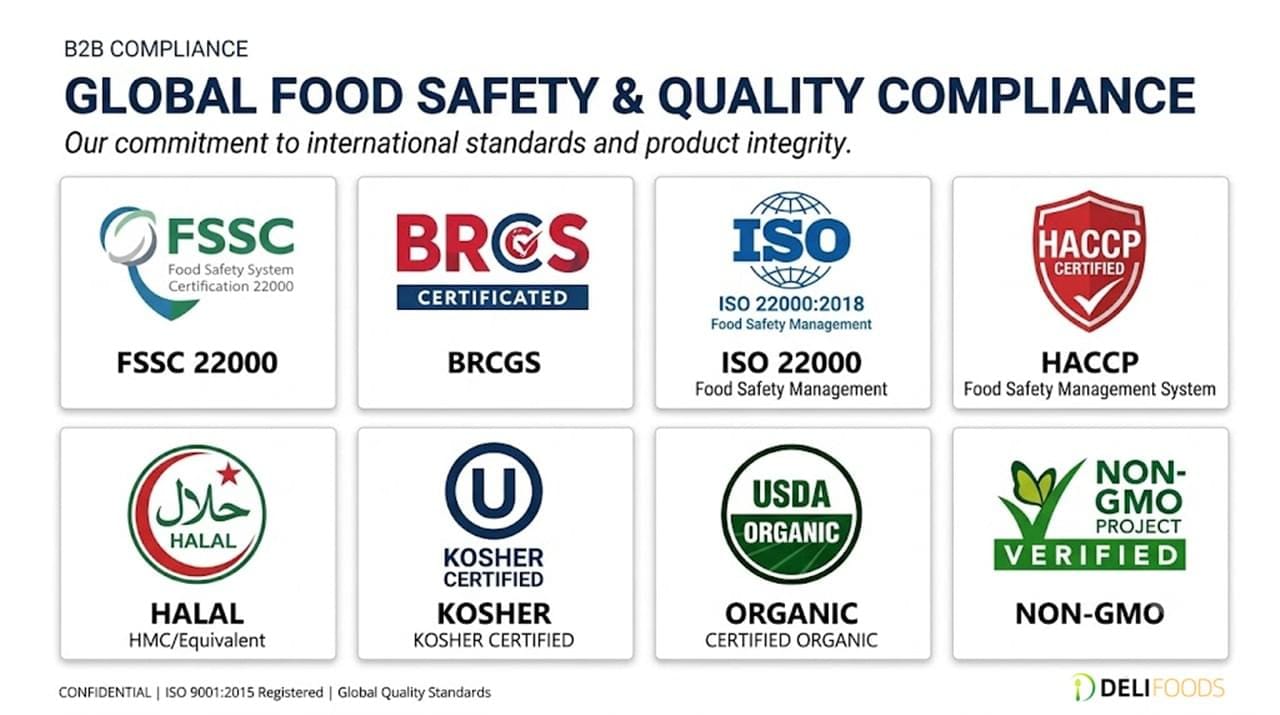
🏅 Sertifikasi Industri yang Paling Dihargai Pembeli
Beyond legal compliance, internationally recognized certifications often play a decisive role in supplier selection.
Large food manufacturers and global brands frequently require suppliers to maintain certifications that verify robust food safety management systems.
Commonly requested certifications include:
| Certification | Primary Purpose | Market Recognition |
|---|---|---|
| FSSC 22000 | Food Safety Management | Excellent |
| ISO 22000 | Food Safety System | Excellent |
| BRCGS Food | Manufacturing Compliance | Sangat Tinggi |
| SQF | Food Safety & Quality | Sangat Tinggi |
| IFS Food | European Retail Supply | Tinggi |
Holding one or more of these certifications demonstrates that a manufacturer follows internationally accepted practices, undergoes regular third-party audits, and maintains continuous improvement programs.
🌍 Sertifikasi Halal dan Kosher
For companies serving global markets, religious certifications can significantly expand business opportunities.
☪️ Sertifikasi Halal
Halal certification is often required when exporting to Muslim-majority countries or supplying food manufacturers that produce Halal-certified products.
Certification confirms that raw materials, processing methods, and manufacturing environments comply with Islamic dietary requirements.
✡️ Sertifikasi Kosher
Kosher certification is widely recognized beyond Jewish communities and is frequently requested by multinational food companies because it reflects rigorous ingredient verification and production controls.
Maintaining current Halal and Kosher certificates can help suppliers access a broader international customer base while simplifying procurement approvals.
📊 Kerangka Spesifikasi Kualitas yang Direkomendasikan
While regulatory requirements establish minimum legal standards, experienced buyers often develop their own technical specifications to ensure consistent product performance.
A comprehensive rice syrup specification typically includes the following categories.
🔬 Sifat Fisik
- Appearance: Clear to light amber
- No visible foreign matter
- Soluble solids (Brix): 78–82°
- Viscosity appropriate for the specified DE value
⚗️ Karakteristik Kimia
- Controlled DE value within agreed tolerances
- pH between 4.0 and 5.5
- Consistent color values
- Low protein and ash content according to product grade
These parameters help maintain stable sweetness, texture, and processing performance across different food applications.
🛡️ Persyaratan Mikrobiologis dan Keamanan
Routine testing should include:
- Total jumlah piring
- Ragi dan Jamur
- Salmonella
- Escherichia coli O157:H7
- Heavy metals
Consistent microbiological control helps protect product quality throughout storage and transportation while reducing food safety risks.
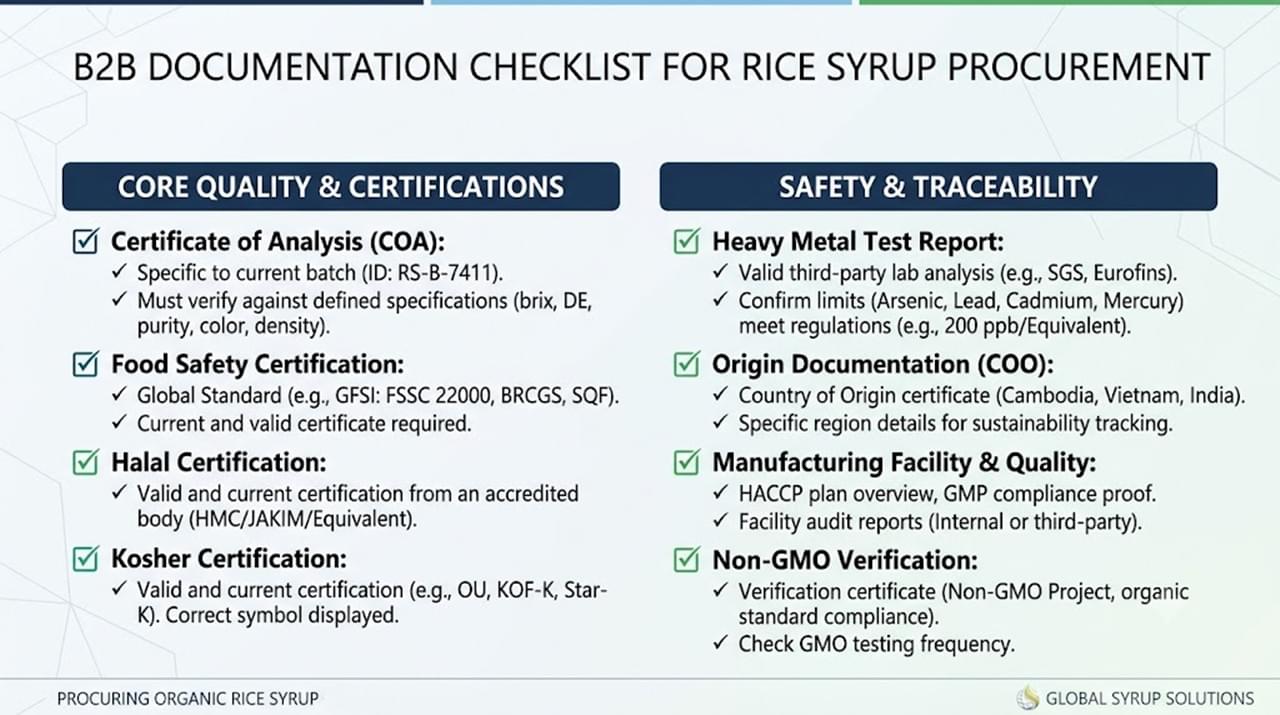
📄 Dokumentasi Penting untuk Pasokan B2B Internasional
Reliable documentation is just as important as product quality itself. Before approving a supplier, buyers typically request a complete compliance package that verifies regulatory conformity and manufacturing standards.
Key documents commonly required include:
- 📑 Certificate of Analysis (COA) for each production batch
- 🏭 Valid ISO 22000 or GFSI-recognized food safety certificate
- ☪️ Halal certificate (when applicable)
- ✡️ Kosher certificate (when applicable)
- 🌱 Organic certificate for certified organic grades
- 🧪 Heavy metal testing reports
- 🌍 Certificate of Origin and export documentation
Providing these documents promptly helps streamline procurement, customs clearance, and customer audits while reinforcing confidence in the supplier’s quality management system.
💡 Tips Ahli untuk Memilih Pemasok Sirup Beras yang Andal
Meeting regulatory requirements is only one aspect of supplier evaluation. Experienced buyers also consider a manufacturer’s technical expertise, production consistency, and long-term reliability.
When comparing potential suppliers, consider the following questions:
- ✅ Does the supplier maintain internationally recognized certifications?
- ✅ Are laboratory reports available for every production batch?
- ✅ Can the supplier support country-specific regulatory requirements?
- ✅ Is there a clear traceability system from raw materials to finished products?
- ✅ Does the supplier provide responsive technical support and documentation?
A supplier that can confidently answer these questions is generally better positioned to support stable, long-term business partnerships and reduce compliance risks.
📌 Pemikiran Akhir
Navigating Standar Kualitas Sirup Beras requires more than simply meeting minimum legal requirements. Successful international suppliers combine regulatory compliance with robust quality management systems, transparent documentation, and continuous product verification.
As food safety regulations continue to evolve, staying informed about FDA requirements, EU legislation, China GB standards, and internationally recognized certification schemes will help businesses reduce risk and strengthen their competitiveness in global markets.
Whether you are sourcing rice syrup for food manufacturing, private-label products, or international distribution, choosing a supplier with proven compliance capabilities is one of the most effective ways to protect product quality and ensure long-term success.
For additional guidance on internationally recognized food safety management systems, visit the official ISO 22000 resource:
https://www.iso.org/iso-22000-food-safety-management.html
📞 Ajukan Dokumentasi Kepatuhan Lengkap
If you need detailed technical information for your sourcing project, our team can provide comprehensive documentation to support supplier qualification, product evaluation, and regulatory review.
Our compliance package is available upon request and may include:
- 📄 Batch-specific Certificates of Analysis (COAs)
- 🏅 Food safety certification documents
- 🧪 Heavy metal testing reports
- 🌱 Organic, Halal, and Kosher certificates (where applicable)
- 🌍 Country of Origin documentation
- 📋 Technical specifications and product data sheets
👉 Request Full Compliance Documentation from Wuhu Deli Foods →
https://www.delisyrup.com/contact/
To learn more about our certification programs, visit our Rice Syrup Food Safety Certifications guide.
For detailed information on contaminant analysis, see our Arsenic & Heavy Metal Testing Guide.
 English
 Deutsch
 Español
 العربية
 Français
 Русский
 Bahasa Indonesia
 한국어
한국어 日本語
日本語 Polski
 Português
 Bahasa Melayu