
世界の食品産業が拡大を続けるにつれて、, 米シロップの品質基準 は、製造業者、流通業者、国際的なバイヤーにとって重要な要素となっています。飲料、菓子、乳幼児栄養、加工食品のいずれの米シロップを調達する場合でも、規制要件を満たすことはもはや任意ではなく、市場へのアクセス、消費者の信頼、長期的なビジネスの成功に不可欠です。.
🌍 すべての仕向け地市場は、食品安全、表示、汚染物質の制限、製造慣行に関して独自の法的枠組みを適用しています。同時に、国際的に認められた認証は、サプライヤーが一貫した品質管理と製造管理を維持していることをさらに保証します。.
このガイドでは、米国、欧州連合、中国、日本の規制を含む、世界中の米シロップを管理する主要な品質基準について説明します。また、バイヤーが一般的に要求する認証、国際貿易に必要な書類、自信を持ってサプライヤーを評価するための実践的な推奨事項についても説明します。.
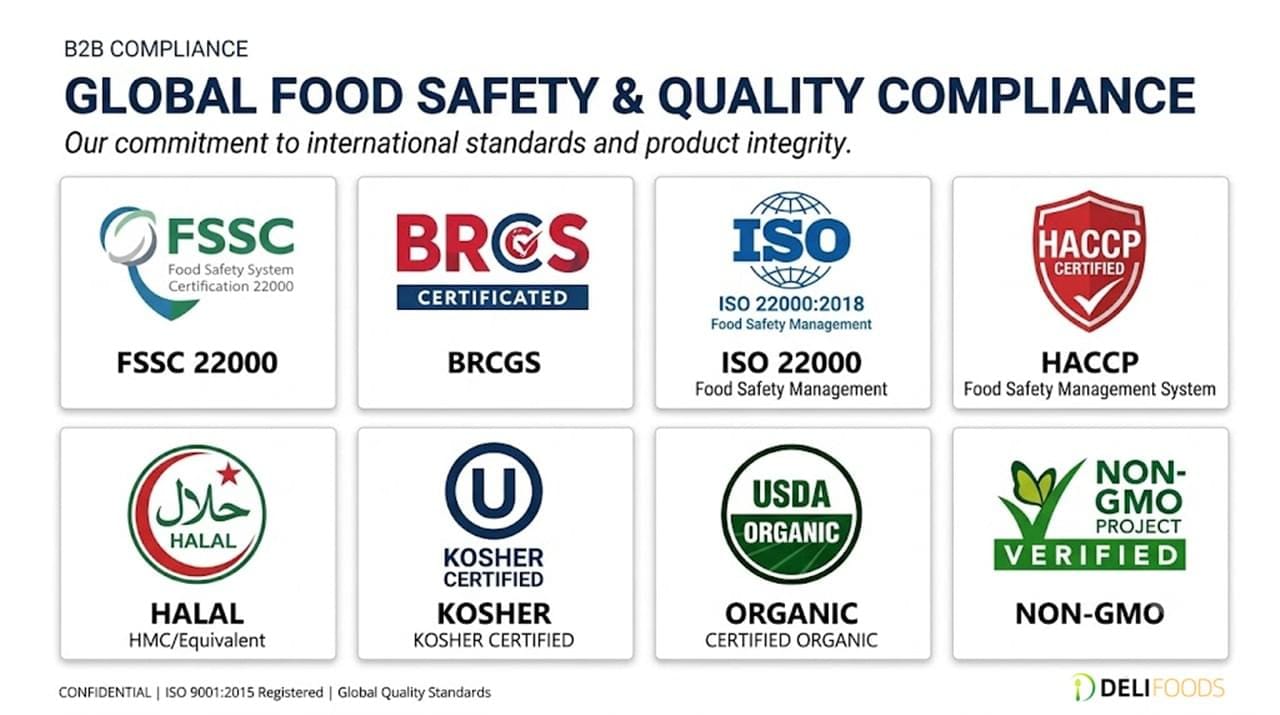
🌍 米シロップ品質基準のグローバルフレームワークを理解する
食品規制は国によって異なりますが、ほとんどの当局は同じ目的を共有しています。それは、食品成分が安全で、正確に表示され、一貫して製造されていることを保証することにより、消費者を保護することです。.
米シロップサプライヤーにとって、コンプライアンスは通常、単一の規制を超えて拡張されます。企業は、以下を含む複数のレベルの要件への適合を実証する必要があります。
- ✅ 国際的な食品安全原則
- ✅ 各国の食品法
- ✅ 製造業の認証
- ✅ 製品試験基準
- ✅ 顧客固有の品質仕様
これらのフレームワークがどのように連携するかを理解することは、企業が規制リスクを軽減し、サプライチェーンの信頼性を向上させるのに役立ちます。.
🌎 コーデックス・アリメンタリウス:国際的なベンチマーク
世界的に最も広く認識されている食品安全の参照資料の1つは、 コーデックス・アリメンタリウス, です。これは、 および によって共同で設立されました。コーデックス規格はそれ自体では法的に拘束力はありませんが、世界中の食品規制および国際貿易政策に強く影響を与えています。 米シロップ製造業者にとって、いくつかのコーデックス文書は貴重なガイダンスを提供します。. コーデックス基準はそれ自体では法的な拘束力はありませんが、世界中の食品規制や国際貿易政策に強く影響を与えています。.
米飴メーカーにとって、いくつかのコーデックス文書は貴重な指針を提供しています。.
✅ 米シロップに関連するコーデックス規格
- Codex STAN 212-1999 — Covers glucose syrups and starch-derived sweeteners.
- Codex STAN 1-1985 — Defines general labeling requirements for pre-packaged foods.
- CAC/RCP 1-1969 — Establishes internationally accepted Good Hygiene Practices and HACCP principles.
Many national authorities use these documents as references when developing their own food regulations, making Codex compliance an important consideration for exporters.
💡 You can explore the complete Codex database here:
https://www.fao.org/fao-who-codexalimentarius/
🏭 ISO食品安全管理システム
While government regulations define legal requirements, certification standards help manufacturers demonstrate that those requirements are consistently implemented.
Among the most recognized systems is ISO 22000:2018, which integrates food safety management with Hazard Analysis and Critical Control Points (HACCP). Rather than focusing only on product testing, ISO 22000 emphasizes preventive risk management throughout production.
Key benefits include:
- ✔ Better traceability throughout manufacturing
- ✔ Improved risk assessment procedures
- ✔ Stronger supplier management
- ✔ Continuous quality improvement
- ✔ Greater confidence for international customers
For buyers evaluating multiple suppliers, ISO certification often serves as an important indicator of operational maturity and quality consistency.
🏆 FSSC 22000が重要な理由
Many multinational food companies require suppliers to hold FSSC 22000 certification because it expands upon ISO 22000 with additional food safety controls recognized by the Global Food Safety Initiative (GFSI).
Compared with standard management certification, FSSC 22000 offers greater assurance that production facilities maintain internationally accepted food safety practices.
メリットは以下のとおりです。
- 🌍 Recognition across major international markets
- 🏭 Strong acceptance among global food brands
- 📋 Enhanced risk management systems
- 🔍 Independent third-party audits
- 🤝 Increased confidence during supplier qualification
For businesses exporting rice syrup to multiple countries, FSSC 22000 can significantly simplify customer approval processes.
🇺🇸 米国における米シロップの品質基準
The United States remains one of the world’s largest food ingredient markets, with regulatory oversight provided primarily by the U.S. Food and Drug Administration (FDA).
Companies exporting rice syrup to the U.S. should understand not only ingredient safety requirements but also facility registration, preventive controls, and labeling obligations.
✅ GRASステータスと食品安全
Rice syrup produced through enzymatic hydrolysis of rice starch is generally considered Generally Recognized As Safe (GRAS) when manufactured using accepted food processing methods.
However, GRAS status does not eliminate regulatory responsibilities. Manufacturers are still expected to implement preventive food safety systems under the Food Safety Modernization Act (FSMA) and maintain comprehensive production records.
Facilities exporting food ingredients to the United States must also register with the FDA before shipping products.
More information is available from the official FDA website:
https://www.fda.gov/
🏷️ FDAの表示要件
Proper labeling is essential for regulatory compliance and smooth customs clearance.
Under FDA labeling rules, rice syrup should:
- ✅ Be declared using its common or usual name, such as “Rice Syrup” or “Brown Rice Syrup.”
- ✅ Appear in ingredient lists according to weight.
- ✅ Meet applicable nutrition labeling requirements.
- ✅ Support any organic claims with valid USDA Organic certification.
Accurate labeling not only fulfills legal obligations but also helps buyers verify product authenticity and maintain transparent supply chains.
⚠️ 重金属モニタリング
Because rice naturally absorbs minerals from soil and water, international buyers increasingly pay attention to heavy metal testing.
Responsible manufacturers routinely monitor:
- 砒素
- 鉛
- カドミウム
- 水星
Advanced analytical methods such as ICP-MS (Inductively Coupled Plasma Mass Spectrometry) provide highly accurate detection of trace contaminants, allowing manufacturers to verify compliance with destination-market limits before shipment.
For products intended for infant nutrition or other sensitive applications, testing frequencies are often higher, with many buyers requesting batch-specific analytical reports instead of annual summaries.
🇪🇺 欧州連合における米シロップの品質基準
The European Union maintains one of the world’s most comprehensive food safety systems. Businesses exporting rice syrup to EU member states must comply with regulations covering ingredient safety, contaminant limits, traceability, labeling, and production practices.
Unlike some markets that focus primarily on finished-product testing, the EU emphasizes preventive food safety management throughout the entire supply chain. As a result, manufacturers should be prepared to provide detailed technical documentation alongside laboratory reports.
🏷️ EUの表示要件
Clear and accurate labeling is essential for entering the European market.
Depending on the product formulation, rice syrup may be declared as:
- ✅ Rice Syrup
- ✅ Glucose Syrup (from Rice)
When the syrup is produced exclusively from rice, it is generally not considered one of the allergens listed under EU Regulation (EU) No. 1169/2011, making it suitable for many allergen-conscious formulations. However, manufacturers should always verify labeling requirements based on the final product and destination country.
For organic products, suppliers must also comply with Regulation (EU) 2018/848, which governs organic production and certification across the European Union.
⚠️ 汚染物質の制限と製品の安全性
European authorities apply strict limits to contaminants commonly monitored in cereal-derived ingredients.
Typical quality control programs include testing for:
- 鉛
- カドミウム
- 水星
- 砒素
- Mycotoxins such as Ochratoxin A
Manufacturers supplying infant foods or products intended for vulnerable consumer groups are usually expected to meet even tighter purity requirements and maintain enhanced production controls.
Regular third-party laboratory testing helps demonstrate compliance while strengthening buyer confidence during supplier qualification.
🇨🇳 中国の米シロップに関するGB規格
China’s national food safety system is built around the GB (Guobiao) standards, which establish mandatory requirements for food production, processing, labeling, and contaminant control.
For rice syrup manufacturers operating in or exporting from China, compliance with the applicable GB standards is a fundamental requirement for legal production and international trade.
📋 主要なGB規格
Several national standards are particularly relevant to rice syrup production.
✅ GB 2760 — 食品添加物および加工助剤
This standard specifies which processing aids may be used during manufacturing, including food-grade enzymes, activated carbon, and ion exchange resins.
Using approved processing materials helps ensure both product safety and regulatory compliance.
✅ GB 2762 — 汚染物質の制限
GB 2762 establishes maximum allowable levels for contaminants such as:
- Heavy metals
- 砒素
- 鉛
- 水星
- カドミウム
Routine monitoring ensures products remain within legal limits before entering domestic or export markets.
✅ GB 7718 — 食品表示
Rice syrup sold in China must follow Chinese labeling requirements, including standardized product names, ingredient declarations, production information, and other mandatory labeling elements.
Accurate labeling not only supports compliance but also improves product traceability throughout the supply chain.
🇯🇵 日本の食品衛生要件
Japan is recognized for maintaining exceptionally high food safety expectations. Importers often conduct detailed supplier evaluations before approving new ingredients.
For rice syrup, manufacturers should pay close attention to:
- ✅ Heavy metal testing
- ✅ Food hygiene controls
- ✅ Product traceability
- ✅ Proper Japanese labeling
- ✅ Consistent quality documentation
Although the Japanese Agricultural Standards (JAS) certification is voluntary for many products, obtaining recognized certifications can strengthen market competitiveness and demonstrate a commitment to quality.
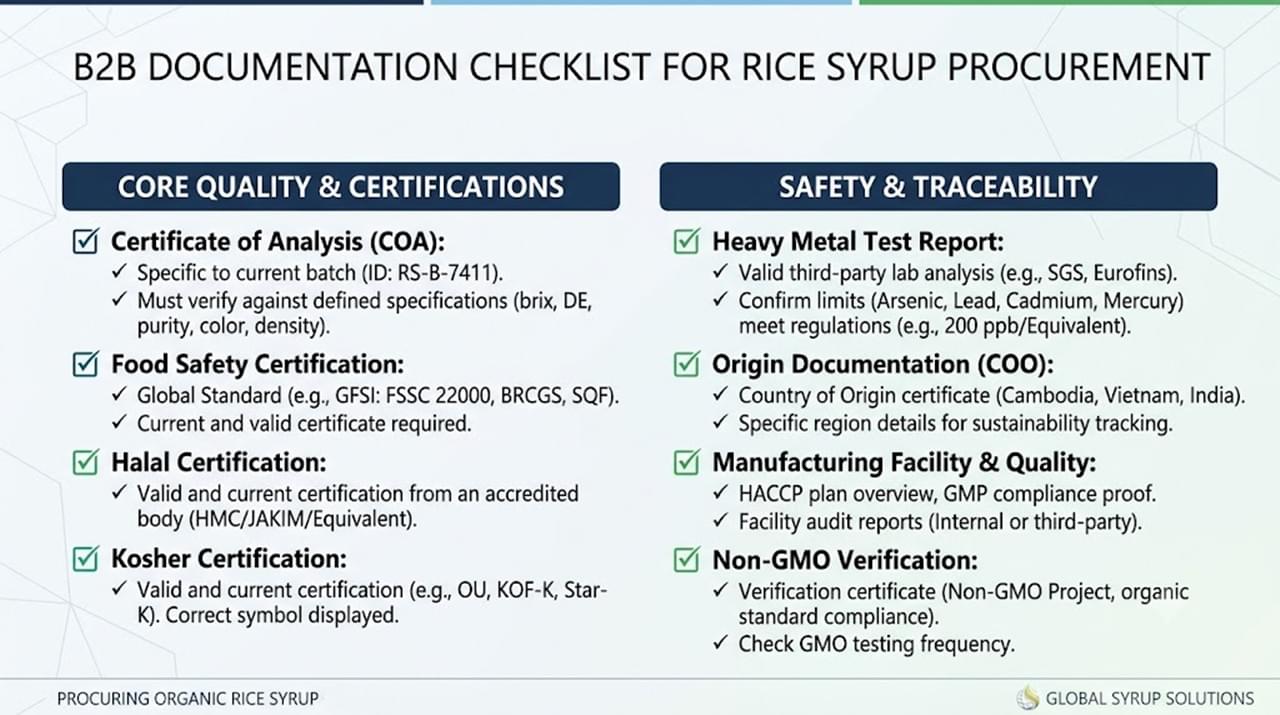
🏅 バイヤーが最も重視する業界認証
Beyond legal compliance, internationally recognized certifications often play a decisive role in supplier selection.
Large food manufacturers and global brands frequently require suppliers to maintain certifications that verify robust food safety management systems.
Commonly requested certifications include:
| Certification | Primary Purpose | Market Recognition |
|---|---|---|
| FSSC 22000 | Food Safety Management | Excellent |
| ISO 22000 | Food Safety System | Excellent |
| BRCGS Food | Manufacturing Compliance | 非常に高い |
| SQF | Food Safety & Quality | 非常に高い |
| IFS Food | European Retail Supply | 高い |
Holding one or more of these certifications demonstrates that a manufacturer follows internationally accepted practices, undergoes regular third-party audits, and maintains continuous improvement programs.
🌍 ハラールおよびコーシャ認証
For companies serving global markets, religious certifications can significantly expand business opportunities.
☪️ ハラール認証
Halal certification is often required when exporting to Muslim-majority countries or supplying food manufacturers that produce Halal-certified products.
Certification confirms that raw materials, processing methods, and manufacturing environments comply with Islamic dietary requirements.
✡️ コーシャ認証
Kosher certification is widely recognized beyond Jewish communities and is frequently requested by multinational food companies because it reflects rigorous ingredient verification and production controls.
Maintaining current Halal and Kosher certificates can help suppliers access a broader international customer base while simplifying procurement approvals.
📊 推奨される品質仕様フレームワーク
While regulatory requirements establish minimum legal standards, experienced buyers often develop their own technical specifications to ensure consistent product performance.
A comprehensive rice syrup specification typically includes the following categories.
🔬 物理的特性
- Appearance: Clear to light amber
- No visible foreign matter
- Soluble solids (Brix): 78–82°
- Viscosity appropriate for the specified DE value
⚗️ 化学的特性
- Controlled DE value within agreed tolerances
- pH between 4.0 and 5.5
- Consistent color values
- Low protein and ash content according to product grade
These parameters help maintain stable sweetness, texture, and processing performance across different food applications.
🛡️ 微生物学的および安全要件
Routine testing should include:
- 総プレート数
- 酵母とカビ
- サルモネラ
- Escherichia coli O157:H7
- Heavy metals
Consistent microbiological control helps protect product quality throughout storage and transportation while reducing food safety risks.
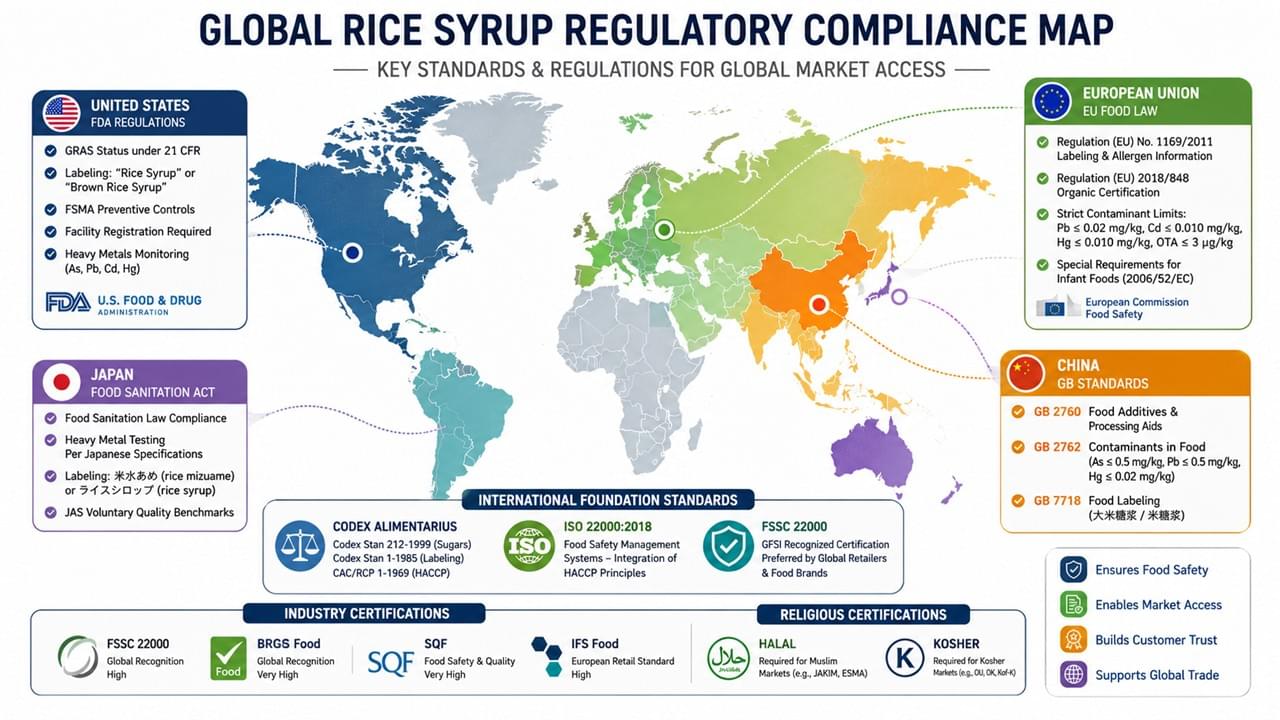
📄 国際B2Bサプライに必要な書類
Reliable documentation is just as important as product quality itself. Before approving a supplier, buyers typically request a complete compliance package that verifies regulatory conformity and manufacturing standards.
Key documents commonly required include:
- 📑 Certificate of Analysis (COA) for each production batch
- 🏭 Valid ISO 22000 or GFSI-recognized food safety certificate
- ☪️ Halal certificate (when applicable)
- ✡️ Kosher certificate (when applicable)
- 🌱 Organic certificate for certified organic grades
- 🧪 Heavy metal testing reports
- 🌍 Certificate of Origin and export documentation
Providing these documents promptly helps streamline procurement, customs clearance, and customer audits while reinforcing confidence in the supplier’s quality management system.
💡 信頼できる米シロップサプライヤーを選択するための専門家のアドバイス
Meeting regulatory requirements is only one aspect of supplier evaluation. Experienced buyers also consider a manufacturer’s technical expertise, production consistency, and long-term reliability.
When comparing potential suppliers, consider the following questions:
- ✅ Does the supplier maintain internationally recognized certifications?
- ✅ Are laboratory reports available for every production batch?
- ✅ Can the supplier support country-specific regulatory requirements?
- ✅ Is there a clear traceability system from raw materials to finished products?
- ✅ Does the supplier provide responsive technical support and documentation?
A supplier that can confidently answer these questions is generally better positioned to support stable, long-term business partnerships and reduce compliance risks.
📌 最終的な考察
Navigating 米シロップの品質基準 requires more than simply meeting minimum legal requirements. Successful international suppliers combine regulatory compliance with robust quality management systems, transparent documentation, and continuous product verification.
As food safety regulations continue to evolve, staying informed about FDA requirements, EU legislation, China GB standards, and internationally recognized certification schemes will help businesses reduce risk and strengthen their competitiveness in global markets.
Whether you are sourcing rice syrup for food manufacturing, private-label products, or international distribution, choosing a supplier with proven compliance capabilities is one of the most effective ways to protect product quality and ensure long-term success.
For additional guidance on internationally recognized food safety management systems, visit the official ISO 22000 resource:
https://www.iso.org/iso-22000-food-safety-management.html
📞 完全なコンプライアンス文書をリクエストする
If you need detailed technical information for your sourcing project, our team can provide comprehensive documentation to support supplier qualification, product evaluation, and regulatory review.
Our compliance package is available upon request and may include:
- 📄 Batch-specific Certificates of Analysis (COAs)
- 🏅 Food safety certification documents
- 🧪 Heavy metal testing reports
- 🌱 Organic, Halal, and Kosher certificates (where applicable)
- 🌍 Country of Origin documentation
- 📋 Technical specifications and product data sheets
👉 Request Full Compliance Documentation from Wuhu Deli Foods →
https://www.delisyrup.com/contact/
To learn more about our certification programs, visit our Rice Syrup Food Safety Certifications guide.
For detailed information on contaminant analysis, see our Arsenic & Heavy Metal Testing Guide.
 English
 Deutsch
 Español
 العربية
 Français
 Русский
 Bahasa Indonesia
 한국어
한국어 日本語
日本語 Polski
 Português
 Bahasa Melayu