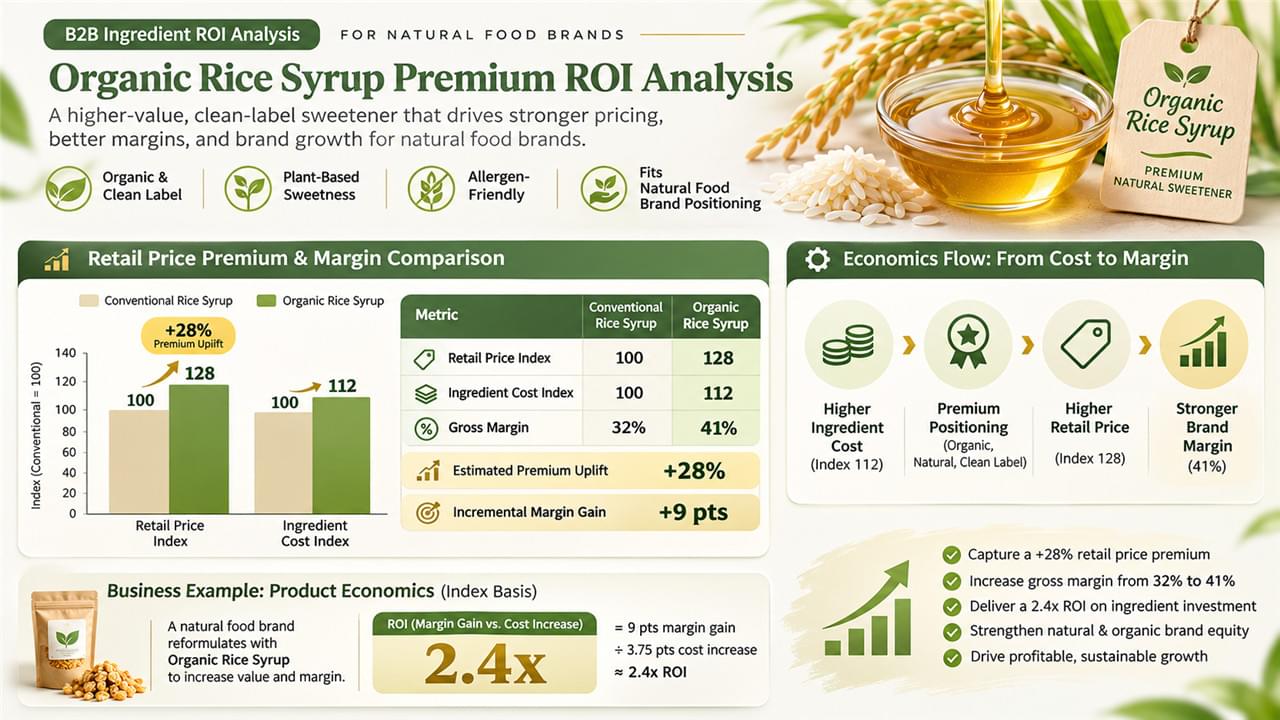
Organic rice syrup premium is typically 20–40% over conventional grade — a number that makes some procurement teams wince and others lean in. 🤔 The honest answer to “is it justified?” is: it depends entirely on your channel, your category, and what the organic label does for your retail price. This article walks through the real cost drivers, the market data behind organic premiums, and a worked ROI example that shows exactly where the money goes. By the end, you’ll know which side of the equation your product sits on.
Where the Extra Money Actually Goes
What Really Drives the Organic Rice Syrup Premium
The price differential isn’t arbitrary — it reflects genuine supply chain cost differences: 🌾
- Organic grain premium: certified organic broken rice costs 25–45% more than conventional equivalents
- Dedicated production lines: certified organic production requires dedicated equipment or fully documented changeover procedures
- Certification overhead: annual third-party audits and documentation management add recurring costs — these organic certification costs are real, auditable, and non-negotiable under the USDA National Organic Program
- Supply chain segregation: maintaining a documented chain of custody adds logistics procedures end to end
In other words, a chunk of the premium is compliance physics. You’re not paying for a nicer label on the drum; you’re paying for an auditable system.
The Market Side: Who Pays Organic Premiums — and How Much
Organic Market Growth Feeds the Organic Rice Syrup Premium
Demand is the other half of the equation. 📈 The US organic food market has grown 6–8% annually and now exceeds $60 billion — numbers tracked in detail by the Organic Trade Association. Retail organic premium structure looks like this:
- Organic labeled products: 15–35% average retail price premium over conventional equivalents
- Premium categories (baby food, snacks, energy products): premiums of 30–50%
- Mass market organic: premiums of 10–20%
That gap between ingredient cost and retail willingness to pay is where clean label premium strategies live — and where brands either capture margin or leave it on the shelf.
Category dynamics matter as much as the headline numbers. Baby food pays the steepest organic premiums because parents treat the label as a safety decision, not a preference. Snacks and energy products follow close behind, driven by gym-bag demographics. Even within one category, the premium widens in specialty retail and narrows in club stores — so the same formulation can justify different ingredient economics depending on where it actually sells. 🛒
Running the Numbers: A Worked Organic Rice Syrup ROI Example
The Organic Rice Syrup Premium Math: A Granola Bar Case Study
Here’s a concrete organic rice syrup ROI calculation for an organic granola bar brand. 🍪
Assumptions: retail price organic bar 3.00vs.conventional3.00vs.conventional2.25 (+33%); organic rice syrup inclusion 18%; organic premium vs. conventional 30%.
Ingredient cost impact: if conventional rice syrup costs 100/MT,organic=100/MT,organic=130/MT. That premium works out to roughly 5.40per100kgoffinishedproduct—about∗∗5.40per100kgoffinishedproduct—about∗∗0.027 per 500g bar**.
Revenue premium from the organic label: 3.00−3.00−2.25 = $0.75 per bar.
Now the punchline: the organic rice syrup premium (0.027/bar)isonly∗∗3.60.027/bar)isonly∗∗3.60.75/bar). The remaining 96.4% flows straight to brand margin improvement. 💰 Very few “marketing investments” convert at that ratio.
The Honest Limits: Where Organic Stops Working
When the Organic Rice Syrup Premium Doesn’t Pay
Honesty cuts both ways — organic rice syrup is economically disadvantaged in:
- Commodity ingredient applications: industrial fermentation substrates, non-retail food service
- B-grade retail channels: discount retail or institutional food service, where no consumer pays for the label
- Categories with weak willingness to pay: products where organic certification doesn’t move shelf price
If your customer never sees — or never values — the organic claim, you’re funding certification that returns nothing. ⚠️
Conclusion: Justified Where the Label Sells, Wasted Where It Doesn’t
The organic rice syrup premium is strongly justified for natural food brands with access to premium organic retail channels, and for products where organic certification supports a USDA Organic claim. For commodity and non-premium applications, conventional grade delivers the same functional performance at lower cost.
The decision framework is refreshingly simple: ask what the organic claim does to your shelf price, then compare that uplift against a 20–40% ingredient premium. If the label multiplies revenue, buy it. If it merely decorates the pack, don’t.
Wuhu Deli Foods supplies both organic and conventional grades with full certification documentation, so your ROI math starts from real numbers. 📋 Contact us to price both options side by side.
 English
 Deutsch
 Español
 العربية
 Français
 Русский
 Bahasa Indonesia
 한국어
 日本語
 Polski
 Português
 Bahasa Melayu