
The rice syrup certificate of analysis is the piece of paper that matters more than most buyers realize. It rides along with every shipment, and read well, it becomes your best early-warning system. Skim it, and you’re signing off on quality you never actually verified. This guide walks through what a COA must contain, which COA red flags deserve immediate attention, and how to validate one before it becomes a specification of record.
📄 What a Certificate of Analysis Actually Is
A Certificate of Analysis is a supplier-issued document reporting the tested results for one specific production lot of rice syrup. A valid rice syrup certificate of analysis should:
- Identify the specific production lot or batch
- Report actual test results (not specification ranges without results)
- Reference the test methods used
- Carry the signature or authentication of a responsible quality official
- Include laboratory accreditation details for third-party tested parameters
Here’s the distinction that trips up newer buyers: a COA is not a specification sheet. It reports actual values for a specific lot, not acceptable ranges. If a document shows only ranges with no measured numbers, that’s not a COA — it’s a brochure wearing a lab coat.
What Every Rice Syrup Certificate of Analysis Must Contain
Header information comes first, and every line gets checked against your shipment paperwork:
- Product name and grade designation
- Lot/batch number (must match the physical container labels)
- Production date and Best Before / Expiry date
- Net weight
- Customer name and order reference
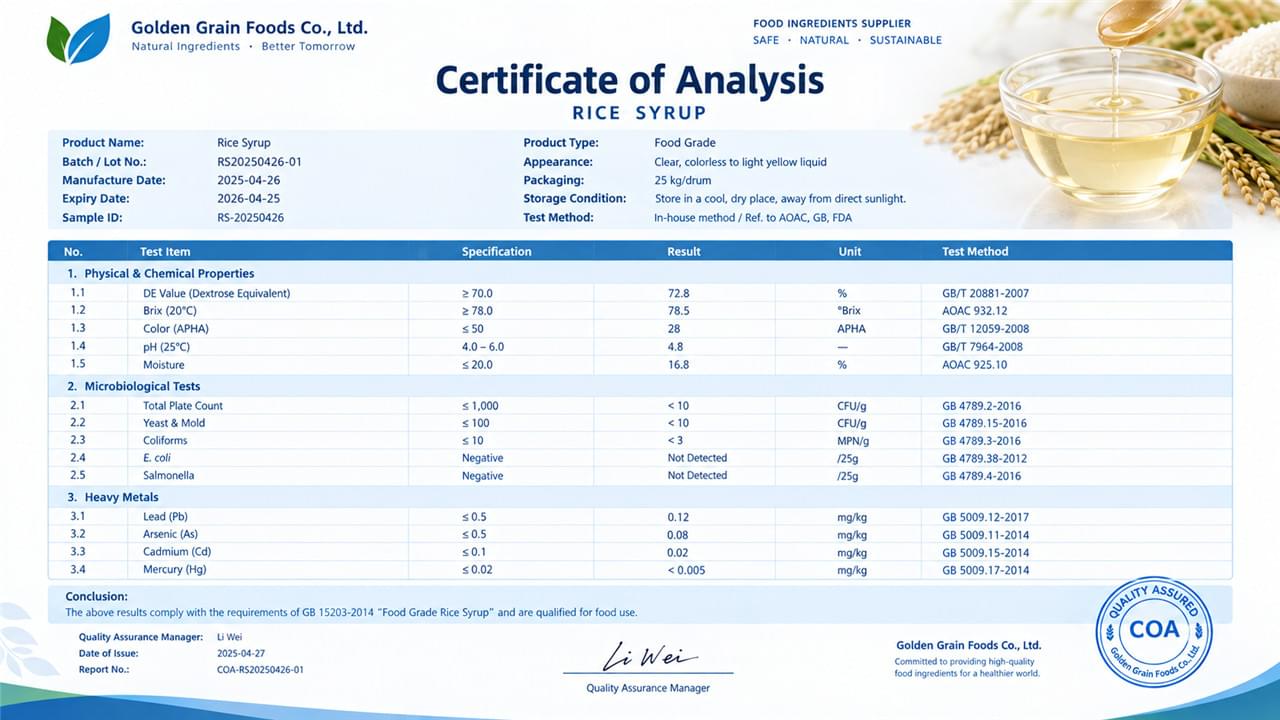
🧾 The Anatomy of a Complete Rice Syrup Certificate of Analysis
A complete rice syrup certificate of analysis reads in four blocks: header, physical-chemical results, microbiology, and contaminants.
Reading the Numbers on a Rice Syrup Certificate of Analysis
Physical and chemical parameters confirm the syrup matches what you ordered:
| Parameter | What It Confirms | Accept/Reject Criteria |
|---|---|---|
| Dextrose Equivalent (DE) | Degree of hydrolysis | Within ±2 DE of specified value |
| Brix | Total solids, concentration | Per specification (e.g., 78.0–82.0) |
| pH | Acidity | Per specification (e.g., 4.5–6.0) |
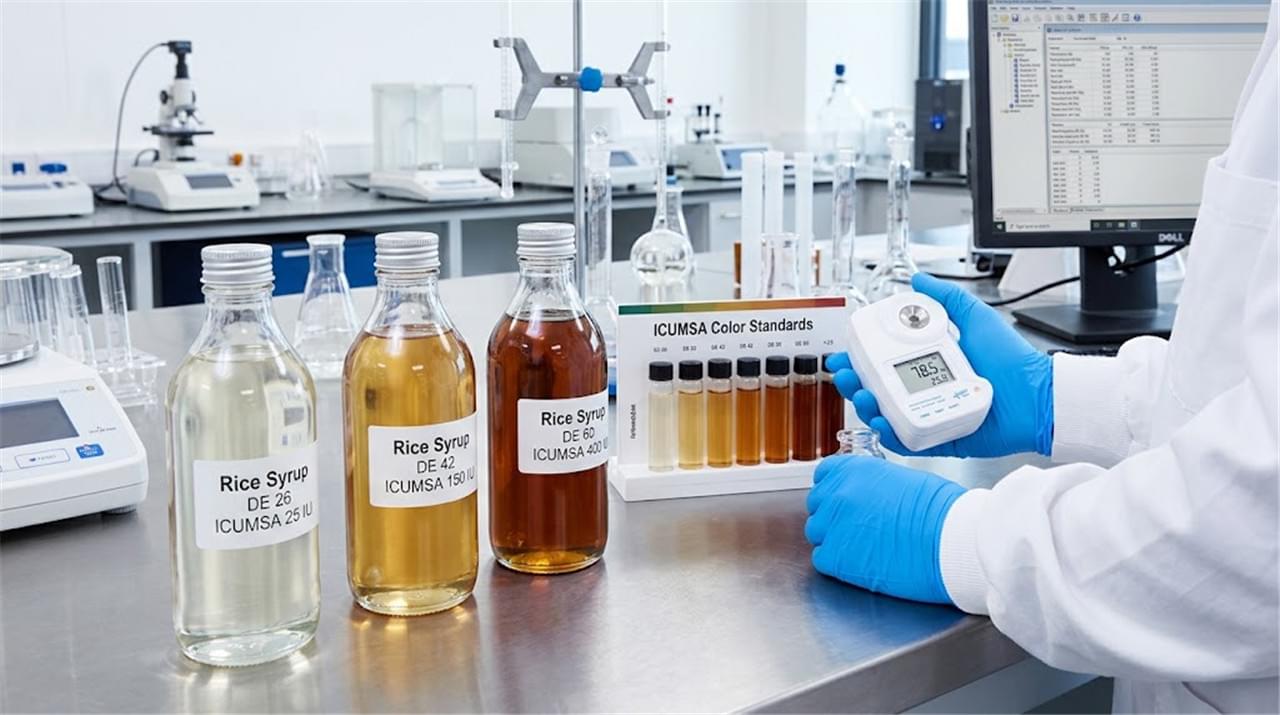
| ICUMSA Color | Product clarity | Below specified maximum |
| Viscosity | Flow properties | At specified temperature per spec |
| Ash Content | Mineral content | Below specified maximum |
| Moisture | Water content | Calculated from Brix; verify consistency |
Microbiological parameters confirm the process hygiene held up:
| Parameter | What It Confirms | Accept/Reject |
|---|---|---|
| Total Plate Count | Overall bacterial load | ≤ 200 CFU/g |
| Yeast | Osmophilic yeast risk | ≤ 10 CFU/g |
| Mold | Mold contamination | ≤ 10 CFU/g |
| Coliforms | Processing hygiene indicator | Absent per 10g |
| Salmonella | Pathogen safety | Absent per 25g |
Contaminant parameters are where rice syrup quality documentation gets serious — this is the section regulators and retailers scrutinize first:
| Parameter | What It Confirms | Accept/Reject |
|---|---|---|
| Total Arsenic | Safety benchmark | Per specification |
| Inorganic Arsenic | Food safety (more meaningful) | ≤ 0.10 mg/kg standard; ≤ 0.05 low-arsenic grade |
| Lead | Heavy metal safety | ≤ 0.10 mg/kg |
| Cadmium | Heavy metal safety | ≤ 0.10 mg/kg |
| Mercury | Heavy metal safety | ≤ 0.05 mg/kg |
Certification declarations round out the package where applicable: organic certification statement with certifier reference, Halal and Kosher certification references, Non-GMO declaration, and allergen declaration.
🚩 5 Rice Syrup Certificate of Analysis Red Flags
Most COA problems announce themselves quietly — the five below show up again and again on a rice syrup certificate of analysis:
Red Flag 1: “Pass” or “Conforms” without numerical values. A COA reporting “Conforms” for DE without the actual measured number tells you nothing usable. Always require numerical results.
Red Flag 2: Lot numbers that don’t match shipment documents. The COA lot number must match the batch number on container labels and shipping papers. Mismatches suggest documentation errors — or substitution.
Red Flag 3: Test methods not specified. Reputable COAs reference recognized methods from bodies like AOAC International or ISO. Without a method reference, a result can’t be independently verified — and that’s a problem.
Red Flag 4: Suspiciously uniform microbiological values. Micro testing involves inherent variability. A COA showing exactly “0 CFU/g” on every test across many consecutive lots may signal testing shortcuts rather than exceptional hygiene.
Red Flag 5: No third-party laboratory information for contaminants. Heavy metal and arsenic testing should come from accredited analytical laboratories. COAs relying solely on in-house results for these parameters warrant independent verification.
🔍 Supplier COA Validation: Trust, Then Verify
Validating a Rice Syrup Certificate of Analysis from a New Supplier
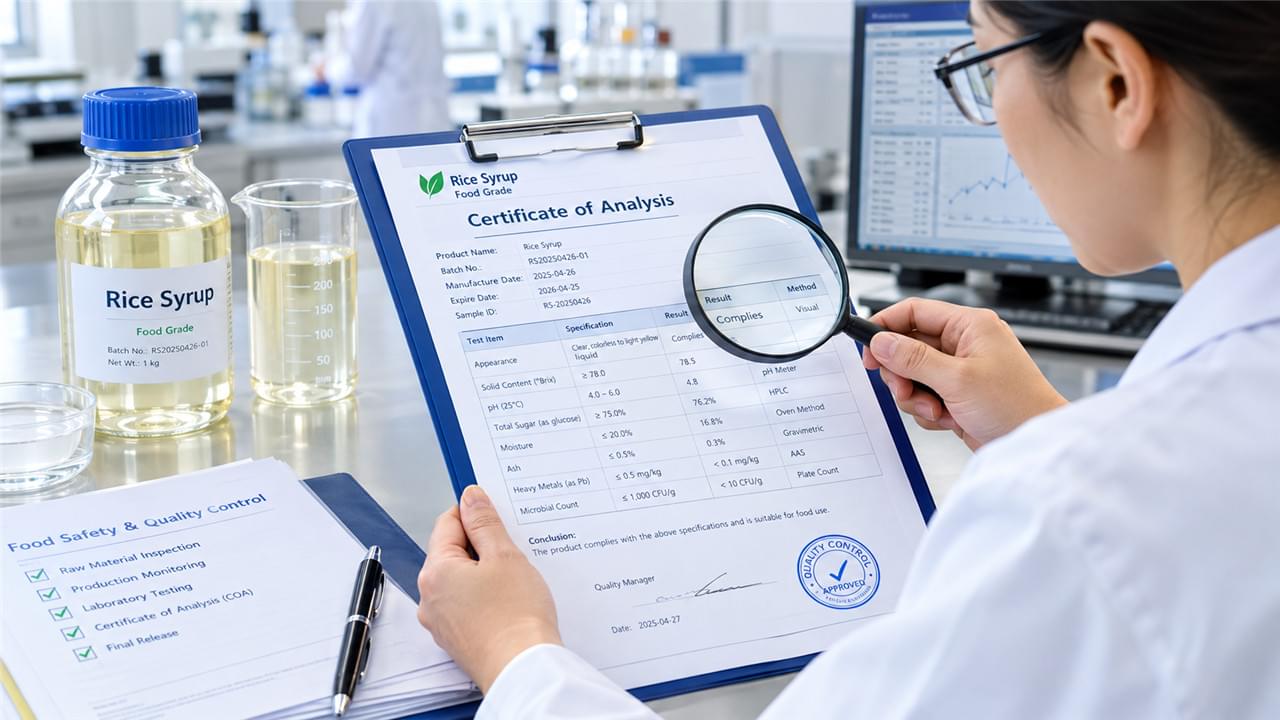
When qualifying a new rice syrup supplier, run supplier COA validation as a five-step exercise:
- Request 3–5 consecutive lot COAs to assess consistency
- Request the third-party laboratory reports underlying the COA data
- Conduct independent testing of initial receipt lots at an accredited laboratory
- Compare results to COA values — systematic deviations reveal calibration issues or documentation inaccuracies
- Verify certifications by contacting the certifying bodies directly
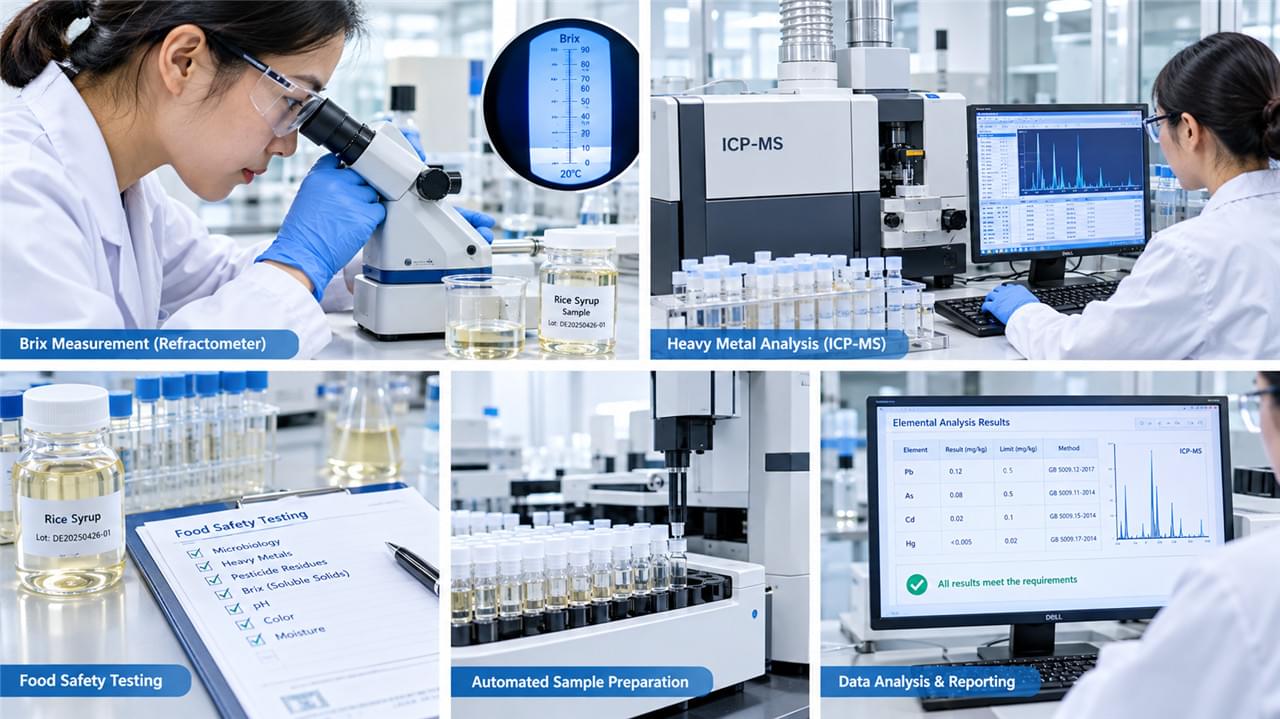
The third step is the one buyers skip most often, and it’s the one that catches the most problems. One accredited lab run on your first receipt lot tells you more about the accuracy of a supplier’s rice syrup certificate of analysis than three years of polite emails.
🗄️ Archiving: The Step That Pays Off Later
Archiving Every Rice Syrup Certificate of Analysis You Receive
Food safety regulations — FSMA in the US, EU food law, China’s Food Safety Law — require ingredient documentation retention. Keep every rice syrup certificate of analysis on file, and follow three solid archiving practices:
- Retain COAs for a minimum of 3 years (or finished product shelf life plus 2 years, whichever is longer)
- Maintain traceability linking COA lot numbers to finished product batch records
- Store digital COA copies with automatic backup
✅ Conclusion
Proficiency in reading a rice syrup certificate of analysis protects product quality, keeps you on the right side of regulators, and makes supplier conversations noticeably shorter. Know what a complete COA looks like, catch the red flags before they catch you, and validate before you trust — that’s the whole game.
Wuhu Deli Foods provides comprehensive COA documentation with every shipment, backed by accredited third-party laboratory testing for all critical parameters. Contact our quality team for COA templates and sample documentation packages.


 English
 Deutsch
 Español
 العربية
 Français
 Русский
 Bahasa Indonesia
 한국어
 日本語
 Polski
 Português
 Bahasa Melayu