
Rice syrup technical specifications are not academic paperwork — they decide whether a product performs in your formulation, clears your customers’ label requirements, and passes regulatory checks in your target markets. This guide decodes each parameter, explains what it means in real production, and helps you build a specification framework your procurement program can lean on.
🎯 DE Value: The Master Parameter
Rice Syrup Technical Specifications Begin with DE
Dextrose Equivalent (DE) is the single most important rice syrup technical specification — a rice syrup DE value measures the degree of starch hydrolysis, expressed as the percentage of reducing sugars (calculated as glucose, on a dry weight basis).
DE scale reference points:
- Intact starch: DE ~0
- Complete hydrolysis to glucose: DE 100
- Commercial rice syrup range: DE 30–65
Higher DE values mean more complete hydrolysis: more short-chain sugars (glucose, maltose), greater sweetness, lower viscosity, higher hygroscopicity, higher fermentability, and higher osmotic pressure.
Lower DE values mean more long-chain glucose polymers (dextrins, oligomers): milder sweetness, higher viscosity, better body and texture, lower crystallization risk, and more gradual energy release.
Standard commercial DE grades:
| DE Range | Classification | Typical Applications |
|---|---|---|
| DE 30–35 | Low DE | Texture building, anti-crystallization, cream stabilization |
| DE 38–42 | Standard DE | General confectionery, bakery, beverage |
| DE 45–50 | Medium-high DE | Energy products, fermentation substrates |
| DE 55–65 | High DE | High-glucose applications, industrial fermentation |
🧴 Brix: Total Soluble Solids
Brix measures total dissolved solids as a weight percentage — read with a refractometer or inline sensor. Commercial rice syrup typically ships at 75–82 Brix.
Why Brix earns its place in any rice syrup technical specifications table:
- Concentration verification: the primary check that the syrup was properly concentrated
- Water activity control: higher Brix means lower water activity — critical for microbiological stability in storage and transit
- Carbohydrate yield calculation: precise dry solids yield per kilogram of syrup
Typical specifications: standard rice syrup 78–82 Brix; high-DE grades 75–78 Brix (slightly lower, thanks to higher hygroscopicity); concentrated grades 82–85 Brix for specialized uses.
Brix and DE interact — specifying both narrows the acceptable product range considerably and gives you a fuller quality fingerprint.
🌊 Viscosity: Where Specs Meet Plant Reality
Rice Syrup Technical Specifications for Pumping and Handling
Rice syrup viscosity determines how the syrup flows, pumps, and handles on your floor — a make-or-break parameter for equipment design, process engineering, and end-product texture alike.
Rice syrup viscosity depends primarily on:
- DE value: lower DE → higher viscosity (more long-chain polymers)
- Brix: higher Brix → higher viscosity
- Temperature: viscosity drops significantly as temperature rises
Typical values (at 25°C):
- DE 42, 80 Brix: 8,000–15,000 mPa·s
- DE 48, 78 Brix: 3,000–6,000 mPa·s
- DE 55, 75 Brix: 500–1,500 mPa·s
Practical planning note: standard plant-grade centrifugal pumps handle rice syrup below ~5,000 mPa·s comfortably; higher viscosity grades may need progressive cavity pumps or heated transfer lines.
🎨 Color: The ICUMSA Scale
ICUMSA Color Grades in Rice Syrup Technical Specifications
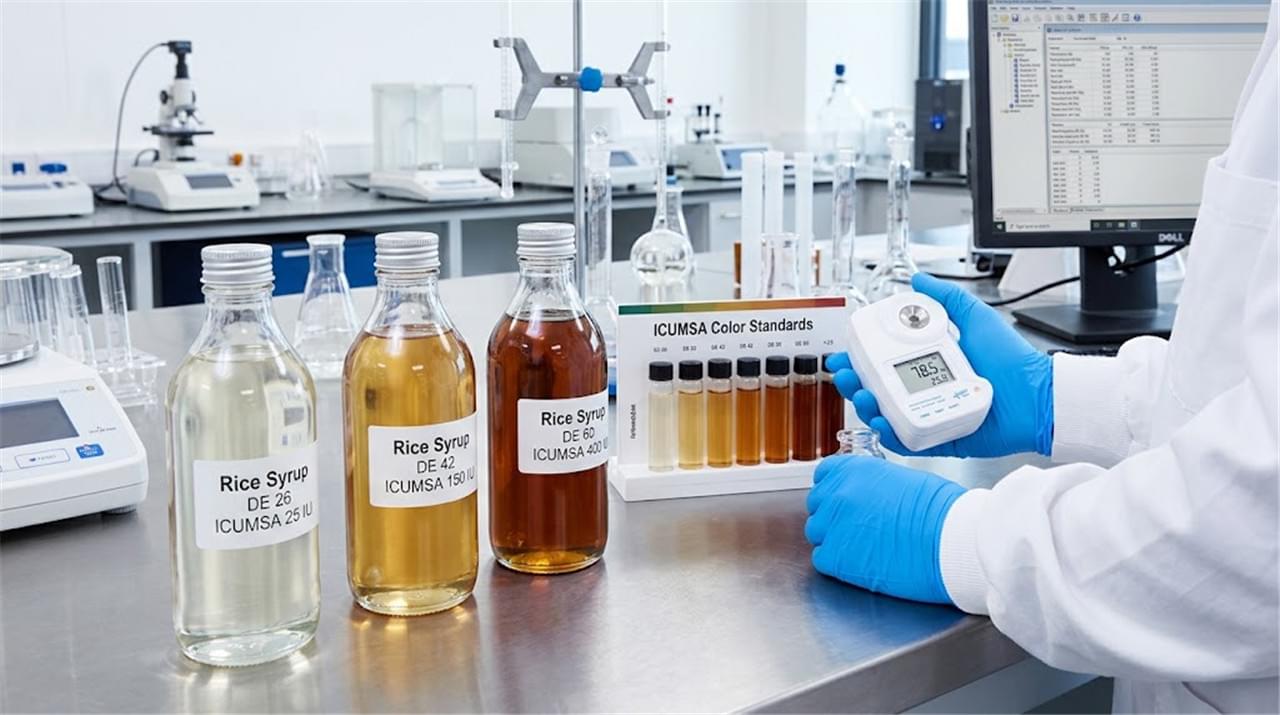
Rice syrup color is measured in ICUMSA units — an internationally standardized colorimetric method. Lower values mean lighter, clearer syrup, and the ICUMSA color grade you need depends entirely on the application:
- ICUMSA < 50: water-white, premium clarity grade
- ICUMSA 50–150: light yellow, standard grade
- ICUMSA 150–300: yellow, economy grade
- ICUMSA > 300: amber-yellow, technical grade
Application requirements:
- Beverages and transparent confectionery: ICUMSA < 50 for visual neutrality
- Bakery and opaque confectionery: ICUMSA < 150 typically acceptable
- Industrial fermentation substrates: color not critical
Color reflects raw material quality, processing intensity, filtration, activated carbon treatment, and ion exchange purification. Holding color consistent takes rigorous process control and careful carbon dosing optimization.
⚗️ pH: Small Range, Real Consequences
Among rice syrup technical specifications, pH is the quiet one — easy to overlook until it bites. Rice syrup pH typically sits between 4.5 and 6.5, depending on process and any pH adjustment. It affects:
- Flavor: lower pH brings slight tartness; higher pH can contribute off-notes
- Stability: pH 4.5–5.5 offers optimal microbiological stability
- Application compatibility: some formulations need specific pH ranges for reactivity control
Most food applications tolerate commercial rice syrup’s pH comfortably. Low-acid beverages or dairy systems should specify a pH range explicitly.
🧬 Sugar Profile: The Full Carbohydrate Fingerprint
Beyond DE, an HPLC sugar profile reveals the complete carbohydrate makeup — a layer serious rice syrup technical specifications never skip:
| Component | DE 42 Typical | DE 55 Typical |
|---|---|---|
| Glucose | 8–12% | 30–40% |
| Maltose | 35–45% | 30–38% |
| Maltotriose | 12–18% | 10–15% |
| Higher oligomers | 30–45% | 12–25% |
Sugar profiles matter when:
- Fermentation substrates: yeast and bacterial processes need specific chain-length distributions
- Sports nutrition: glucose polymer distribution drives energy release kinetics
- Confectionery: the maltose-to-glucose ratio shapes crystallization behavior and hygroscopicity
🔥 Ash: The Mineral Signal
Ash content (sulfated ash) reflects mineral content — mostly potassium, sodium, and trace minerals from the grain. Target: < 0.3% on dry basis.
Elevated ash signals incomplete demineralization, which can nudge flavor (mineral or metallic notes), accelerate Maillard browning, and disturb fermentation performance. Ion exchange treatment (cation and anion resins) is the primary ash-reduction technology.
🦠 Microbiological Specifications
Standard microbiological limits in rice syrup technical specifications:
| Parameter | Typical Limit |
|---|---|
| Total Plate Count (TPC) | < 200 CFU/g |
| Yeast | < 10 CFU/g |
| Mold | < 10 CFU/g |
| Coliforms | Absent/10g |
| Salmonella | Absent/25g |
High Brix (>78°) provides osmotic inhibition of microbial growth — properly concentrated syrup is microbiologically stable under appropriate storage conditions.
⚠️ Heavy Metals and Contaminants
Safety Lines in Rice Syrup Technical Specifications
| Contaminant | Specification | Standard |
|---|---|---|
| Inorganic Arsenic | < 0.1 mg/kg | CODEX/EU |
| Lead | < 0.1 mg/kg | CODEX |
| Cadmium | < 0.1 mg/kg | CODEX |
| Mercury | < 0.05 mg/kg | CODEX |
These contaminant ceilings are the safety backbone of rice syrup technical specifications. For infant and toddler applications, specify tighter arsenic limits (< 0.05 mg/kg inorganic arsenic).
📋 Building Your Specification Sheet
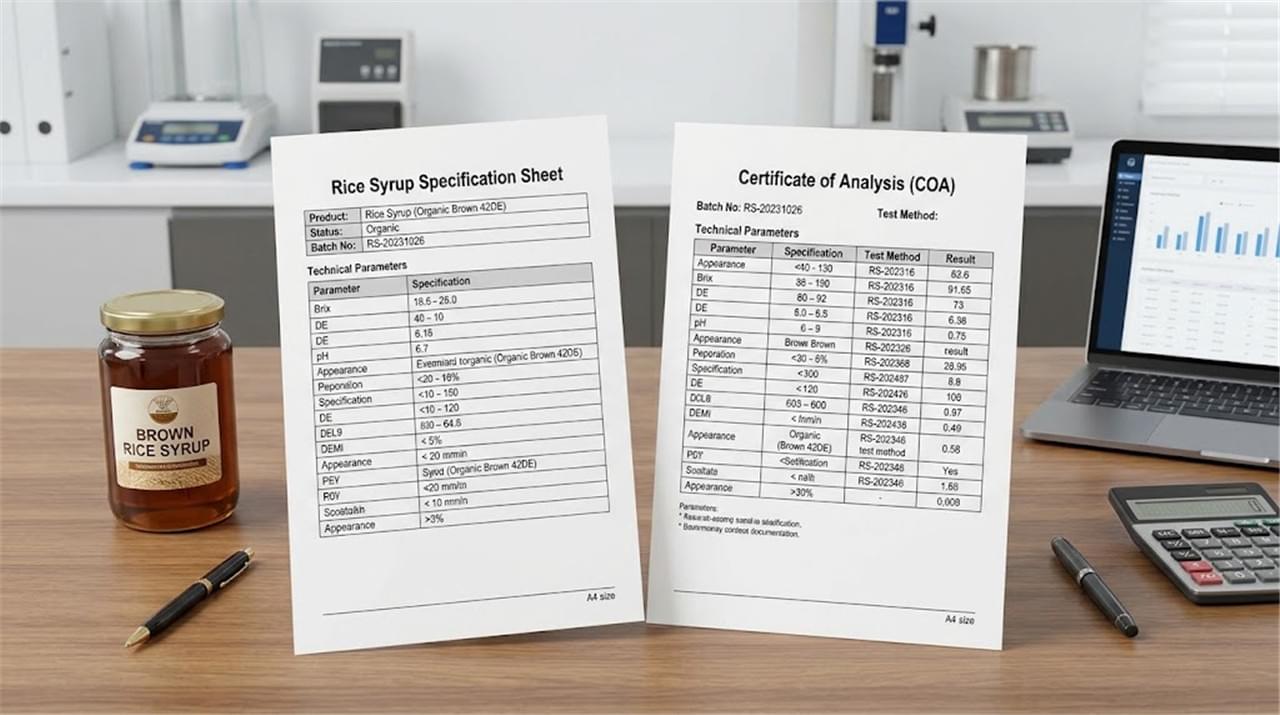
A complete rice syrup technical specifications sheet should include:
- DE value (target ± range, e.g., 42 ± 2)
- Brix (minimum and maximum)
- pH range
- Color (maximum ICUMSA)
- Viscosity at a specified temperature
- Ash content maximum
- Microbiological limits
- Heavy metal limits
- Sugar profile (if critical to the application)
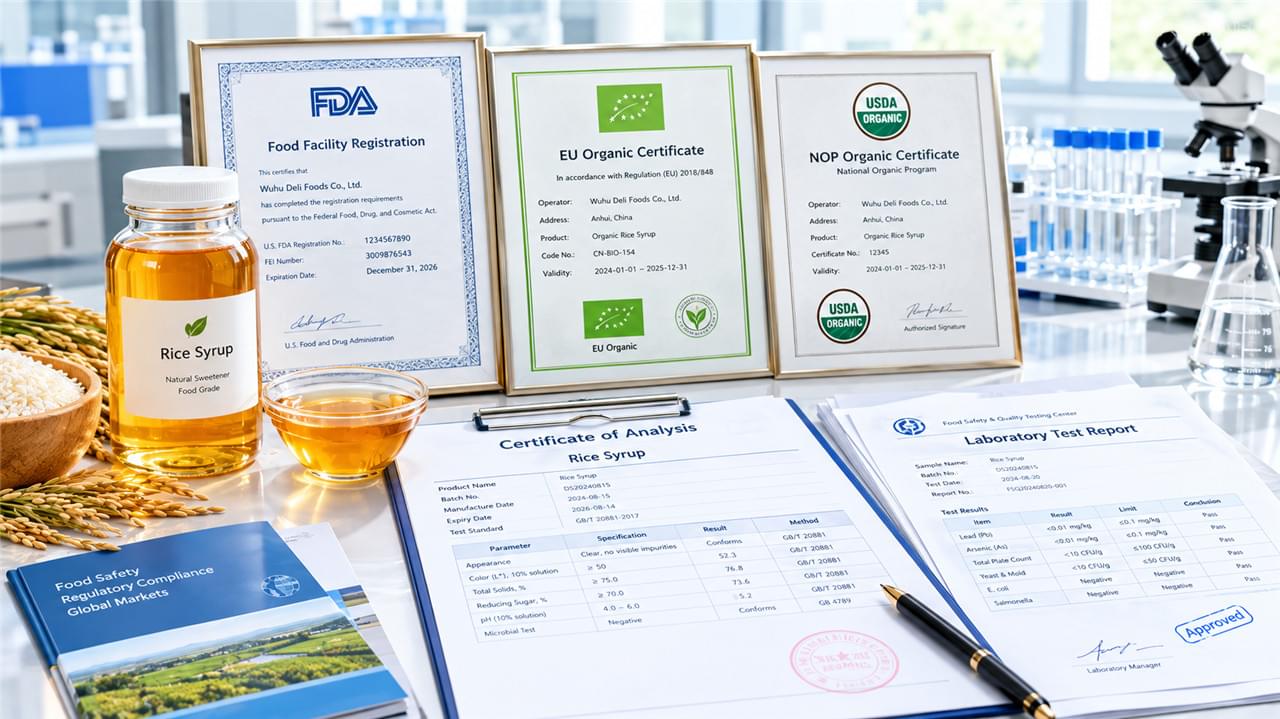
- Certification requirements (organic, Halal, Kosher, non-GMO)
Treat these rice syrup quality parameters as a package — a supplier who controls all ten controls the ones you haven’t thought to ask about yet.
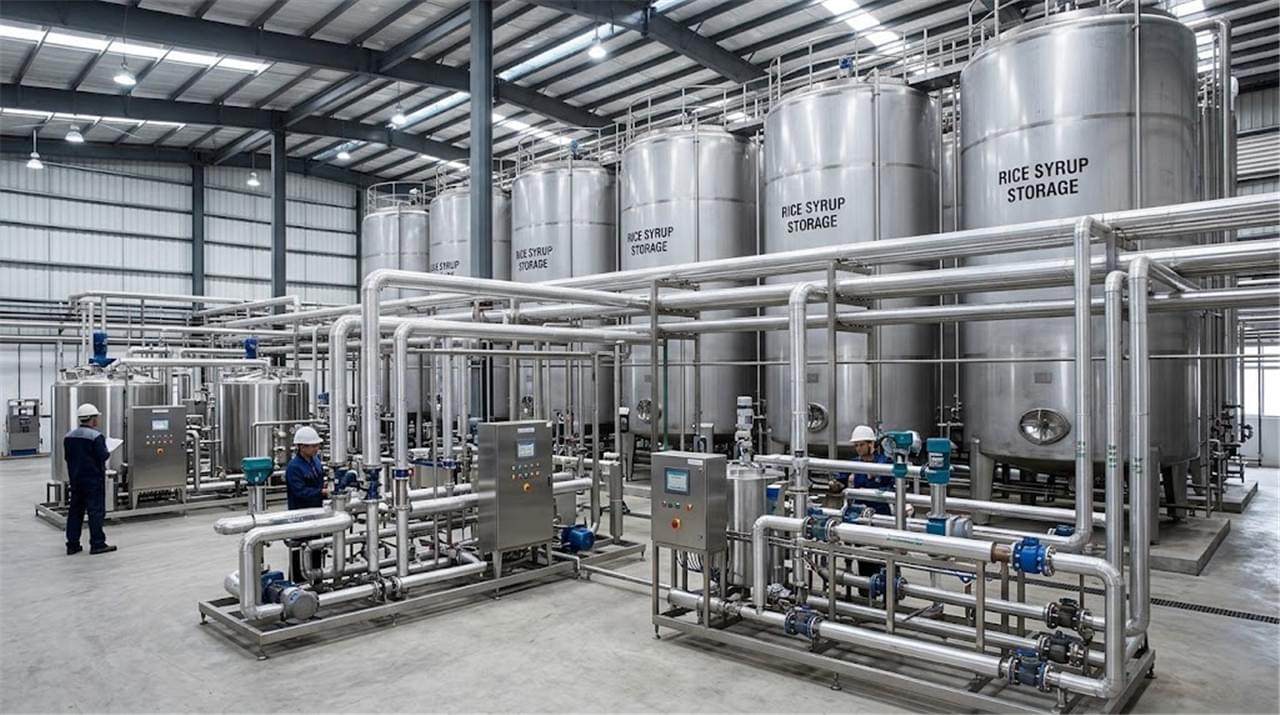
🤝 How Wuhu Deli Foods Supports Spec Development
Wuhu Deli Foods provides prospective customers with:
- Standard grade specification sheets for all product grades
- Custom specification development consultation for specialized applications
- Certificate of Analysis (COA) with every shipment
- Third-party testing documentation upon request
- Technical support for specification optimization
Contact our technical team to discuss your requirements and receive matched product grade recommendations.
✅ Conclusion: Specifications Are Strategy
Reading rice syrup technical specifications closely is the difference between buying an ingredient and buying predictable performance. Nail the rice syrup DE value, Brix, viscosity, ICUMSA color grade, and safety limits up front — and your formulation, label, and compliance teams all start from solid ground.


 English
 Deutsch
 Español
 العربية
 Français
 Русский
 Bahasa Indonesia
 한국어
 日本語
 Polski
 Português
 Bahasa Melayu