
Rice syrup regulatory trends are reshaping formulation decisions faster than most ingredient handbooks can keep up with. Sugar taxes, labeling mandates, contaminant limits, and organic rules are all moving at once across global markets — and manufacturers formulating with rice syrup need a practical compliance roadmap, not a legal textbook. Here are the five rules that matter most.
🧾 Rule 1: Know How Sugar Taxes Treat Rice Syrup
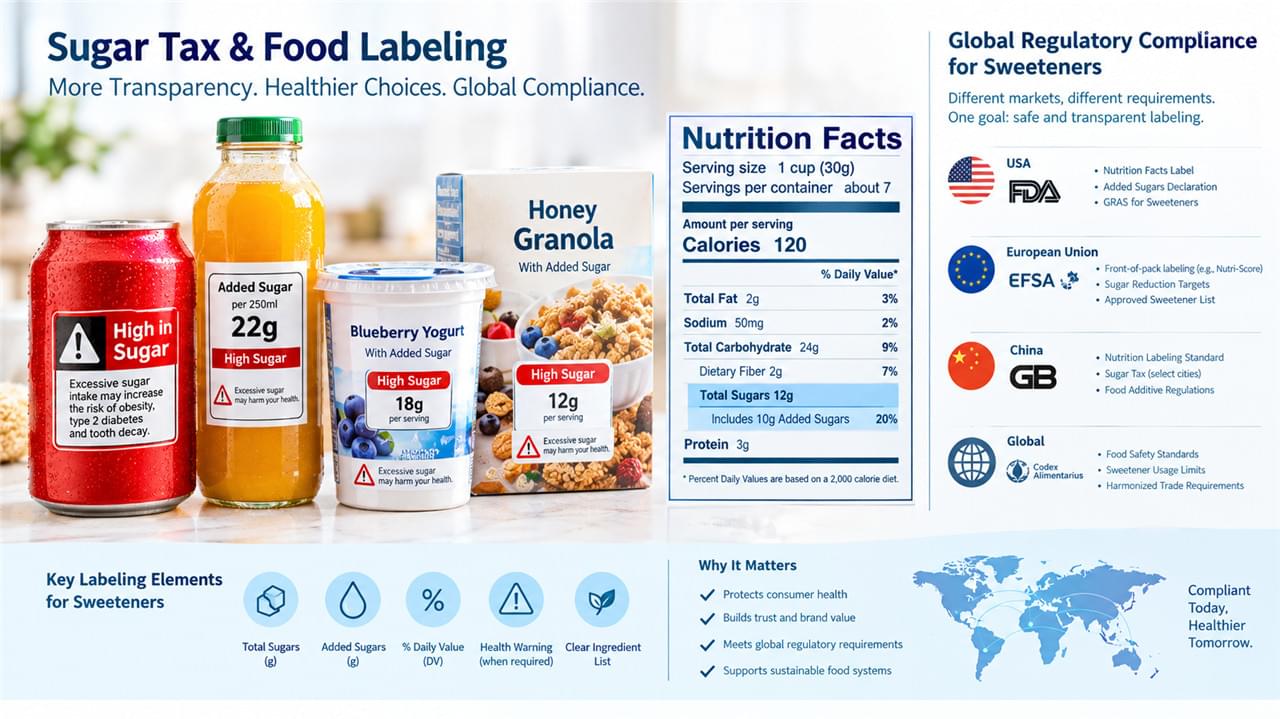
Sugar and sweetened beverage taxes have spread quickly as governments chase public health targets. As of 2025, sugar taxes or levies are in effect in over 50 jurisdictions worldwide — the UK, France, Mexico, South Africa, and numerous US states among them.
The tax treatment of rice syrup varies by jurisdiction and usually depends on:
- Total sugar content of the finished product (not the individual ingredient)
- Whether the product falls in taxed categories (typically beverages)
- DE value and the resulting sugar composition of the syrup
In most frameworks, rice syrup contributes to total and added sugar content — so it generally faces the same treatment as other nutritive sweeteners in taxable categories.
Rice Syrup Regulatory Trends in Sugar Tax Frameworks
Strategic implications:
- Blend rice syrup with high-intensity natural sweeteners (stevia, monk fruit) to cut total sweetener usage while keeping sweetness
- Concentrate rice syrup use in untaxed categories (confectionery, bakery) for the lightest rice syrup compliance burden
- Monitor jurisdiction-specific tax structures continuously — definitions and exemptions vary widely
🇺🇸 Rule 2: Master FDA Added Sugar Labeling
The FDA’s Nutrition Facts reform made “Added Sugars” declaration mandatory — and per FDA guidance, rice syrup is classified as an added sugar regardless of its natural origin.
Rice Syrup Regulatory Trends Under FDA Added Sugar Labeling
Practical implications:
- Rice syrup counts toward the “Added Sugars” line on the Nutrition Facts panel
- Products chasing “low added sugar” positioning must account for its contribution
- The 10% Daily Value threshold is a key formulation parameter
Compliance approach: work with a qualified nutritional labeling service to calculate rice syrup’s added sugars contribution in your specific formulation — DE value matters, since it determines the mono- and disaccharide proportion.
🇪🇺 Rule 3: Get EU Ingredient Labeling Right
In the European Union, rice syrup appears on ingredient labels as “rice syrup,” “glucose syrup (from rice),” or “rice malt syrup” depending on composition and the applicable EU rules.
Key EU regulatory considerations:
- Regulation (EC) 1333/2008: food additives law — rice syrup is an ingredient, not an additive
- Regulation (EU) 1169/2011: food information to consumers — general labeling requirements
- Allergen declaration: rice is not a designated EU allergen, but labels must still reflect composition accurately
Of all rice syrup regulatory trends, EU naming conventions trip up the most first-time exporters — worth confirming the exact declaration with your notifier before artwork goes to print.
⚗️ Rule 4: Stay Ahead of Arsenic Standards
Inorganic arsenic in rice-based ingredients has drawn serious regulatory attention — the strictest of today’s rice syrup regulatory trends. Rice syrup used in food manufacturing is generally exempt from the specific rice-product limits under EU Regulation 2015/1006, but it must still meet general food safety principles (EC 178/2002). Meanwhile, FDA guidance sets a 100 ppb action level for total arsenic in infant rice cereals, with ongoing monitoring of rice-derived ingredients in infant and toddler foods.
Arsenic: The Tightest Rice Syrup Regulatory Trends to Watch
Compliance strategy for arsenic standards for rice syrup:
- Request inorganic arsenic test results (not just total arsenic) with every production lot
- Set internal specification limits tighter than regulatory maximums — <0.05 ppm inorganic arsenic is a defensible target
- Prioritize suppliers with traceable, low-arsenic rice sourcing programs
🌿 Rule 5: Match Organic Rules to Each Market
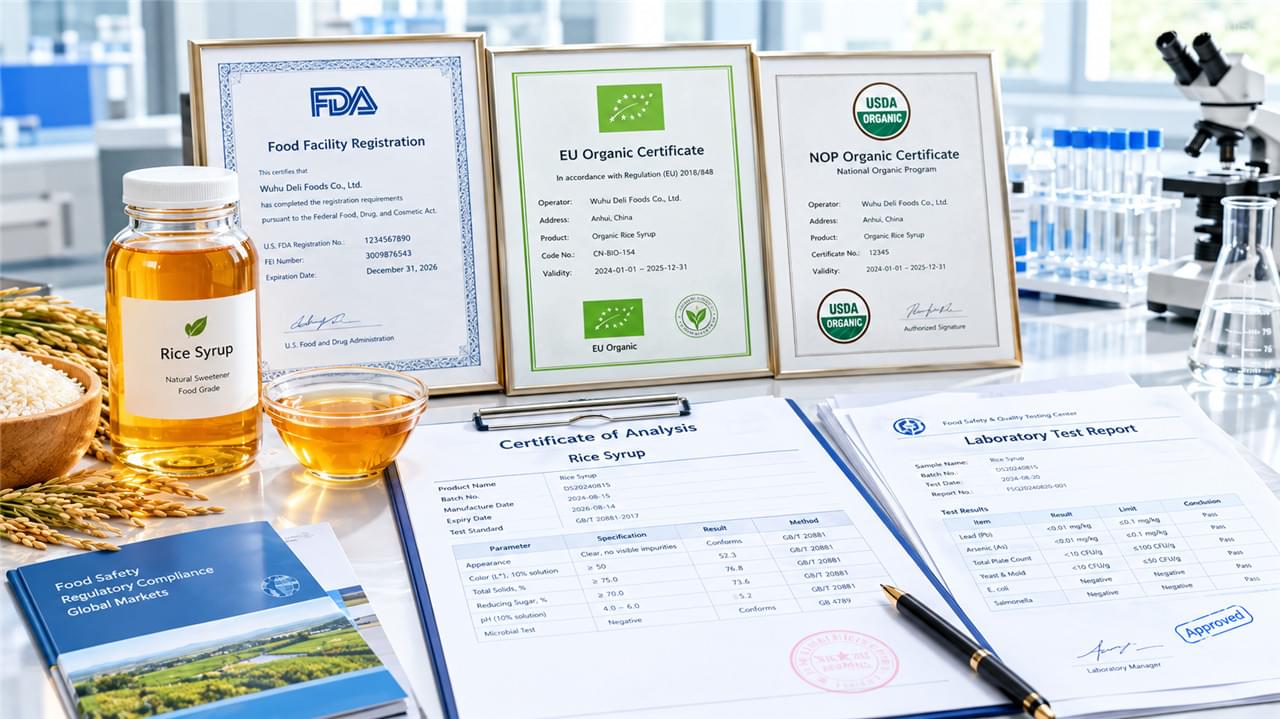
Organic rice syrup regulations differ by destination market, and each demands its own certification:
Rice Syrup Regulatory Trends in Organic Certification
USDA National Organic Program (NOP): certified organic rice, permitted processing aids only, annual inspection by an accredited certifier
EU Organic Regulation (2018/848): the new EU framework strengthens requirements for processing, labeling, and control systems — third-party certification body inspection required
China GB/T 19630: administered by CNCA, mandatory for domestic organic label use in China
🔮 Future Trends Worth Watching
Several emerging developments will shape procurement decisions:
- Front-of-pack warning labels: several countries are mandating warnings on high sugar/calorie products
- Mandatory LCA disclosure: some jurisdictions are moving toward required environmental impact disclosure for foods
- Tightening arsenic limits: arsenic standards for rice syrup may tighten further as the science advances
✅ Conclusion: Compliance as a Competitive Edge
Rice syrup regulatory trends reward proactive monitoring and engaged supplier partnerships. Manufacturers are best served by suppliers who maintain current regulatory intelligence across major markets and can deliver compliant documentation that unlocks market access.
Wuhu Deli Foods monitors regulatory developments across all key export markets and provides customers with current compliance documentation and regulatory update communications.
Contact Wuhu Deli Foods for regulatory compliance support.


 English
 Deutsch
 Español
 العربية
 Français
 Русский
 Bahasa Indonesia
 한국어
한국어 日本語
日本語 Polski
 Português
 Bahasa Melayu