
À medida que a indústria alimentar global continua a expandir-se, Normas de Qualidade de Xarope de Arroz tornaram-se um fator crítico para fabricantes, distribuidores e compradores internacionais. Quer esteja a adquirir xarope de arroz para bebidas, confeitaria, nutrição infantil ou alimentos processados, o cumprimento dos requisitos regulamentares já não é opcional — é essencial para o acesso ao mercado, a confiança do consumidor e o sucesso empresarial a longo prazo.
🌍 Cada mercado de destino aplica o seu próprio quadro legal para segurança alimentar, rotulagem, limites de contaminantes e práticas de produção. Ao mesmo tempo, as certificações reconhecidas internacionalmente fornecem uma garantia adicional de que um fornecedor mantém uma gestão de qualidade e controlos de fabrico consistentes.
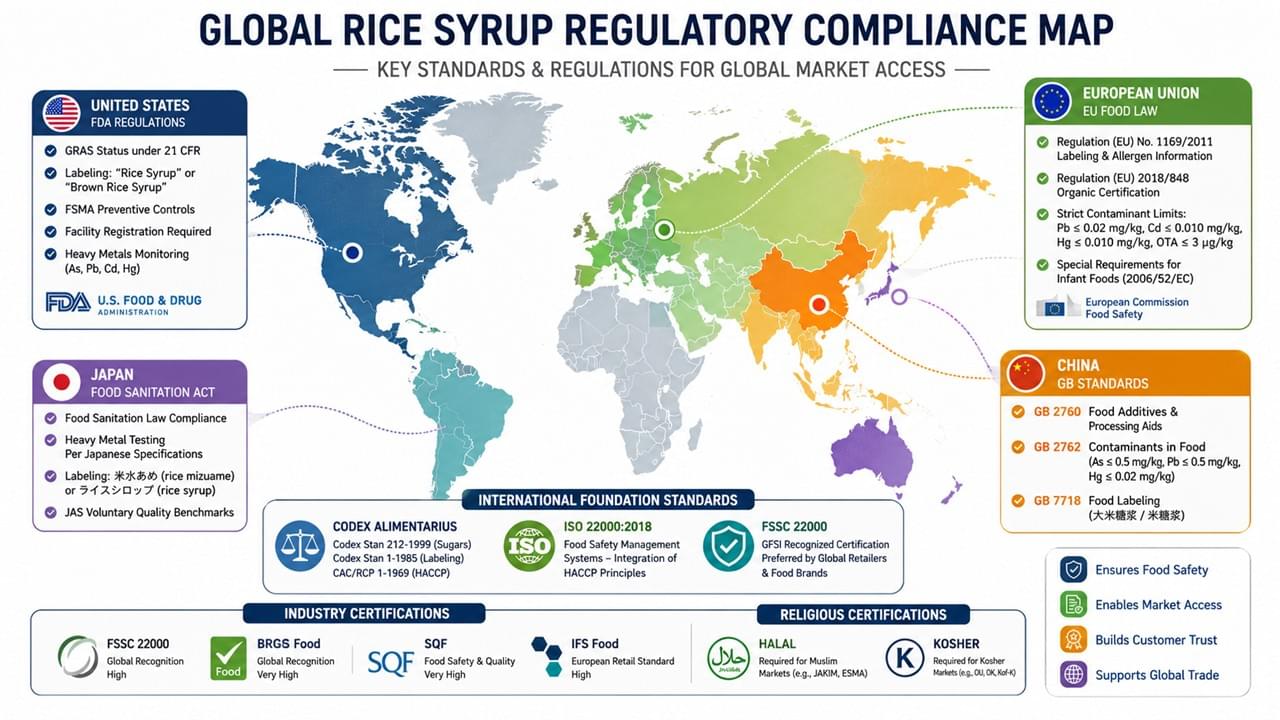
Este guia explica as principais normas de qualidade que regem o xarope de arroz em todo o mundo, incluindo regulamentos nos Estados Unidos, União Europeia, China e Japão. Irá também aprender quais as certificações que os compradores solicitam comummente, a documentação necessária para o comércio internacional e recomendações práticas para avaliar fornecedores com confiança.
🌍 Compreender o Quadro Global para Normas de Qualidade de Xarope de Arroz
Embora os regulamentos alimentares difiram de país para país, a maioria das autoridades partilha o mesmo objetivo: proteger os consumidores garantindo que os ingredientes alimentares são seguros, rotulados com precisão e fabricados de forma consistente.
Para os fornecedores de xarope de arroz, a conformidade geralmente estende-se para além de um único regulamento. As empresas devem demonstrar conformidade com múltiplas camadas de requisitos, incluindo:
- ✅ Princípios internacionais de segurança alimentar
- ✅ Leis nacionais de alimentos
- ✅ Certificações de fabrico
- ✅ Normas de teste de produtos
- ✅ Especificações de qualidade específicas do cliente
Compreender como estes quadros funcionam em conjunto ajuda as empresas a reduzir os riscos regulamentares, ao mesmo tempo que melhoram a fiabilidade da cadeia de abastecimento.
🌎 Codex Alimentarius: O Ponto de Referência Internacional
Uma das referências mais amplamente reconhecidas para a segurança alimentar global é o Códice Alimentarius, estabelecido conjuntamente pela Organização das Nações Unidas para a Alimentação e a Agricultura (FAO) e pela Organização Mundial de Saúde (OMS). As normas Codex não são legalmente vinculativas por si só, mas influenciam fortemente os regulamentos alimentares e as políticas de comércio internacional em todo o mundo.
Para os fabricantes de xarope de arroz, vários documentos Codex fornecem orientação valiosa.
✅ Normas Codex Relevantes para Xarope de Arroz
- Codex STAN 212-1999 — Covers glucose syrups and starch-derived sweeteners.
- Codex STAN 1-1985 — Defines general labeling requirements for pre-packaged foods.
- CAC/RCP 1-1969 — Establishes internationally accepted Good Hygiene Practices and HACCP principles.
Many national authorities use these documents as references when developing their own food regulations, making Codex compliance an important consideration for exporters.
💡 You can explore the complete Codex database here:
https://www.fao.org/fao-who-codexalimentarius/
🏭 Sistemas de Gestão de Segurança Alimentar ISO
While government regulations define legal requirements, certification standards help manufacturers demonstrate that those requirements are consistently implemented.
Among the most recognized systems is ISO 22000:2018, which integrates food safety management with Hazard Analysis and Critical Control Points (HACCP). Rather than focusing only on product testing, ISO 22000 emphasizes preventive risk management throughout production.
Key benefits include:
- ✔ Better traceability throughout manufacturing
- ✔ Improved risk assessment procedures
- ✔ Stronger supplier management
- ✔ Continuous quality improvement
- ✔ Greater confidence for international customers
For buyers evaluating multiple suppliers, ISO certification often serves as an important indicator of operational maturity and quality consistency.
🏆 Porquê a FSSC 22000 Importa
Many multinational food companies require suppliers to hold FSSC 22000 certification because it expands upon ISO 22000 with additional food safety controls recognized by the Global Food Safety Initiative (GFSI).
Compared with standard management certification, FSSC 22000 offers greater assurance that production facilities maintain internationally accepted food safety practices.
Os benefícios incluem:
- 🌍 Recognition across major international markets
- 🏭 Strong acceptance among global food brands
- 📋 Enhanced risk management systems
- 🔍 Independent third-party audits
- 🤝 Increased confidence during supplier qualification
For businesses exporting rice syrup to multiple countries, FSSC 22000 can significantly simplify customer approval processes.
🇺🇸 Normas de Qualidade de Xarope de Arroz nos Estados Unidos
The United States remains one of the world’s largest food ingredient markets, with regulatory oversight provided primarily by the U.S. Food and Drug Administration (FDA).
Companies exporting rice syrup to the U.S. should understand not only ingredient safety requirements but also facility registration, preventive controls, and labeling obligations.
✅ Estatuto GRAS e Segurança Alimentar
Rice syrup produced through enzymatic hydrolysis of rice starch is generally considered Generally Recognized As Safe (GRAS) when manufactured using accepted food processing methods.
However, GRAS status does not eliminate regulatory responsibilities. Manufacturers are still expected to implement preventive food safety systems under the Food Safety Modernization Act (FSMA) and maintain comprehensive production records.
Facilities exporting food ingredients to the United States must also register with the FDA before shipping products.
More information is available from the official FDA website:
https://www.fda.gov/
🏷️ Requisitos de Rotulagem da FDA
Proper labeling is essential for regulatory compliance and smooth customs clearance.
Under FDA labeling rules, rice syrup should:
- ✅ Be declared using its common or usual name, such as “Rice Syrup” or “Brown Rice Syrup.”
- ✅ Appear in ingredient lists according to weight.
- ✅ Meet applicable nutrition labeling requirements.
- ✅ Support any organic claims with valid USDA Organic certification.
Accurate labeling not only fulfills legal obligations but also helps buyers verify product authenticity and maintain transparent supply chains.
⚠️ Monitorização de Metais Pesados
Because rice naturally absorbs minerals from soil and water, international buyers increasingly pay attention to heavy metal testing.
Responsible manufacturers routinely monitor:
- Arsênico
- Liderar
- Cádmio
- Mercúrio
Advanced analytical methods such as ICP-MS (Inductively Coupled Plasma Mass Spectrometry) provide highly accurate detection of trace contaminants, allowing manufacturers to verify compliance with destination-market limits before shipment.
For products intended for infant nutrition or other sensitive applications, testing frequencies are often higher, with many buyers requesting batch-specific analytical reports instead of annual summaries.
🇪🇺 Normas de Qualidade de Xarope de Arroz na União Europeia
The European Union maintains one of the world’s most comprehensive food safety systems. Businesses exporting rice syrup to EU member states must comply with regulations covering ingredient safety, contaminant limits, traceability, labeling, and production practices.
Unlike some markets that focus primarily on finished-product testing, the EU emphasizes preventive food safety management throughout the entire supply chain. As a result, manufacturers should be prepared to provide detailed technical documentation alongside laboratory reports.
🏷️ Requisitos de Rotulagem da UE
Clear and accurate labeling is essential for entering the European market.
Depending on the product formulation, rice syrup may be declared as:
- ✅ Rice Syrup
- ✅ Glucose Syrup (from Rice)
When the syrup is produced exclusively from rice, it is generally not considered one of the allergens listed under EU Regulation (EU) No. 1169/2011, making it suitable for many allergen-conscious formulations. However, manufacturers should always verify labeling requirements based on the final product and destination country.
For organic products, suppliers must also comply with Regulation (EU) 2018/848, which governs organic production and certification across the European Union.
⚠️ Limites de Contaminantes e Segurança do Produto
European authorities apply strict limits to contaminants commonly monitored in cereal-derived ingredients.
Typical quality control programs include testing for:
- Liderar
- Cádmio
- Mercúrio
- Arsênico
- Mycotoxins such as Ochratoxin A
Manufacturers supplying infant foods or products intended for vulnerable consumer groups are usually expected to meet even tighter purity requirements and maintain enhanced production controls.
Regular third-party laboratory testing helps demonstrate compliance while strengthening buyer confidence during supplier qualification.
🇨🇳 Normas GB da China para Xarope de Arroz
China’s national food safety system is built around the GB (Guobiao) standards, which establish mandatory requirements for food production, processing, labeling, and contaminant control.
For rice syrup manufacturers operating in or exporting from China, compliance with the applicable GB standards is a fundamental requirement for legal production and international trade.
📋 Principais Normas GB
Several national standards are particularly relevant to rice syrup production.
✅ GB 2760 — Aditivos Alimentares e Auxiliares de Processamento
This standard specifies which processing aids may be used during manufacturing, including food-grade enzymes, activated carbon, and ion exchange resins.
Using approved processing materials helps ensure both product safety and regulatory compliance.
✅ GB 2762 — Limites de Contaminantes
GB 2762 establishes maximum allowable levels for contaminants such as:
- Heavy metals
- Arsênico
- Liderar
- Mercúrio
- Cádmio
Routine monitoring ensures products remain within legal limits before entering domestic or export markets.
✅ GB 7718 — Rotulagem de Alimentos
Rice syrup sold in China must follow Chinese labeling requirements, including standardized product names, ingredient declarations, production information, and other mandatory labeling elements.
Accurate labeling not only supports compliance but also improves product traceability throughout the supply chain.
🇯🇵 Requisitos de Higiene Alimentar do Japão
Japan is recognized for maintaining exceptionally high food safety expectations. Importers often conduct detailed supplier evaluations before approving new ingredients.
For rice syrup, manufacturers should pay close attention to:
- ✅ Heavy metal testing
- ✅ Food hygiene controls
- ✅ Product traceability
- ✅ Proper Japanese labeling
- ✅ Consistent quality documentation
Although the Japanese Agricultural Standards (JAS) certification is voluntary for many products, obtaining recognized certifications can strengthen market competitiveness and demonstrate a commitment to quality.
🏅 Certificações da Indústria Que os Compradores Mais Valorizam
Beyond legal compliance, internationally recognized certifications often play a decisive role in supplier selection.
Large food manufacturers and global brands frequently require suppliers to maintain certifications that verify robust food safety management systems.
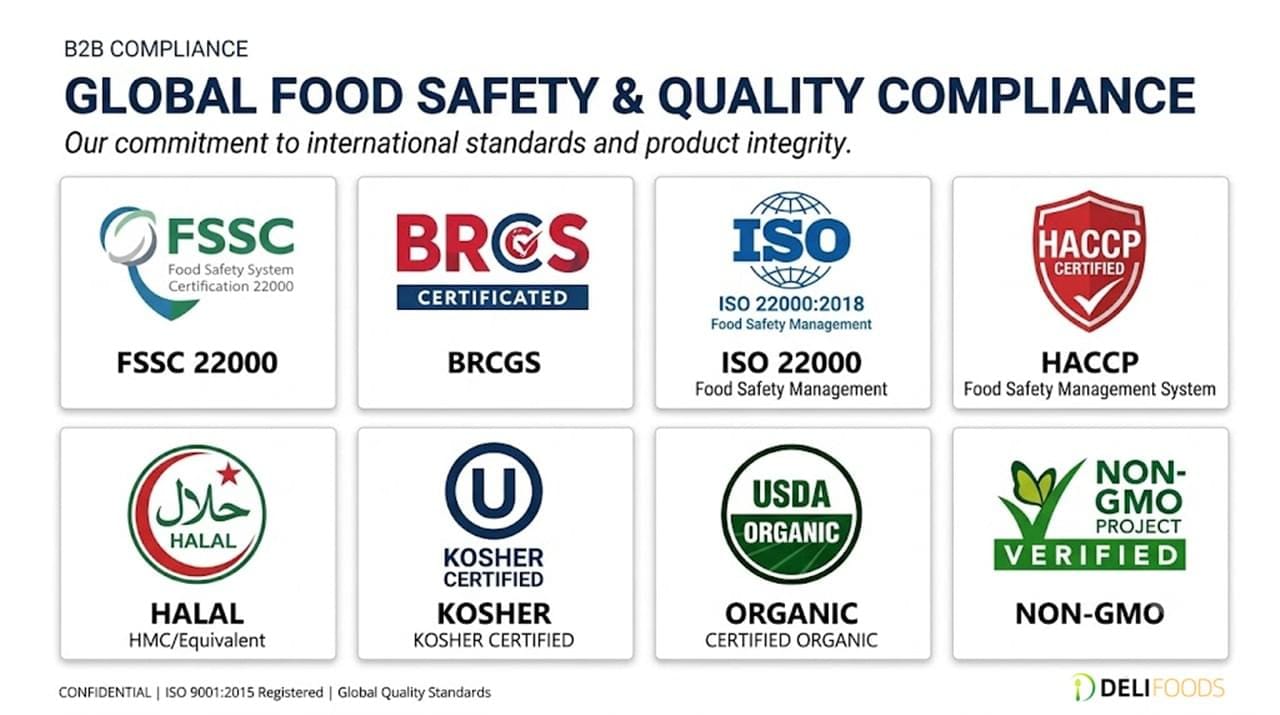
Commonly requested certifications include:
| Certification | Primary Purpose | Market Recognition |
|---|---|---|
| FSSC 22000 | Food Safety Management | Excellent |
| ISO 22000 | Food Safety System | Excellent |
| BRCGS Food | Manufacturing Compliance | Muito alto |
| SQF | Food Safety & Quality | Muito alto |
| IFS Food | European Retail Supply | Alto |
Holding one or more of these certifications demonstrates that a manufacturer follows internationally accepted practices, undergoes regular third-party audits, and maintains continuous improvement programs.
🌍 Certificações Halal e Kosher
For companies serving global markets, religious certifications can significantly expand business opportunities.
☪️ Certificação Halal
Halal certification is often required when exporting to Muslim-majority countries or supplying food manufacturers that produce Halal-certified products.
Certification confirms that raw materials, processing methods, and manufacturing environments comply with Islamic dietary requirements.
✡️ Certificação Kosher
Kosher certification is widely recognized beyond Jewish communities and is frequently requested by multinational food companies because it reflects rigorous ingredient verification and production controls.
Maintaining current Halal and Kosher certificates can help suppliers access a broader international customer base while simplifying procurement approvals.
📊 Quadro Recomendado de Especificações de Qualidade
While regulatory requirements establish minimum legal standards, experienced buyers often develop their own technical specifications to ensure consistent product performance.
A comprehensive rice syrup specification typically includes the following categories.
🔬 Propriedades Físicas
- Appearance: Clear to light amber
- No visible foreign matter
- Soluble solids (Brix): 78–82°
- Viscosity appropriate for the specified DE value
⚗️ Características Químicas
- Controlled DE value within agreed tolerances
- pH between 4.0 and 5.5
- Consistent color values
- Low protein and ash content according to product grade
These parameters help maintain stable sweetness, texture, and processing performance across different food applications.
🛡️ Requisitos Microbiológicos e de Segurança
Routine testing should include:
- Contagem Total de Pratos
- Fermento e mofo
- salmonela
- Escherichia coli O157:H7
- Heavy metals
Consistent microbiological control helps protect product quality throughout storage and transportation while reducing food safety risks.
📄 Documentação Essencial para o Fornecimento B2B Internacional
Reliable documentation is just as important as product quality itself. Before approving a supplier, buyers typically request a complete compliance package that verifies regulatory conformity and manufacturing standards.
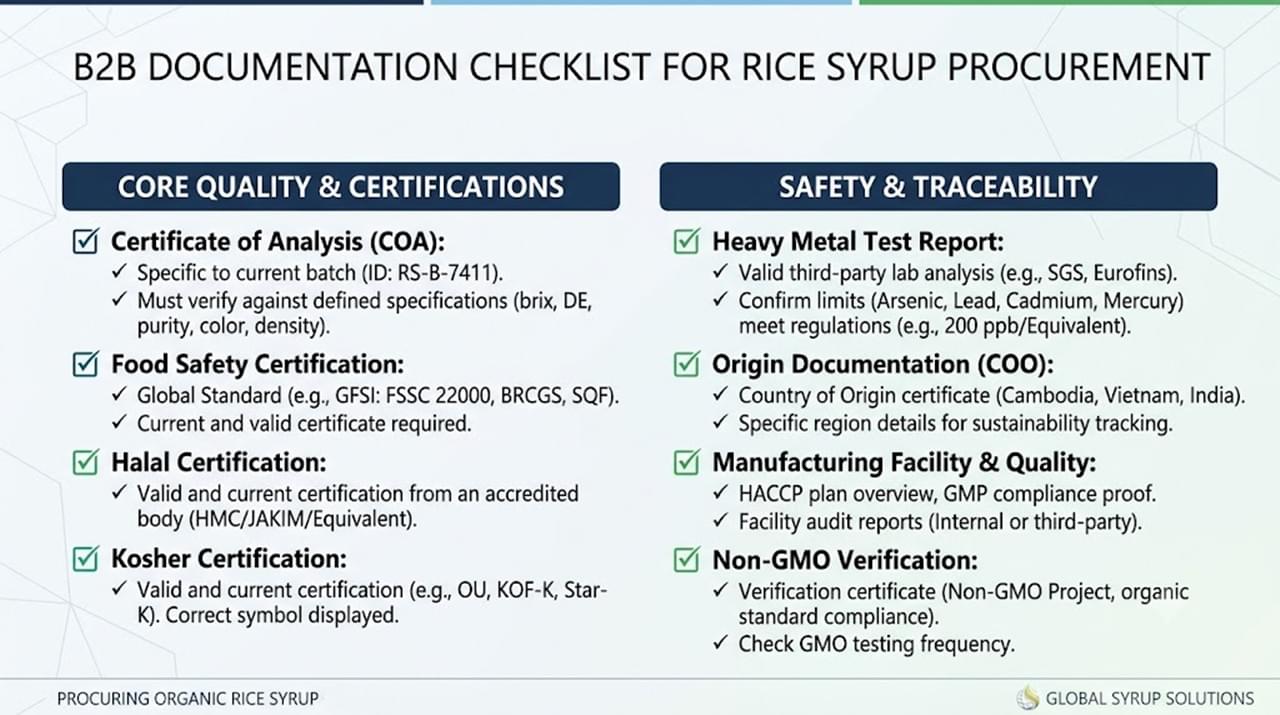
Key documents commonly required include:
- 📑 Certificate of Analysis (COA) for each production batch
- 🏭 Valid ISO 22000 or GFSI-recognized food safety certificate
- ☪️ Halal certificate (when applicable)
- ✡️ Kosher certificate (when applicable)
- 🌱 Organic certificate for certified organic grades
- 🧪 Heavy metal testing reports
- 🌍 Certificate of Origin and export documentation
Providing these documents promptly helps streamline procurement, customs clearance, and customer audits while reinforcing confidence in the supplier’s quality management system.
💡 Dicas de Especialistas para Escolher um Fornecedor de Xarope de Arroz Fiável
Meeting regulatory requirements is only one aspect of supplier evaluation. Experienced buyers also consider a manufacturer’s technical expertise, production consistency, and long-term reliability.
When comparing potential suppliers, consider the following questions:
- ✅ Does the supplier maintain internationally recognized certifications?
- ✅ Are laboratory reports available for every production batch?
- ✅ Can the supplier support country-specific regulatory requirements?
- ✅ Is there a clear traceability system from raw materials to finished products?
- ✅ Does the supplier provide responsive technical support and documentation?
A supplier that can confidently answer these questions is generally better positioned to support stable, long-term business partnerships and reduce compliance risks.
📌 Considerações Finais
Navigating Normas de Qualidade de Xarope de Arroz requires more than simply meeting minimum legal requirements. Successful international suppliers combine regulatory compliance with robust quality management systems, transparent documentation, and continuous product verification.
As food safety regulations continue to evolve, staying informed about FDA requirements, EU legislation, China GB standards, and internationally recognized certification schemes will help businesses reduce risk and strengthen their competitiveness in global markets.
Whether you are sourcing rice syrup for food manufacturing, private-label products, or international distribution, choosing a supplier with proven compliance capabilities is one of the most effective ways to protect product quality and ensure long-term success.
For additional guidance on internationally recognized food safety management systems, visit the official ISO 22000 resource:
https://www.iso.org/iso-22000-food-safety-management.html
📞 Solicitar Documentação Completa de Conformidade
If you need detailed technical information for your sourcing project, our team can provide comprehensive documentation to support supplier qualification, product evaluation, and regulatory review.
Our compliance package is available upon request and may include:
- 📄 Batch-specific Certificates of Analysis (COAs)
- 🏅 Food safety certification documents
- 🧪 Heavy metal testing reports
- 🌱 Organic, Halal, and Kosher certificates (where applicable)
- 🌍 Country of Origin documentation
- 📋 Technical specifications and product data sheets
👉 Request Full Compliance Documentation from Wuhu Deli Foods →
https://www.delisyrup.com/contact/
To learn more about our certification programs, visit our Rice Syrup Food Safety Certifications guide.
For detailed information on contaminant analysis, see our Arsenic & Heavy Metal Testing Guide.
 English
 Deutsch
 Español
 العربية
 Français
 Русский
 Bahasa Indonesia
 한국어
한국어 日本語
日本語 Polski
 Português
 Bahasa Melayu