
🍯 Rice Syrup DE Value: A Technical Optimization Guide for Consistent Quality
Rice Syrup DE Value is one of the most decisive parameters in determining the functionality and commercial performance of rice syrup. From sweetness intensity to viscosity and fermentability, controlling DE value is not just a technical step—it’s the foundation of product consistency and application success.
At Wuhu Deli Foods, process optimization ensures precise DE value control across a wide spectrum (30–65), helping global food manufacturers achieve reliable formulation outcomes.
🧪 Understanding Rice Syrup DE Value Fundamentals
What is Rice Syrup DE Value?
The Rice Syrup DE Value reflects the degree of starch hydrolysis:
- DE 0 → Pure starch
- DE 100 → Pure glucose
It is calculated as:
DE = (Reducing sugars as glucose / Total solids) × 100
This value directly determines how the syrup behaves in food systems.
Why Rice Syrup DE Value Matters
The functionality of rice syrup changes significantly with DE levels:
- 🍬 Sweetness: Higher DE increases sweetness
- 🧴 Viscosity: Lower DE results in thicker texture
- 🍞 Fermentability: Higher DE improves yeast activity
- 💧 Hygroscopicity: Higher DE absorbs more moisture
- ❄️ Crystallization: Lower DE reduces crystallization risk
🍰 Application-Based Rice Syrup DE Value Selection
Choosing the right Rice Syrup DE Value depends on the final product:
🍭 Confectionery (DE 40–50)
Balanced sweetness with effective crystallization control.
🍞 Bakery (DE 35–45)
Supports fermentation while enabling optimal browning.
🥤 Beverages (DE 50–65)
High solubility and clean sweetness profile.
🥛 Dairy (DE 42–48)
Moderate sweetness with excellent stability.

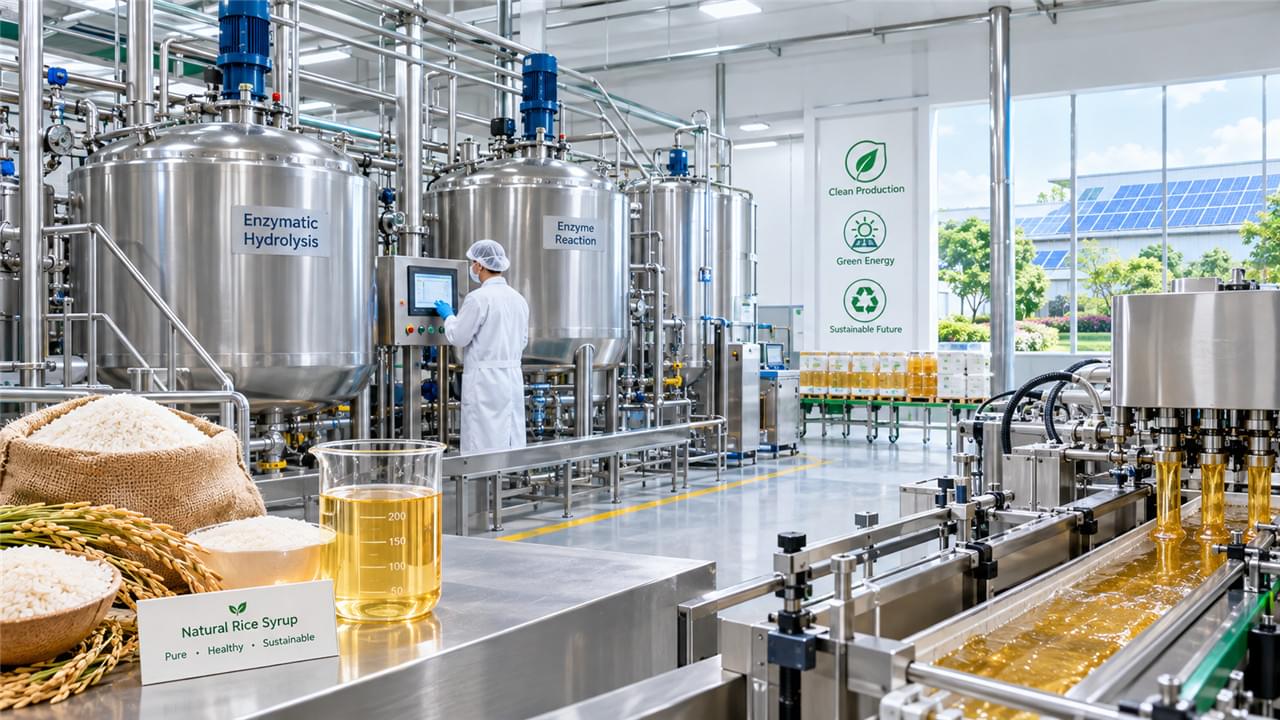
⚙️ Enzymatic Control in Rice Syrup DE Value Production
Low DE Syrup (DE 30–40)
- Enzyme: Limited α-amylase
- Minimal glucoamylase
- ⏱️ 12–24 hours
- 🌡️ 55–60°C
👉 Focus: Controlled hydrolysis to maintain viscosity
Medium DE Syrup (DE 40–50)
- Standard α-amylase
- Moderate glucoamylase
- ⏱️ 24–36 hours
- 🌡️ 60–65°C
👉 Focus: Balanced conversion and functionality
High DE Syrup (DE 50–65)
- High-activity α-amylase
- Significant glucoamylase
- ⏱️ 36–48 hours
- 🌡️ 65–70°C
👉 Focus: Maximum saccharification and sweetness

🔄 Multi-Stage Hydrolysis Strategy
Stage 1: Liquefaction
- Target: DE 10–15
- High temperature, α-amylase dominant
Stage 2: Saccharification
- Controlled conversion to target Rice Syrup DE Value
- Balanced enzyme combination
Stage 3: Completion
- Final DE adjustment
- Precise enzyme inactivation timing
📊 Viscosity & Concentration Optimization
Viscosity Ranges
- DE 30 → 8,000–12,000 cP
- DE 42 → 3,000–5,000 cP
- DE 65 → 800–1,500 cP
Solids Control Strategy
- Low DE: 70–75% solids
- Medium DE: 75–80% solids
- High DE: 80–85% solids
👉 Careful temperature control prevents degradation and ensures stability.
🎯 Advanced Rice Syrup DE Value Control Systems
Precision is essential in industrial production:
- 📡 Real-time DE monitoring
- 🤖 Automated feedback control
- 📈 Statistical process control
Key Benchmarks
- DE tolerance: ±1
- Batch variation: ≤2%
- Process capability: Cp ≥ 1.33
⚠️ Technical Challenges in Different DE Ranges
Low DE Challenges
- High viscosity handling
- Filtration difficulty
- Crystallization risks
High DE Challenges
- Color control (Maillard reaction)
- Microbial growth risk
- Storage stability
🔗 Practical Industry Insights & Resources
For deeper technical understanding of starch conversion and enzymatic processes, you can explore this authoritative resource from the Food and Agriculture Organization:
👉 https://www.fao.org/3/y4358e/y4358e08.htm
Additionally, reviewing ingredient functionality trends on Institute of Food Technologists can provide valuable formulation insights:
👉 https://www.ift.org
🚀 Mastering Rice Syrup DE Value for Competitive Advantage
Controlling Rice Syrup DE Value is not just about hitting a number—it’s about engineering performance, consistency, and application success. From enzyme selection to process monitoring, every parameter contributes to the final product’s quality.
Manufacturers who invest in precise DE control gain a clear advantage: better product functionality, stronger customer trust, and greater flexibility across applications.
If you’re looking to optimize DE value rice syrup manufacturing or develop tailored formulations, working with experienced producers like Wuhu Deli Foods can significantly streamline your process and improve outcomes.
❓ FAQ Section
- What is the ideal Rice Syrup DE Value for beverages?
Typically between 50–65, offering high solubility and clean sweetness. - How does DE value affect viscosity?
Lower DE values result in higher viscosity due to larger carbohydrate chains. - Can DE value be adjusted after production?
Only within limits; most adjustments must occur during enzymatic hydrolysis. - Why is high DE syrup more prone to microbial growth?
Because higher sugar availability supports fermentation and microbial activity.
For DE value selection context, see our Pillar 1: Rice Syrup Production Technology guide. For full product specifications by DE value, explore our product specifications database.

 English
 Deutsch
 Español
 العربية
 Français
 Русский
 Bahasa Indonesia
 한국어
한국어 日本語
日本語 Polski
 Português
 Bahasa Melayu