
전 세계 식품 산업이 계속 확장됨에 따라, 쌀 시럽 품질 표준 제조업체, 유통업체 및 국제 구매자에게 중요한 요소가 되었습니다. 음료, 제과, 영유아 영양 또는 가공 식품용 쌀 시럽을 소싱하든 규제 요구 사항을 충족하는 것은 더 이상 선택 사항이 아니라 시장 접근, 소비자 신뢰 및 장기적인 비즈니스 성공을 위해 필수적입니다.
🌍 모든 대상 시장은 식품 안전, 라벨링, 오염 물질 한도 및 생산 관행에 대한 자체 법적 프레임워크를 적용합니다. 동시에 국제적으로 인정된 인증은 공급업체가 일관된 품질 관리 및 제조 통제를 유지한다는 추가적인 보증을 제공합니다.
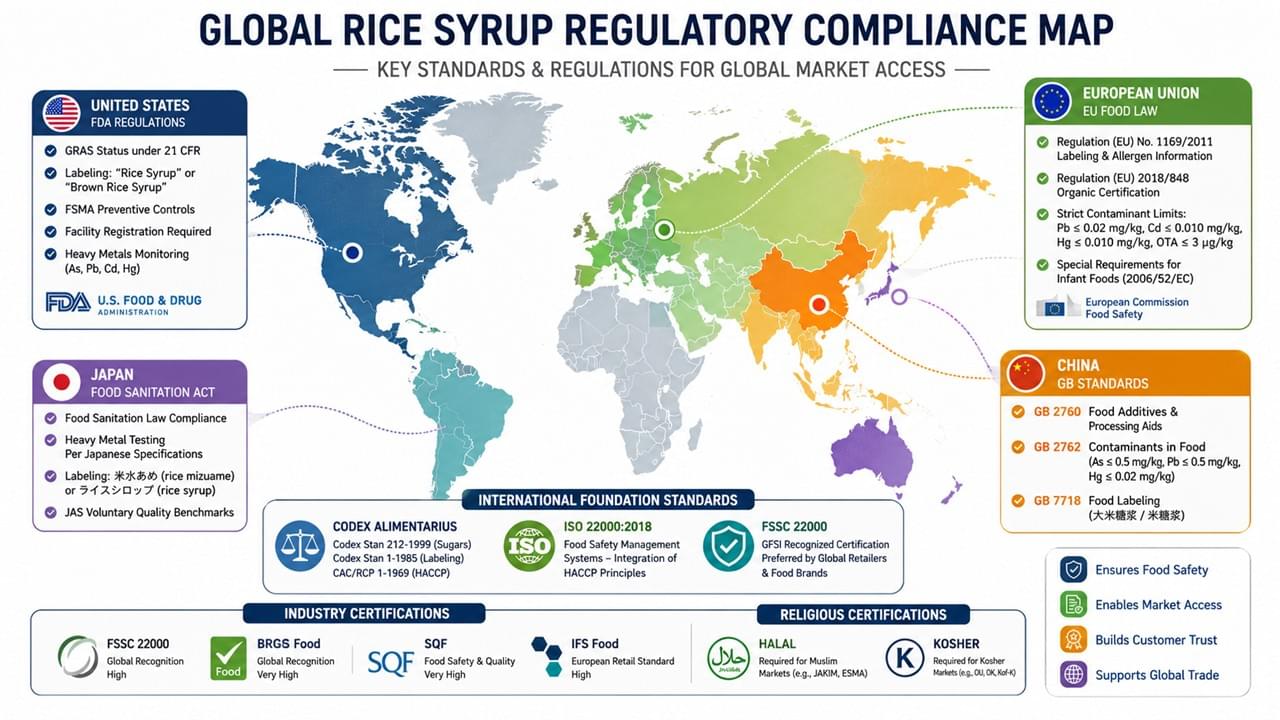
이 가이드에서는 미국, 유럽 연합, 중국 및 일본의 규정을 포함하여 전 세계적으로 쌀 시럽을 규제하는 주요 품질 표준을 설명합니다. 또한 구매자가 일반적으로 요청하는 인증, 국제 무역에 필요한 문서 및 자신감을 가지고 공급업체를 평가하기 위한 실용적인 권장 사항도 배울 수 있습니다.
🌍 쌀 시럽 품질 표준에 대한 글로벌 프레임워크 이해
식품 규정은 국가마다 다르지만 대부분의 당국은 동일한 목표를 공유합니다. 즉, 식품 성분이 안전하고 정확하게 라벨링되며 일관되게 제조되도록 보장하여 소비자를 보호하는 것입니다.
쌀 시럽 공급업체의 경우 규정 준수는 일반적으로 단일 규정을 넘어섭니다. 기업은 다음을 포함한 여러 계층의 요구 사항에 대한 적합성을 입증해야 합니다.
- ✅ 국제 식품 안전 원칙
- ✅ 국가 식품 법률
- ✅ 제조 인증
- ✅ 제품 테스트 표준
- ✅ 고객별 품질 사양
이러한 프레임워크가 어떻게 함께 작동하는지 이해하면 기업은 규제 위험을 줄이는 동시에 공급망 신뢰성을 향상시킬 수 있습니다.
🌎 코덱스 알리멘타리우스: 국제 벤치마크
전 세계 식품 안전에 대한 가장 널리 인정되는 참조 중 하나는 코덱스 알리멘타리우스, , 와 에 의해 공동으로 설립되었습니다. 식량 농업 기구(FAO). 및.
세계 보건 기구(WHO).
✅ 쌀 시럽 관련 코덱스 표준
- Codex STAN 212-1999 — Covers glucose syrups and starch-derived sweeteners.
- Codex STAN 1-1985 — Defines general labeling requirements for pre-packaged foods.
- CAC/RCP 1-1969 — Establishes internationally accepted Good Hygiene Practices and HACCP principles.
Many national authorities use these documents as references when developing their own food regulations, making Codex compliance an important consideration for exporters.
💡 You can explore the complete Codex database here:
https://www.fao.org/fao-who-codexalimentarius/
🏭 ISO 식품 안전 관리 시스템
While government regulations define legal requirements, certification standards help manufacturers demonstrate that those requirements are consistently implemented.
Among the most recognized systems is ISO 22000:2018, which integrates food safety management with Hazard Analysis and Critical Control Points (HACCP). Rather than focusing only on product testing, ISO 22000 emphasizes preventive risk management throughout production.
Key benefits include:
- ✔ Better traceability throughout manufacturing
- ✔ Improved risk assessment procedures
- ✔ Stronger supplier management
- ✔ Continuous quality improvement
- ✔ Greater confidence for international customers
For buyers evaluating multiple suppliers, ISO certification often serves as an important indicator of operational maturity and quality consistency.
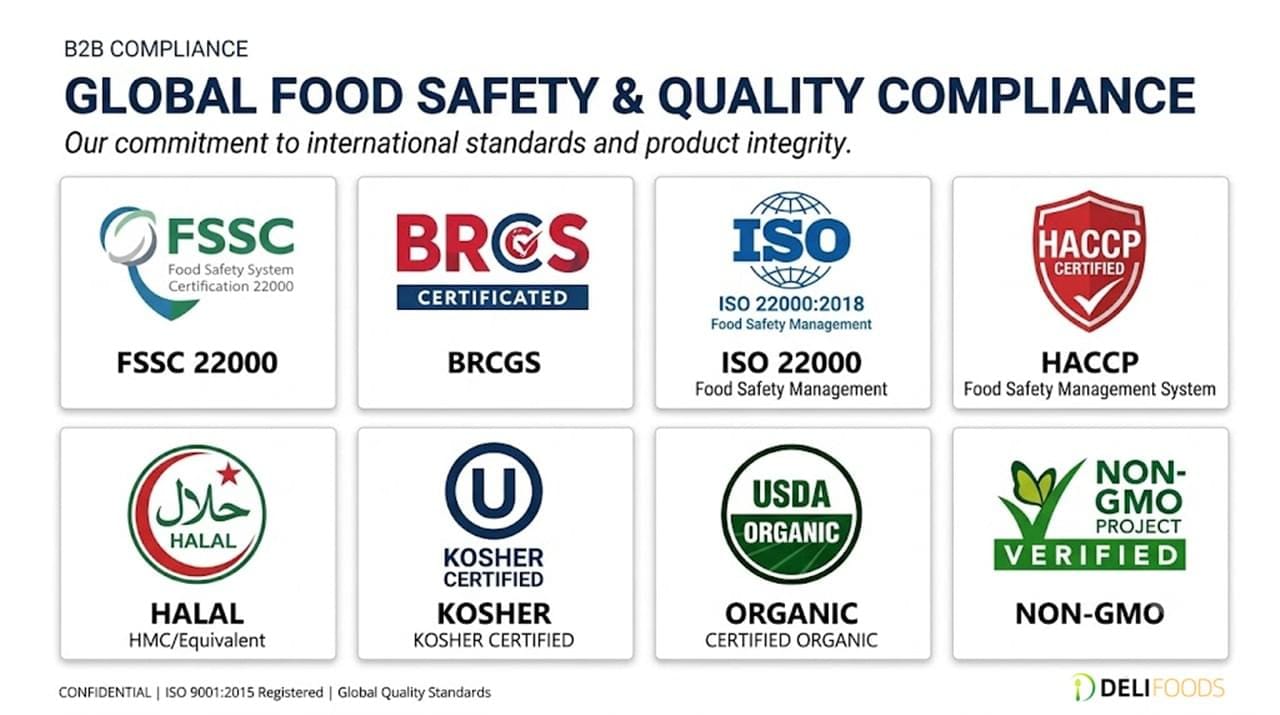
🏆 FSSC 22000이 중요한 이유
Many multinational food companies require suppliers to hold FSSC 22000 certification because it expands upon ISO 22000 with additional food safety controls recognized by the Global Food Safety Initiative (GFSI).
Compared with standard management certification, FSSC 22000 offers greater assurance that production facilities maintain internationally accepted food safety practices.
혜택은 다음과 같습니다:
- 🌍 Recognition across major international markets
- 🏭 Strong acceptance among global food brands
- 📋 Enhanced risk management systems
- 🔍 Independent third-party audits
- 🤝 Increased confidence during supplier qualification
For businesses exporting rice syrup to multiple countries, FSSC 22000 can significantly simplify customer approval processes.
🇺🇸 미국 쌀 시럽 품질 표준
The United States remains one of the world’s largest food ingredient markets, with regulatory oversight provided primarily by the U.S. Food and Drug Administration (FDA).
Companies exporting rice syrup to the U.S. should understand not only ingredient safety requirements but also facility registration, preventive controls, and labeling obligations.
✅ GRAS 상태 및 식품 안전
Rice syrup produced through enzymatic hydrolysis of rice starch is generally considered Generally Recognized As Safe (GRAS) when manufactured using accepted food processing methods.
However, GRAS status does not eliminate regulatory responsibilities. Manufacturers are still expected to implement preventive food safety systems under the Food Safety Modernization Act (FSMA) and maintain comprehensive production records.
Facilities exporting food ingredients to the United States must also register with the FDA before shipping products.
More information is available from the official FDA website:
https://www.fda.gov/
🏷️ FDA 라벨링 요구 사항
Proper labeling is essential for regulatory compliance and smooth customs clearance.
Under FDA labeling rules, rice syrup should:
- ✅ Be declared using its common or usual name, such as “Rice Syrup” or “Brown Rice Syrup.”
- ✅ Appear in ingredient lists according to weight.
- ✅ Meet applicable nutrition labeling requirements.
- ✅ Support any organic claims with valid USDA Organic certification.
Accurate labeling not only fulfills legal obligations but also helps buyers verify product authenticity and maintain transparent supply chains.
⚠️ 중금속 모니터링
Because rice naturally absorbs minerals from soil and water, international buyers increasingly pay attention to heavy metal testing.
Responsible manufacturers routinely monitor:
- 비소
- 선두
- 카드뮴
- 수은
Advanced analytical methods such as ICP-MS (Inductively Coupled Plasma Mass Spectrometry) provide highly accurate detection of trace contaminants, allowing manufacturers to verify compliance with destination-market limits before shipment.
For products intended for infant nutrition or other sensitive applications, testing frequencies are often higher, with many buyers requesting batch-specific analytical reports instead of annual summaries.
🇪🇺 유럽 연합 쌀 시럽 품질 표준
The European Union maintains one of the world’s most comprehensive food safety systems. Businesses exporting rice syrup to EU member states must comply with regulations covering ingredient safety, contaminant limits, traceability, labeling, and production practices.
Unlike some markets that focus primarily on finished-product testing, the EU emphasizes preventive food safety management throughout the entire supply chain. As a result, manufacturers should be prepared to provide detailed technical documentation alongside laboratory reports.
🏷️ EU 라벨링 요구 사항
Clear and accurate labeling is essential for entering the European market.
Depending on the product formulation, rice syrup may be declared as:
- ✅ Rice Syrup
- ✅ Glucose Syrup (from Rice)
When the syrup is produced exclusively from rice, it is generally not considered one of the allergens listed under EU Regulation (EU) No. 1169/2011, making it suitable for many allergen-conscious formulations. However, manufacturers should always verify labeling requirements based on the final product and destination country.
For organic products, suppliers must also comply with Regulation (EU) 2018/848, which governs organic production and certification across the European Union.
⚠️ 오염 물질 한도 및 제품 안전
European authorities apply strict limits to contaminants commonly monitored in cereal-derived ingredients.
Typical quality control programs include testing for:
- 선두
- 카드뮴
- 수은
- 비소
- Mycotoxins such as Ochratoxin A
Manufacturers supplying infant foods or products intended for vulnerable consumer groups are usually expected to meet even tighter purity requirements and maintain enhanced production controls.
Regular third-party laboratory testing helps demonstrate compliance while strengthening buyer confidence during supplier qualification.
🇨🇳 중국 쌀 시럽 GB 표준
China’s national food safety system is built around the GB (Guobiao) standards, which establish mandatory requirements for food production, processing, labeling, and contaminant control.
For rice syrup manufacturers operating in or exporting from China, compliance with the applicable GB standards is a fundamental requirement for legal production and international trade.
📋 주요 GB 표준
Several national standards are particularly relevant to rice syrup production.
✅ GB 2760 — 식품 첨가물 및 가공 보조제
This standard specifies which processing aids may be used during manufacturing, including food-grade enzymes, activated carbon, and ion exchange resins.
Using approved processing materials helps ensure both product safety and regulatory compliance.
✅ GB 2762 — 오염 물질 한도
GB 2762 establishes maximum allowable levels for contaminants such as:
- Heavy metals
- 비소
- 선두
- 수은
- 카드뮴
Routine monitoring ensures products remain within legal limits before entering domestic or export markets.
✅ GB 7718 — 식품 라벨링
Rice syrup sold in China must follow Chinese labeling requirements, including standardized product names, ingredient declarations, production information, and other mandatory labeling elements.
Accurate labeling not only supports compliance but also improves product traceability throughout the supply chain.
🇯🇵 일본 식품 위생 요구 사항
Japan is recognized for maintaining exceptionally high food safety expectations. Importers often conduct detailed supplier evaluations before approving new ingredients.
For rice syrup, manufacturers should pay close attention to:
- ✅ Heavy metal testing
- ✅ Food hygiene controls
- ✅ Product traceability
- ✅ Proper Japanese labeling
- ✅ Consistent quality documentation
Although the Japanese Agricultural Standards (JAS) certification is voluntary for many products, obtaining recognized certifications can strengthen market competitiveness and demonstrate a commitment to quality.
🏅 구매자가 가장 중요하게 생각하는 산업 인증
Beyond legal compliance, internationally recognized certifications often play a decisive role in supplier selection.
Large food manufacturers and global brands frequently require suppliers to maintain certifications that verify robust food safety management systems.
Commonly requested certifications include:
| Certification | Primary Purpose | Market Recognition |
|---|---|---|
| FSSC 22000 | Food Safety Management | Excellent |
| ISO 22000 | Food Safety System | Excellent |
| BRCGS Food | Manufacturing Compliance | 매우 높음 |
| SQF | Food Safety & Quality | 매우 높음 |
| IFS Food | European Retail Supply | 높은 |
Holding one or more of these certifications demonstrates that a manufacturer follows internationally accepted practices, undergoes regular third-party audits, and maintains continuous improvement programs.
🌍 할랄 및 코셔 인증
For companies serving global markets, religious certifications can significantly expand business opportunities.
☪️ 할랄 인증
Halal certification is often required when exporting to Muslim-majority countries or supplying food manufacturers that produce Halal-certified products.
Certification confirms that raw materials, processing methods, and manufacturing environments comply with Islamic dietary requirements.
✡️ 코셔 인증
Kosher certification is widely recognized beyond Jewish communities and is frequently requested by multinational food companies because it reflects rigorous ingredient verification and production controls.
Maintaining current Halal and Kosher certificates can help suppliers access a broader international customer base while simplifying procurement approvals.
📊 권장 품질 사양 프레임워크
While regulatory requirements establish minimum legal standards, experienced buyers often develop their own technical specifications to ensure consistent product performance.
A comprehensive rice syrup specification typically includes the following categories.
🔬 물리적 특성
- Appearance: Clear to light amber
- No visible foreign matter
- Soluble solids (Brix): 78–82°
- Viscosity appropriate for the specified DE value
⚗️ 화학적 특성
- Controlled DE value within agreed tolerances
- pH between 4.0 and 5.5
- Consistent color values
- Low protein and ash content according to product grade
These parameters help maintain stable sweetness, texture, and processing performance across different food applications.
🛡️ 미생물 및 안전 요구 사항
Routine testing should include:
- 총 플레이트 수
- 효모와 곰팡이
- 살모넬라
- Escherichia coli O157:H7
- Heavy metals
Consistent microbiological control helps protect product quality throughout storage and transportation while reducing food safety risks.
📄 국제 B2B 공급을 위한 필수 문서
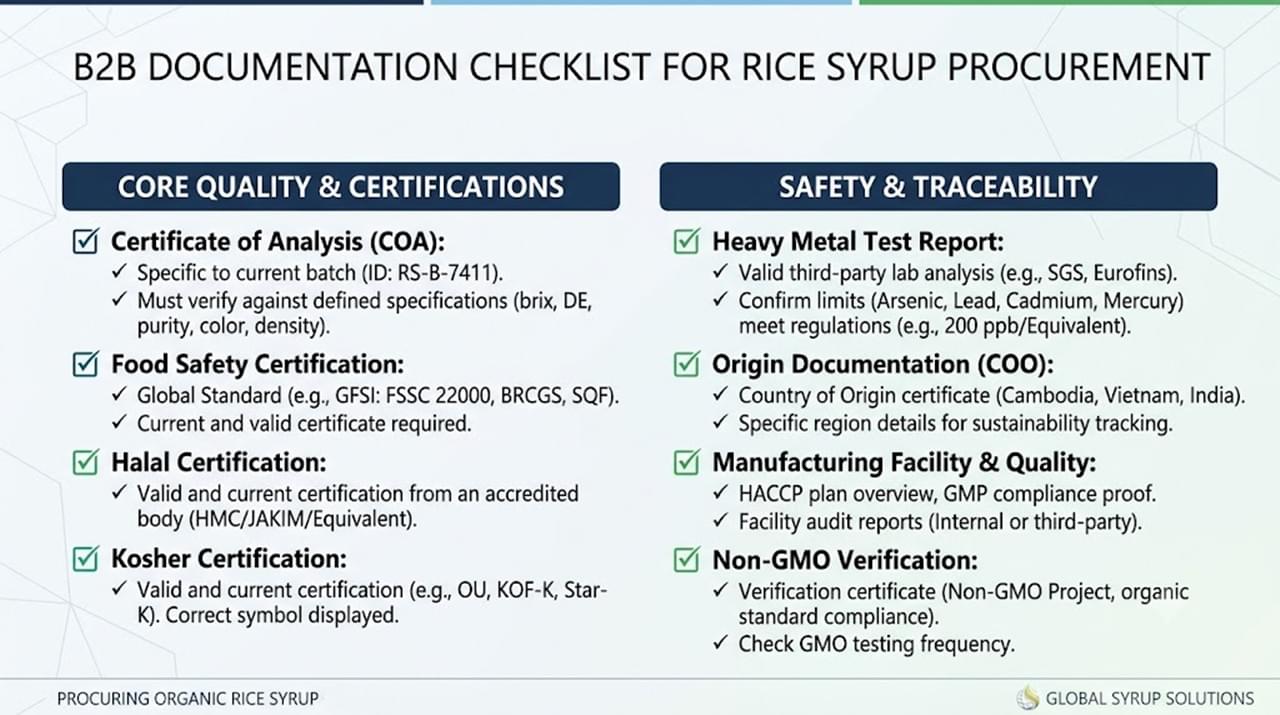
Reliable documentation is just as important as product quality itself. Before approving a supplier, buyers typically request a complete compliance package that verifies regulatory conformity and manufacturing standards.
Key documents commonly required include:
- 📑 Certificate of Analysis (COA) for each production batch
- 🏭 Valid ISO 22000 or GFSI-recognized food safety certificate
- ☪️ Halal certificate (when applicable)
- ✡️ Kosher certificate (when applicable)
- 🌱 Organic certificate for certified organic grades
- 🧪 Heavy metal testing reports
- 🌍 Certificate of Origin and export documentation
Providing these documents promptly helps streamline procurement, customs clearance, and customer audits while reinforcing confidence in the supplier’s quality management system.
💡 신뢰할 수 있는 쌀 시럽 공급업체 선택을 위한 전문가 팁
Meeting regulatory requirements is only one aspect of supplier evaluation. Experienced buyers also consider a manufacturer’s technical expertise, production consistency, and long-term reliability.
When comparing potential suppliers, consider the following questions:
- ✅ Does the supplier maintain internationally recognized certifications?
- ✅ Are laboratory reports available for every production batch?
- ✅ Can the supplier support country-specific regulatory requirements?
- ✅ Is there a clear traceability system from raw materials to finished products?
- ✅ Does the supplier provide responsive technical support and documentation?
A supplier that can confidently answer these questions is generally better positioned to support stable, long-term business partnerships and reduce compliance risks.
📌 최종 생각
Navigating 쌀 시럽 품질 표준 requires more than simply meeting minimum legal requirements. Successful international suppliers combine regulatory compliance with robust quality management systems, transparent documentation, and continuous product verification.
As food safety regulations continue to evolve, staying informed about FDA requirements, EU legislation, China GB standards, and internationally recognized certification schemes will help businesses reduce risk and strengthen their competitiveness in global markets.
Whether you are sourcing rice syrup for food manufacturing, private-label products, or international distribution, choosing a supplier with proven compliance capabilities is one of the most effective ways to protect product quality and ensure long-term success.
For additional guidance on internationally recognized food safety management systems, visit the official ISO 22000 resource:
https://www.iso.org/iso-22000-food-safety-management.html
📞 전체 규정 준수 문서 요청
If you need detailed technical information for your sourcing project, our team can provide comprehensive documentation to support supplier qualification, product evaluation, and regulatory review.
Our compliance package is available upon request and may include:
- 📄 Batch-specific Certificates of Analysis (COAs)
- 🏅 Food safety certification documents
- 🧪 Heavy metal testing reports
- 🌱 Organic, Halal, and Kosher certificates (where applicable)
- 🌍 Country of Origin documentation
- 📋 Technical specifications and product data sheets
👉 Request Full Compliance Documentation from Wuhu Deli Foods →
https://www.delisyrup.com/contact/
To learn more about our certification programs, visit our Rice Syrup Food Safety Certifications guide.
For detailed information on contaminant analysis, see our Arsenic & Heavy Metal Testing Guide.
 English
 Deutsch
 Español
 العربية
 Français
 Русский
 Bahasa Indonesia
 한국어
한국어 日本語
日本語 Polski
 Português
 Bahasa Melayu