
“Glucose syrup” is a broad category term you’ll see everywhere in European food regulation and ingredient specifications worldwide. Rice syrup is technically a type of glucose syrup — one made from rice starch — but in commercial usage, “glucose syrup” usually means corn- or wheat-starch-derived product. So any rice syrup vs glucose syrup conversation is really about source grain, GMO status, allergen profile, and what your label says to shoppers. This guide sorts out the distinctions and hands you a practical selection framework.
📖 Defining the Terms
Rice Syrup vs Glucose Syrup: What Each Term Covers
Conventional Glucose Syrup
- Source: Corn starch (primary globally), wheat starch (EU), potato starch, tapioca starch
- Process: Enzymatic or acid-enzymatic hydrolysis
- Sugar profile: Varies by DE — similar to rice syrup in principle
- EU labeling: “Glucose syrup” (no source grain declaration unless from an allergen-containing grain)
- US labeling: “Corn syrup” or “glucose syrup”
Rice Syrup
- Source: Rice starch exclusively
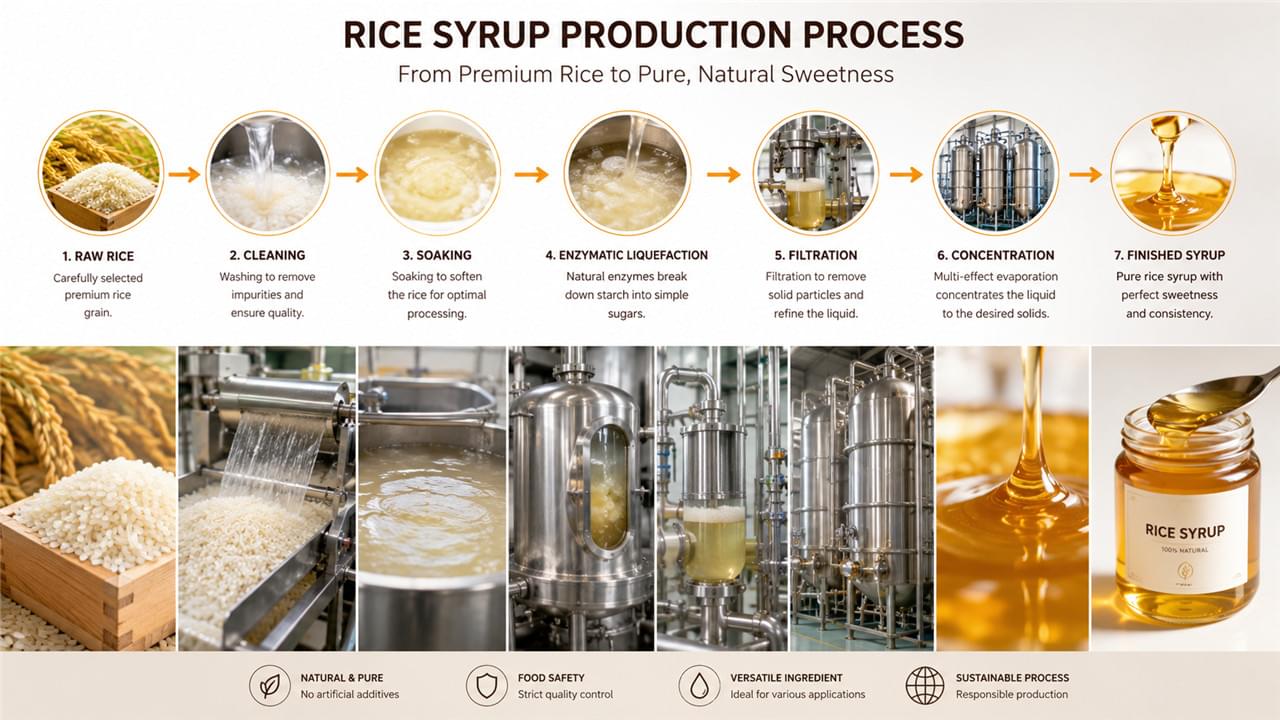
- Process: Multi-enzyme hydrolysis (α-amylase, glucoamylase, pullulanase)
- Sugar profile: Glucose + maltose + oligosaccharides (similar to corn glucose syrup at equivalent DE)
- EU labeling: “Glucose syrup (from rice)” or “rice syrup”
- US labeling: “Rice syrup” or “brown rice syrup”
🧪 Sugar Profile Comparison at Equivalent DE
Rice Syrup vs Glucose Syrup: The Sugar Profile Test
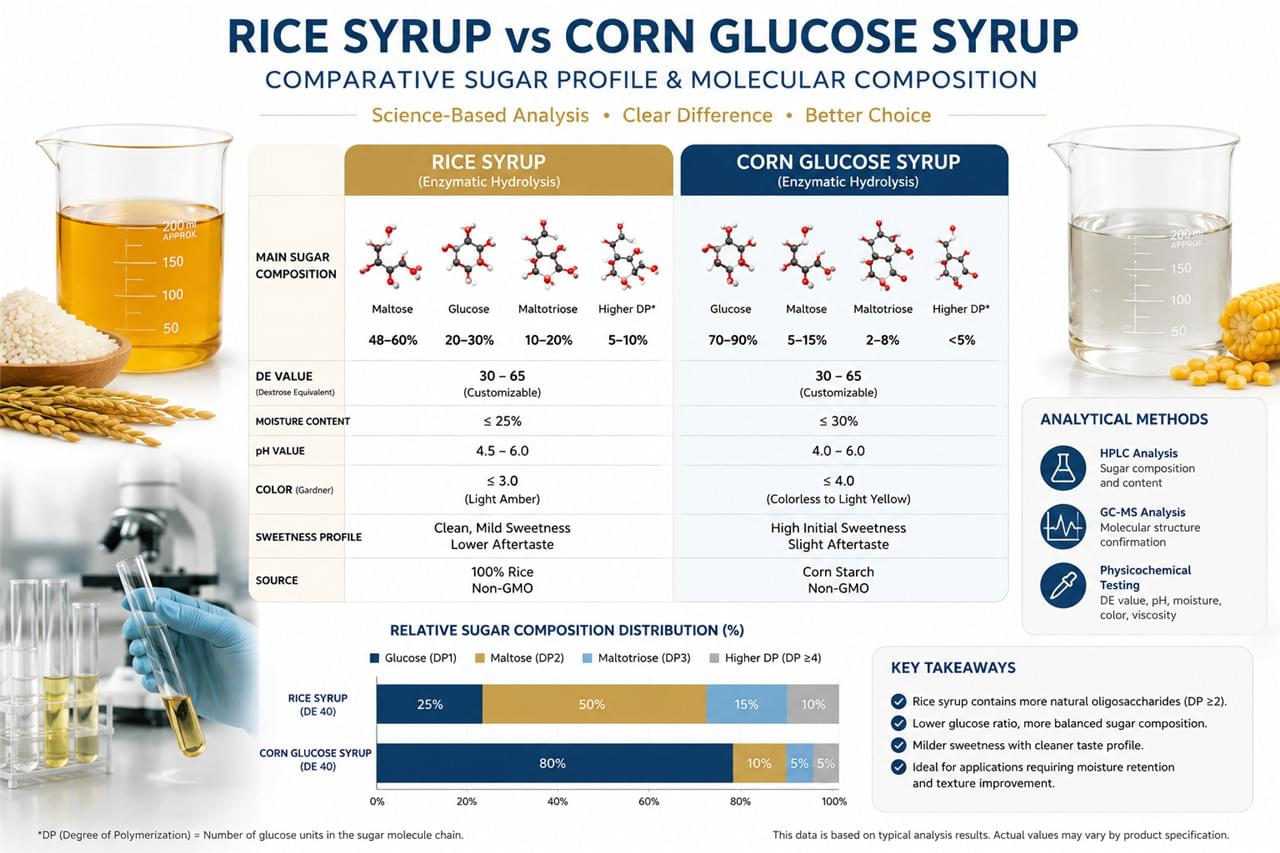
At DE 42, a glucose syrup comparison between rice and corn origins gets almost boring — the numbers barely move:
| Component | Rice Syrup (DE 42) | Corn Glucose Syrup (DE 42) |
|---|---|---|
| Glucose | 18–22% | 19–23% |
| Maltose | 14–18% | 13–17% |
| Maltotriose | 11–15% | 12–16% |
| Higher saccharides | 45–55% | 44–54% |
| Sweetness | ~45% | ~45% |
That’s the honest headline of every rice syrup vs glucose syrup lab report: at equivalent DE values, they’re functionally near-identical in sugar profile and properties. The real differences live elsewhere — in the source grain, GMO status, allergen situation, and label appeal.
🏷️ Regulatory and Label Differences
Rice Syrup vs Glucose Syrup: The EU Allergen Rule
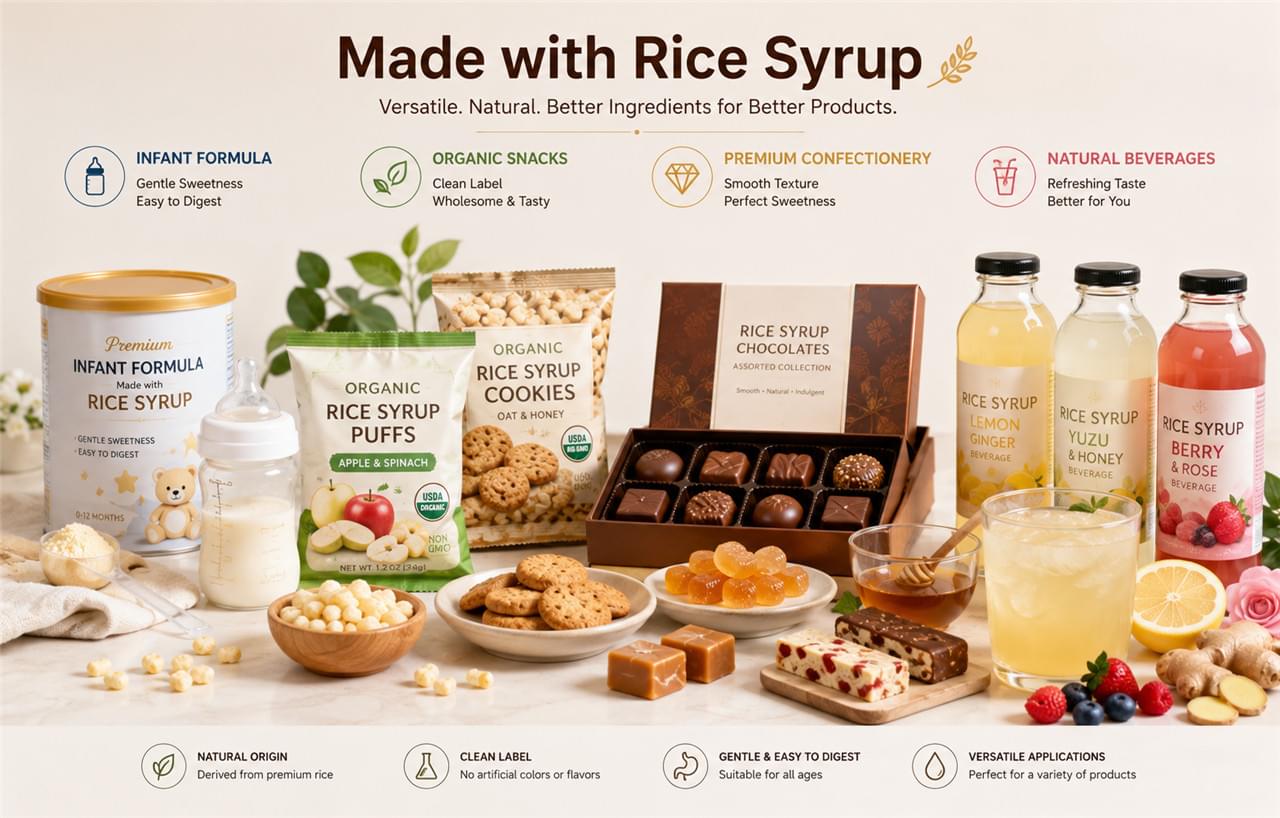
In the EU, glucose syrup derived from wheat must declare wheat on the label as an allergen under Regulation (EU) No 1169/2011. Corn-derived glucose syrup needs no allergen declaration but still identifies corn as the source. Rice syrup (“glucose syrup from rice”) requires no allergen declaration and brings three bonus points: a clear, identifiable source, positive consumer associations, and non-GMO positioning — there’s no commercially approved GM rice.
Rice Syrup vs Glucose Syrup: The US Label Split
In the US, the split is even sharper. Corn-derived syrup gets labeled “corn syrup” — a term shoppers now associate with processed food. Rice-derived syrup gets labeled “rice syrup” or “brown rice syrup,” and the FDA’s standard food labeling framework treats that name as a clean, familiar ingredient declaration. Consumer perception follows the name.
⚙️ Functional Property Comparison
Rice Syrup vs Glucose Syrup: Functional Parity
| Property | Rice Syrup (DE 42) | Corn Glucose Syrup (DE 42) |
|---|---|---|
| Viscosity | Nearly identical | Nearly identical |
| Sweetness | ~45% | ~45% |
| Color | ≤50 ICUMSA (premium) | ≤50–100 ICUMSA |
| Flavor | Very clean, neutral | Clean (slight corn note possible) |
| Fermentability | Similar | Similar |
| Crystal inhibition | Similar | Similar |
For formulators, this table is reassuring: switching origins doesn’t force recipe rework. Viscosity, fermentability, and crystal inhibition all carry over. The only functional nuances worth noting are color headroom (rice syrup runs consistently lighter) and flavor (rice syrup stays neutral with zero corn note).
🎯 When to Choose Which
Rice Syrup vs Glucose Syrup: The Selection Framework
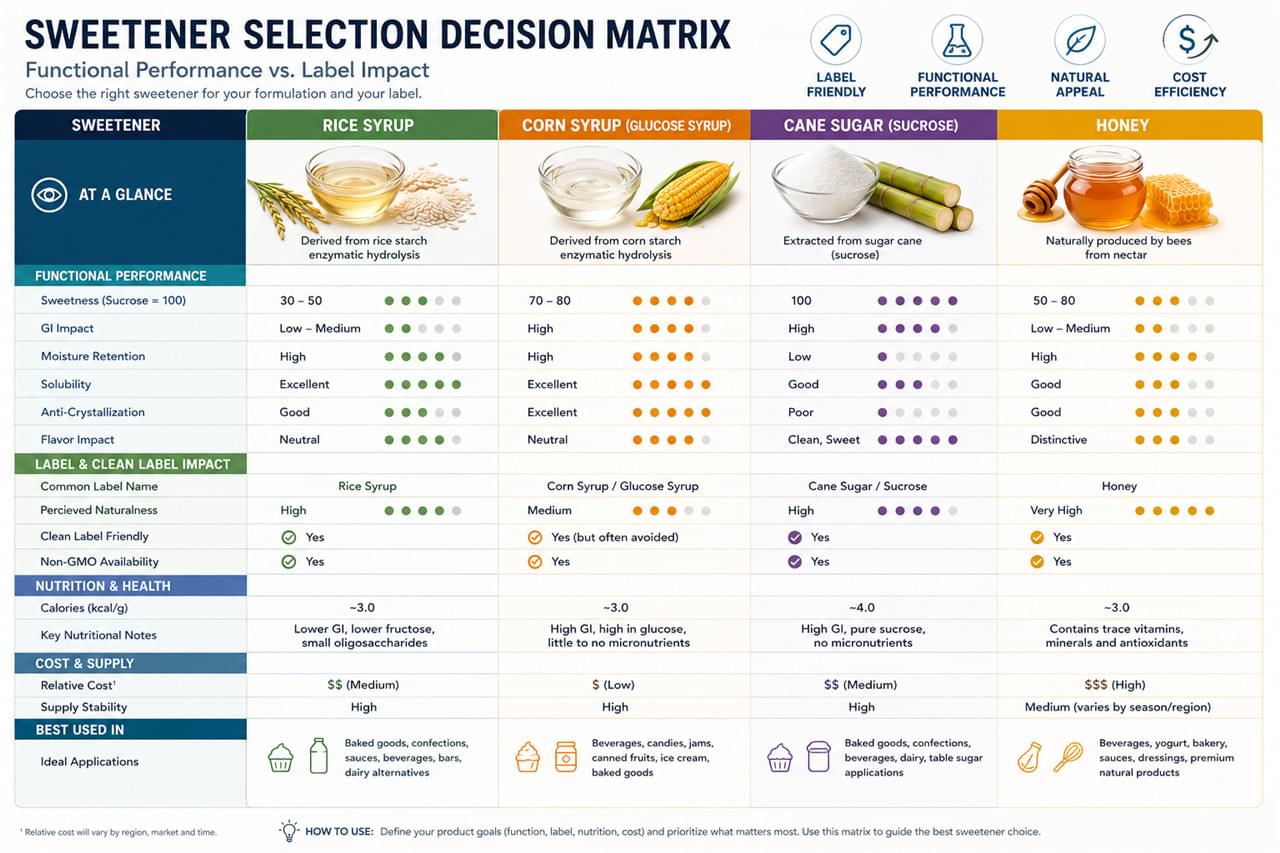
Starch sweetener selection comes down to three questions: what does your label need, what does your market demand, and what does your cost model tolerate? Here’s how the rice syrup vs glucose syrup answer usually lands.
Choose Rice Syrup when:
- Label optimization is a priority (“rice syrup” beats “glucose syrup from corn”)
- Non-GMO certification is required
- Organic grade is needed
- Gluten-free certification is needed (wheat-derived glucose must be avoided)
- Premium market positioning calls for ingredient-level differentiation
- Infant or baby food applications demand maximum purity
Choose Conventional Glucose Syrup when:
- Cost minimization is the primary driver
- Label differentiation provides no commercial value in that market
- Local production availability is critical (corn glucose is more available in the Americas)
💰 Price Premium Analysis
Rice Syrup vs Glucose Syrup: The Price Question
Rice syrup typically carries a 15–35% price premium over comparable corn-derived glucose syrup. The premium buys real things: certified rice instead of commodity corn, a more complex multi-enzyme process, smaller global production volume, and non-GMO/organic certification costs. For brands in the natural, organic, and premium segments, that cost is consistently paid back through label improvement — the rice syrup vs glucose syrup price gap closes fastest where shoppers read ingredients.
🔄 Practical Substitution
For food manufacturers switching from corn glucose syrup to rice syrup, the changeover is refreshingly simple:
- Substitution ratio: 1:1 by weight
- Process adjustment: None required in most cases
- Quality check: Verify DE value match; confirm color specification
- Label review: Update the ingredient declaration to “Rice Syrup” or “Glucose Syrup (from Rice)”
Before you commit, line up your current rice syrup specifications against the sample — DE, color, and solids content should match your existing glucose syrup documents. Wuhu Deli Foods can custom-match any DE specification of conventional glucose syrup, providing a drop-in replacement.
✅ Conclusion
Rice Syrup vs Glucose Syrup: The Bottom Line
Strip away the sourcing details and the rice syrup vs glucose syrup decision is straightforward: technically near-identical at equivalent DE, with the real differentiation sitting in source grain transparency, GMO status, allergen profile, and label appeal — areas where rice syrup consistently outperforms conventional alternatives.
Key Takeaways:
- At equivalent DE, rice syrup and corn glucose syrup have nearly identical functionality
- Rice syrup provides non-GMO, allergen-free, and clean-label advantages
- Wheat-derived glucose syrup requires allergen declaration in the EU — rice syrup does not
- 1:1 substitution is straightforward with no process changes required
- Wuhu Deli Foods custom-matches any glucose syrup DE specification on request
Contact Wuhu Deli Foods for matching samples against your current glucose syrup specification.
 English
 Deutsch
 Español
 العربية
 Français
 Русский
 Bahasa Indonesia
 한국어
한국어 日本語
日本語 Polski
 Português
 Bahasa Melayu